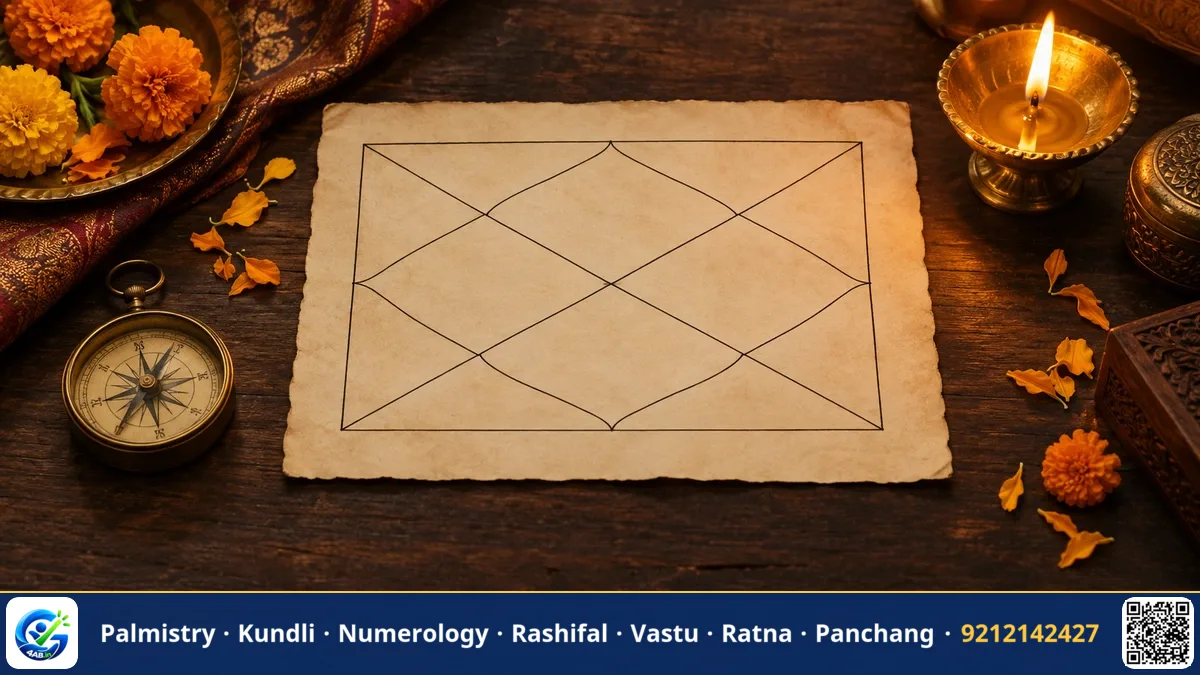
The 12 houses in Vedic astrology: a beginner's overview

This post gives you a simple tour of the twelve houses in a kundli.
You will learn what each house is traditionally associated with, and how to start reading them in order.
What a bhava is and why the lagna comes first
A bhava is one of the twelve divisions of a birth chart. In Vedic astrology, the bhavas are used to examine different areas of life in a kundli. Think of each one as a field of experience in which the planets and signs do their work.
The lagna is the sign rising on the eastern horizon at the exact time and place of birth. It is the reference point for arranging all the houses. This is why two people born on the same day can have different houses: the positions depend on time and location, not on date alone.
So before you read any house, you need the correct birth time and birth place. A small error in time can change the lagna, and then every house changes with it. Check the time against a birth certificate or family records.
How houses are counted
You count the houses in order, starting with the lagna as the first house. The numbering goes counter-clockwise. The seventh house sits opposite the first, the eighth opposite the second, and so on. Each house is 180° of longitude away from the sixth house after it.
Many Vedic charts use the whole-sign method. Here, the entire sign that holds the lagna becomes the first house. The next sign becomes the second house, and so on. Each house then matches exactly one sign. This is easier for a beginner than systems that cut houses at unequal points.
Astrologers hold different opinions about which house system is most accurate. No single method is accepted by everyone. If you use a tool, check which method it uses. The free kundli page on this site, for example, states that it uses the sidereal (Lahiri) zodiac with whole-sign houses.
Many teachers also link each house with its matching sign in order. The first house has a natural affinity with the first sign, Aries, and so on. Use this as a memory aid, not as a rule that overrides the chart.
The twelve bhavas and their traditional meanings
The table below lists the life areas each house is traditionally associated with. Treat these as themes to study, not as fixed results.
| House | Common name | Traditionally associated with |
|---|---|---|
| 1st | Tanu bhava | Self, body, temperament, how you present yourself |
| 2nd | Dhana bhava | Family, speech, savings, food habits |
| 3rd | Sahaja bhava | Siblings, effort, courage, short journeys, skills |
| 4th | Sukha bhava | Mother, home, comfort, vehicles, early schooling |
| 5th | Putra bhava | Children, learning, creativity, intelligence |
| 6th | Ripu bhava | Daily work, service, debts, disputes, routine |
| 7th | Kalatra bhava | Marriage, partnerships, close one-to-one relationships |
| 8th | Randhra bhava | Sudden change, shared resources, research, long-term transformation |
| 9th | Dharma bhava | Father, teachers, higher learning, beliefs, long journeys |
| 10th | Karma bhava | Profession, public role, responsibility |
| 11th | Labha bhava | Gains, income, friends, groups, fulfilment of wishes |
| 12th | Vyaya bhava | Expenses, distant places, solitude, letting go |
Names and lists vary slightly between teachers and traditions. Learn the main theme of each house first. The extra details can wait.
Houses that are often grouped together
Beginners find the chart easier when they group the twelve houses. These groups are commonly used in teaching.
- Houses 1, 4, 7, 10 (kendra): traditionally held as the pillars of the chart. They cover self, home, partnership and work.
- Houses 1, 5, 9 (trikona): traditionally linked with learning, merit and purpose.
- Houses 6, 8, 12 (dusthana): traditionally linked with struggle, change and loss. This does not mean difficult events are certain. These houses also relate to service, research and spiritual growth.
- Houses 2, 6, 10 and 3, 7, 11: sometimes grouped by teachers as houses of material matters and of desire respectively.
Use these groups as a memory aid. Do not use them to frighten yourself or anyone else. Our own approach on this site is the same: doshas and remedies are explained as classical indications, never as fear.
A simple way to read one house
Reading a house is not only about its number. Look at three things together. This is a method many teachers share with beginners.
Example: reading the 10th house (work)
- Find the sign on the 10th house. This tells you the style of the area.
- Find the planet that rules that sign, and see which house it sits in. This links work to another area of life.
- Note any planets placed in the 10th house. They add their own themes to it.
Repeat the same steps for any other house. The pattern stays the same.
Time also matters. In the Vimshottari dasha system, each planet rules a set period of life, so the same house may be more active in some periods than in others. Learn the houses first, then move on to dashas.
Common beginner mistakes
- Reading a house as a verdict. A house shows an area of life. It does not settle an outcome.
- Using a wrong birth time. The lagna and every house depend on it.
- Mixing Western and Vedic ideas. Vedic astrology relies mainly on the sidereal zodiac, while Western astrology uses the tropical zodiac. The way houses are drawn can differ too.
- Judging one house alone. Houses connect through their ruling planets, so always look at the links.
Astrology is a traditional belief system, and the scientific consensus is that it is a pseudoscience. Use it for reflection, and take medical, legal or money decisions to qualified professionals.
Where to go next
Pick one house that matters to you now, such as the 4th or the 10th. Read about it in depth, then look at that house in your own chart. If you do not have a chart yet, you can create a free kundli by entering your date of birth, exact time of birth and place of birth. The Houses tab on that page lets you view the house details for your own chart.
Key takeaways
- The twelve bhavas are traditionally held to cover twelve areas of life.
- The lagna is the first house, and all others are counted from it.
- Correct birth time and place are needed, because the lagna depends on both.
- Read each house through its sign, its ruling planet and the planets in it.
- Treat house meanings as themes to study, never as fixed outcomes.
Frequently asked questions
What is the difference between a house and a sign?
A sign is one of the twelve divisions of the zodiac. A house is an area of life in your chart. The lagna decides which sign falls in which house for you.
Why do two people born on the same day have different houses?
Houses depend on time and location, not on date. A different birth time or place can give a different lagna, and therefore a different set of houses.
Are the 6th, 8th and 12th houses bad?
They are traditionally called difficult houses, but they are also linked with service, research and spiritual growth. They do not mean trouble is certain.
Do all astrologers use the same house system?
No. There are different methods to divide the houses, and astrologers hold different opinions about which is most accurate. Many Vedic charts use the whole-sign method.
Do I need the exact birth time?
Yes. To calculate the houses you need the exact time, date and location, so even a small error in time can change the chart.
What to do next. Try it yourself on the page below.
Free Kundli — Birth Chart, Dasha, Transits & Analysis →