Understanding Vimshottari Dasha: How Planetary Cycles Work
This guide explains how planetary timing cycles are mapped across a human life in Vedic astrology. You will learn how to read your personal timeline using the Vimshottari dasha feature on your birth chart.
What is Vimshottari dasha in Vedic astrology?
A birth chart or kundli records the sky at birth. Using the sidereal zodiac with the Lahiri ayanamsa, it maps planets across twelve signs and houses. While the chart shows your lifelong baseline, human experience unfolds in stages. Timing these stages requires a system called a dasha.
The Sanskrit word dasha means a condition or period of life. Among traditional methods, Vimshottari dasha is the primary timing system. The name comes from vimshottari, meaning one hundred and twenty, representing a 120-year cycle.
Under this system, each planet governs specific years. It is traditionally held (माना जाता है) that an active planetary ruler highlights the houses it owns and occupies. Astrology is an interpretive framework rather than an empirical science. A dasha does not dictate unalterable fate; it offers a timing map showing which life themes invite conscious attention.
The 120-year cycle and nine planetary rulers
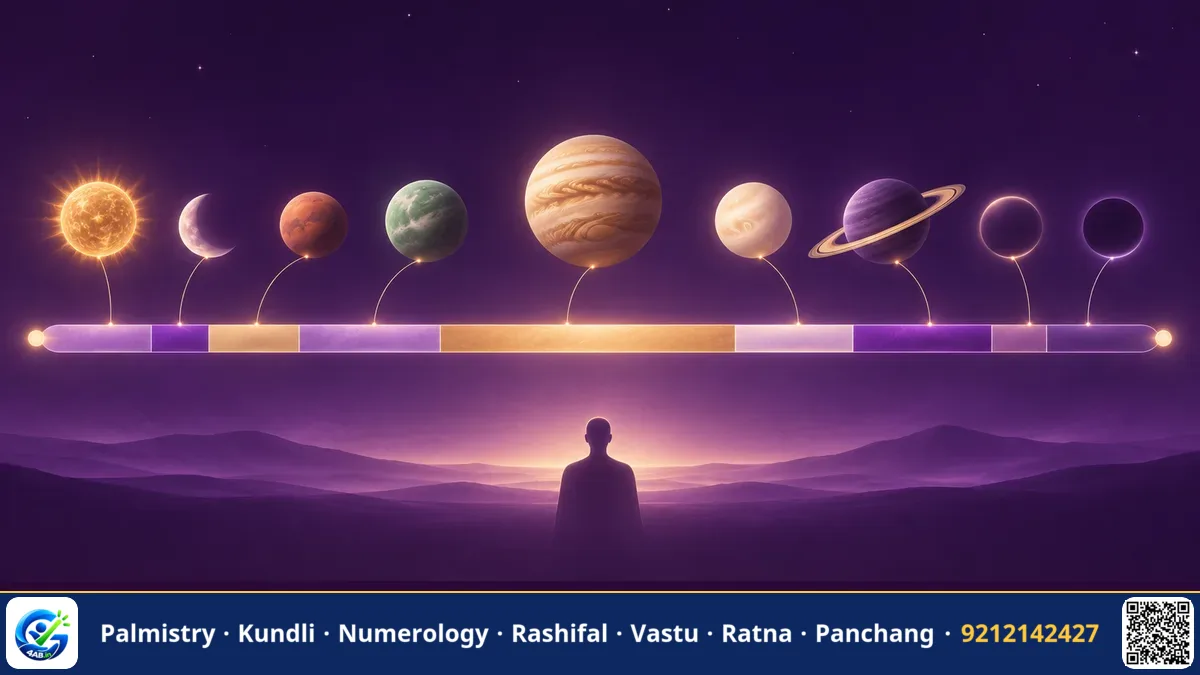
The 120-year cycle is divided among nine planetary rulers. These periods are called major periods or mahadashas. Each planet receives a fixed number of years established in classical traditions.
The planets follow an unvarying order: Ketu, Venus, Sun, Moon, Mars, Rahu, Jupiter, Saturn, and Mercury. Whichever planet starts your life, the remaining periods follow this exact sequence before repeating.
| Planet | Duration | Sequence order | Traditional focus |
|---|---|---|---|
| Ketu | 7 years | 1 | Spiritual reflection and detachment |
| Venus | 20 years | 2 | Relationships, arts, and comfort |
| Sun | 6 years | 3 | Leadership, vitality, and public role |
| Moon | 10 years | 4 | Mind, emotions, and nurturing |
| Mars | 7 years | 5 | Energy, initiative, and courage |
| Rahu | 18 years | 6 | Ambition and worldly exploration |
| Jupiter | 16 years | 7 | Wisdom, education, and ethics |
| Saturn | 19 years | 8 | Discipline, duty, and perseverance |
| Mercury | 17 years | 9 | Intellect, trade, and communication |
The durations are unequal. Venus governs the longest period at 20 years, while the Sun spans 6 years. All nine periods sum to 120 years.
How your starting dasha is calculated at birth
Two people born in the same year often experience different planetary periods. The starting point depends entirely on the Moon's position at birth.
The 360-degree zodiac is divided into 27 lunar mansions called nakshatras. Each nakshatra covers an arc of 13 degrees and 20 minutes (13°20′). Every nakshatra is assigned a planetary lord in the same nine-planet sequence repeated three times.
Your birth dasha is determined by the ruler of the nakshatra where the Moon was positioned when you were born. The Moon's exact longitude within that nakshatra determines your dasha balance—the remaining time left in that planet's cycle at birth.
Worked example: Calculating dasha balance at birth
- Locate the Moon: Suppose the Moon is at 15° Taurus in a birth chart.
- Find the nakshatra: In Taurus, the nakshatra Rohini spans from 10°00′ to 23°20′. Because 15° falls in this range, the birth nakshatra is Rohini. Rohini is ruled by the Moon, so the individual begins in Moon mahadasha.
- Measure traversed distance: Rohini's total span is 13°20′ (800 minutes of arc). From 10°00′ to 15°00′, the Moon has crossed 5°00′ (300 minutes).
- Calculate elapsed share: 300 divided by 800 equals 37.5% crossed before birth.
- Determine remaining balance: 62.5% of the nakshatra remains uncrossed.
- Apply to duration: Moon mahadasha lasts 10 years. 62.5% of 10 years equals 6 years and 3 months remaining at birth.
The child experiences Moon mahadasha until age 6 years and 3 months. Next comes Mars mahadasha for 7 years, then Rahu for 18 years, following the fixed order.
Understanding mahadasha, antardasha, and pratyantar dasha
A mahadasha lasts from 6 to 20 years. Because circumstances evolve over decades, classical astrology divides major periods into finer sub-cycles.
The primary subdivision is the antardasha (sub-period). Every mahadasha contains nine antardashas ruled by each planet in sequence, starting with the mahadasha lord. A Saturn mahadasha begins with Saturn antardasha, followed by Mercury, Ketu, Venus, Sun, Moon, Mars, Rahu, and Jupiter. Each antardasha's duration is proportional to that planet's share of 120 years.
For greater precision, each antardasha is divided into nine pratyantar dashas (sub-sub-periods). While the mahadasha sets the overall life theme across years, the antardasha focuses on specific developments over months, and the pratyantar dasha marks timing across weeks.
Traditionally, how a period feels depends on chart placement between the mahadasha and antardasha lords. Harmonious placements are traditionally held to support constructive progress, whereas conflicting placements call for deliberate patience.
Reading the dasha timeline on your Janam Kundli
Manual dasha calculation involves spherical astronomy. On the Janam Kundli page, the sidereal Lahiri engine calculates this timeline automatically.
To inspect your dasha timeline, take the following steps:
- Submit birth details: Enter your date, exact time, and place of birth on the Create Your Free Janam Kundli form. An optional six-digit PIN code refines location coordinates.
- Choose your chart view: Select either North Indian or South Indian chart formats to view your Rashi (D1) chart.
- Select the Dasha tab: Go to the Dasha section on the results page to see your complete Vimshottari timeline from birth forward.
- Identify active periods: Note the start and end dates of your active mahadasha, antardasha, and pratyantar dasha.
- Connect to life areas: Check the Houses and Planets tabs alongside your active dasha. You can review specific Life Areas such as Career, Marriage, Finance, and Education, or ask Great Astrology AI about your dasha timing.
- Compare with live transits: Internal timing (dashas) works alongside real-time planetary movements. Check the Transits tab to see how movements like Saturn's Sade Sati align with your running periods.
Astrological indications are interpretive guidance for reflection, never guarantees of career, health, or financial outcomes.
Key takeaways
- Vimshottari dasha is a 120-year cycle mapping planetary timing in an unchanging sequence from Ketu to Mercury.
- Your starting planetary period and initial balance depend on the Moon's exact position in its birth nakshatra.
- Mahadashas are subdivided into antardashas and pratyantar dashas to track both long-term themes and shorter phases.
- The Janam Kundli page calculates this timeline using the sidereal Lahiri ayanamsa across North and South Indian chart styles.
- Planetary periods are traditionally held as reflective cycles for self-awareness, not as unalterable predictions.
Frequently asked questions
What happens when the 120-year cycle finishes?
The Vimshottari cycle is continuous. If someone lives beyond their full cycle, the sequence restarts from the beginning in the same order.
Can the order of planetary dashas ever change?
No. The sequence is fixed by classical principles. Every birth chart follows the exact planetary order from Ketu through Mercury.
Why is the Moon used to calculate your starting dasha?
In Vedic tradition, the Moon governs the mind and perception. Calculating the dasha from the Moon's nakshatra reflects how a person subjectively experiences life events over time.
Does a challenging dasha guarantee negative outcomes?
No. Astrological periods indicate areas requiring focus, responsibility, and effort. They are traditionally viewed as opportunities for personal maturity rather than predetermined outcomes.
What to do next. Try it yourself on the page below.
Free Kundli — Birth Chart, Dasha, Transits & Analysis →