Q20 · CSIR-NET Chemistry, June 2015
Paper: CSIR-NET June 2015 · Subject: Organic Chemistry · Chapter: Reagents, Reaction Mechanisms & Named Reactions · Topic: Named Reactions · Marks: 2 · Difficulty: Hard
The major product formed in following reaction is 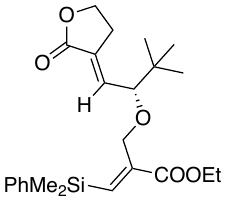
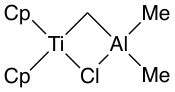


(a)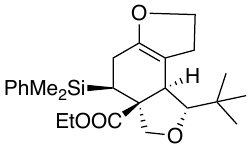
(b)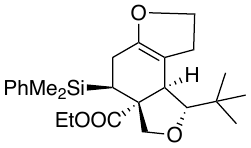
(c)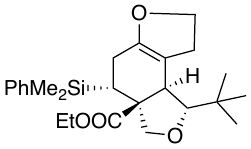
(d)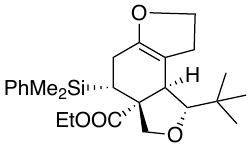
Answer
Answer: C ✓ checked by 4AB · confidence medium
Key C kept. The explanation was rewritten because Tebbe methylenation followed by an intramolecular Diels–Alder, not a Claisen/Michael cascade, builds the cyclohexene. The scan shows SiMe₂Ph trans to CO₂Et in the dienophile, which leaves (b) and (c); (a) and (d) have them cis.
Explanation
The Tebbe reagent (Cp₂Ti(μ-Cl)(μ-CH₂)AlMe₂, pyridine) methylenates the lactone C=O. This turns the α-alkylidene lactone into a 2-methylene-3-alkylidenetetrahydrofuran, an electron-rich 2-alkoxy-1,3-diene. The diene then undergoes an intramolecular Diels–Alder reaction with the silyl-substituted acrylate tethered through the ether oxygen. The new cyclohexene carries the dihydrofuran enol ether C=C, and the O–CH₂ tether closes a fused tetrahydrofuran ring. The cycloaddition is stereospecific. In the dienophile SiMe₂Ph is trans to CO₂Et, so they stay trans in the product. This rules out (a) and (d), where they are cis. The t-Bu-bearing stereocentre controls which face reacts, and this gives the tricyclic product (c).
Study loop for Reagents, Reaction Mechanisms & Named Reactions