Q71 · CSIR-NET Chemistry, June 2015
Paper: CSIR-NET June 2015 · Subject: Inorganic Chemistry · Chapter: Organometallic Compounds · Topic: Organometallic Compounds – General · Marks: 2 · Difficulty: Hard
With respect to $\sigma$ and $\pi$ bonding in Pt III in the structure given below, which of the following represent the correct bonding diagram 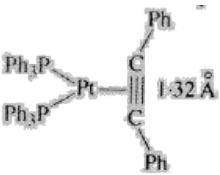
(a)$\mathrm{M}(\sigma) \rightarrow \mathrm{L}(\sigma)$ and $\mathrm{M}(\pi) \rightarrow \mathrm{L}\left(\pi^{*}\right)$
(b)$\mathrm{L}(\sigma) \rightarrow \mathrm{M}(\pi)$ and $\mathrm{L}(\pi) \rightarrow \mathrm{M}(\pi)$
(c)$\mathrm{L}(\pi) \rightarrow \mathrm{M}(\pi)$ and $\mathrm{L}(\sigma) \rightarrow \mathrm{M}(\pi)$
(d)$\mathrm{L}(\pi) \rightarrow \mathrm{M}(\sigma)$ and $\mathrm{M}(\pi) \rightarrow \mathrm{L}\left(\pi^{*}\right)$
Answer
Answer: D ✓ checked by 4AB · confidence medium
Explanation
Dewar–Chatt–Duncanson: the alkene π orbital donates into a metal σ-type acceptor orbital, and filled metal dπ orbitals back-donate into the alkene π* — L(π)→M(σ) and M(π)→L(π*) (d).
Study loop for Organometallic Compounds