Why nitrous oxide serves as a whipping cream propellant — CSIR NET 2013 PYQ solved
This question tests the properties and applications of nitrogen oxides. You will learn why nitrous oxide acts as an ideal food propellant while other nitrogen oxides fail.
Correct option: (A) — N₂O
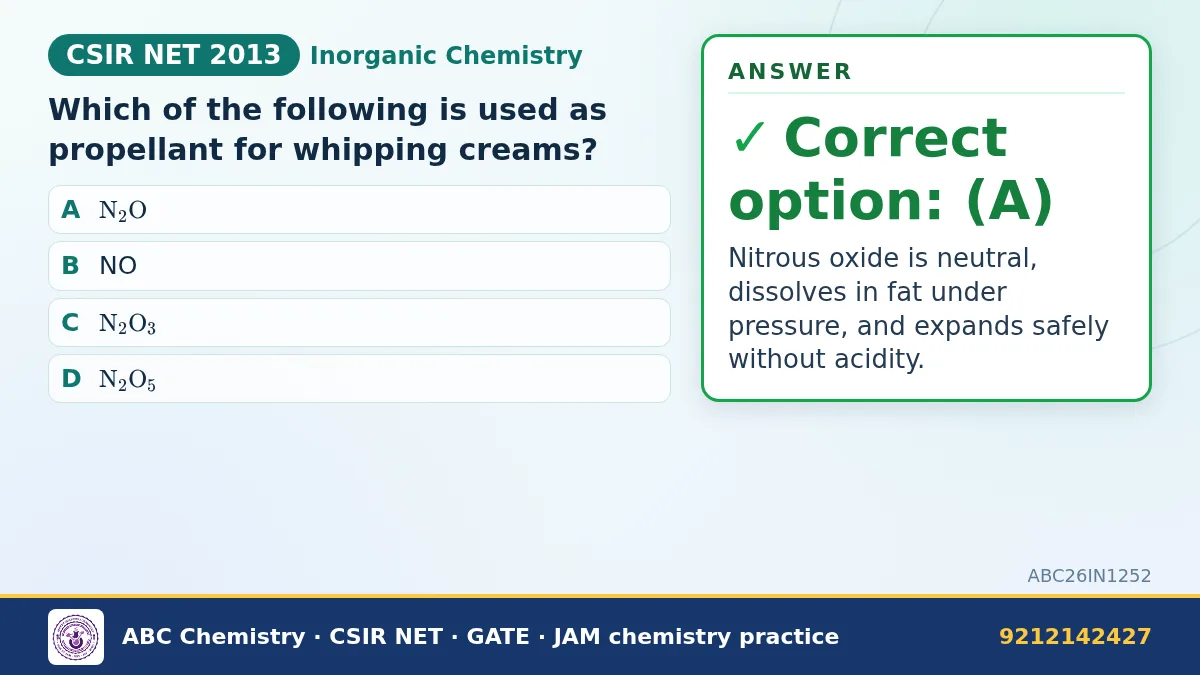
What nitrous oxide propellant is
Nitrous oxide, N₂O, is a neutral oxide of nitrogen with an oxidation state of +1. It is a colourless, non-flammable gas at room temperature. An aerosol propellant is a pressurized gas that expels liquid from a canister to produce foam or spray.
A food propellant must be chemically inert, non-toxic, and soluble in the product. Nitrogen forms binary oxides with oxidation states from +1 to +5. Among them, N₂O is unique because it does not react with food nutrients or pose health hazards.
The N₂O molecule is linear. Its electronic structure is described by canonical Lewis forms: :N≡N⁺-O⁻ and ⁻N=N⁺=O. Formal positive charge sits on central nitrogen, while negative charge is shared by terminal atoms. Because bond dipoles cancel, N₂O has a very small dipole moment, making it lipophilic and unreactive.
How it works
Whipped cream is an emulsion of butterfat droplets in water, stabilized by casein proteins. In a cream dispenser, liquid cream is sealed under high gas pressure.
Due to its low polarity, N₂O dissolves readily into butterfat globules following Henry's law:
c = k P
Here, c is the dissolved gas concentration, k is the Henry's law constant, and P is the pressure. Under pressure, substantial N₂O dissolves into the fat phase.
When the valve opens, pressure drops to 1 atmosphere. Because solubility drops sharply, dissolved N₂O vaporizes into microscopic bubbles. As the gas expands, it whips the cream into a rich foam. Milk proteins and fat globules coat these bubbles, stabilizing the foam against collapse.
Why it behaves this way
The performance of N₂O as a propellant depends on its electronic structure, neutrality, and solubility.
First, N₂O is a closed-shell diamagnetic molecule with paired electrons. Unlike free radicals, it does not oxidize unsaturated fats, preventing rancidity. It also displaces air from the canister headspace, inhibiting aerobic microbial growth.
Second, N₂O is a neutral oxide. It does not react with water or release hydrogen ions. Acidic conditions lower the pH toward the isoelectric region of casein, causing milk proteins to aggregate and curdle.
Third, N₂O is thermodynamically unstable relative to its elements:
2 N₂O → 2 N₂ + O₂
However, high activation energy makes it kinetically inert at room temperature. It cannot foam fat-free liquids because low lipid solubility prevents adequate gas dissolution.
Where the idea comes from
Pressurized food dispensing developed from classical gas laws. Boyle's law established that gas volume is inversely proportional to pressure:
P₁ V₁ = P₂ V₂
Henry's law showed that gas solubility in a liquid increases directly with pressure. Early dispensers applied these principles using carbon dioxide.
However, carbon dioxide fails in dairy products because it reacts with water to form carbonic acid:
CO₂ + H₂O ⇌ H₂CO₃
Carbonic acid releases hydrogen ions, lowering the pH. This acidity denatures milk proteins, curdling the cream into a sour lump.
Chemists needed a gas that dissolves under pressure like carbon dioxide but remains neutral. Nitrous oxide, isoelectronic with carbon dioxide, matched the required physical behaviour without forming acids in water.
Where it is used
Nitrous oxide is used in food packaging, organic synthesis, semiconductor fabrication, and analytical spectroscopy.
In food packaging, it is the standard propellant for dessert toppings and cooking sprays. High solubility in fats allows smooth dispensing without mechanical whipping.
In organic synthesis, N₂O acts as a clean oxidant in transition-metal catalysis, yielding inert dinitrogen as the sole byproduct:
N₂O + R → N₂ + RO
This process generates no hazardous chemical waste.
In semiconductor fabrication, high-purity N₂O reacts with silane in chemical vapour deposition to deposit silicon dioxide and silicon oxynitride films on silicon wafers.
In analytical laboratories, an acetylene-nitrous oxide flame is used in atomic absorption spectroscopy to atomize refractory elements like aluminium and titanium.
A fresh worked example
A student charges a 1 L whipper with 0.5 L of cream and compresses N₂O to 4 atm at constant temperature. The solubility constant of N₂O in this cream is 2 g per litre per atmosphere. At 1 atm, N₂O gas has a density of 2 g per litre.
Calculate the dissolved gas mass, the expanded gas volume, and the cream overrun.
Step 1: Calculate the dissolved mass
solubility = 2 g/(L·atm) × 4 atm = 8 g/L
mass dissolved in 0.5 L cream = 8 g/L × 0.5 L = 4 g
Step 2: Calculate the expanded gas volume
volume of gas = mass / density = 4 g / (2 g/L) = 2 L
Step 3: Calculate the overrun
total foam volume = liquid volume + gas volume = 0.5 L + 2 L = 2.5 L
overrun = [(2.5 L - 0.5 L) / 0.5 L] × 100 = (2 L / 0.5 L) × 100 = 400%
The dissolved N₂O expands the 0.5 L of cream into 2.5 L of stable foam.
Solving the question step by step
- Identify propellant criteria: A whipping cream propellant must be non-toxic, unreactive, soluble in fats under pressure, and non-acidic.
- Determine oxidation states: The options give nitrogen in states +1 for N₂O, +2 for NO, +3 for N₂O₃, and +5 for N₂O₅.
- Eliminate acidic oxides: N₂O₃ and N₂O₅ are acidic anhydrides that react with water to form nitrous acid and nitric acid, which curdle cream and are toxic. This eliminates options (c) and (d).
- Eliminate the reactive radical: Nitric oxide, NO, is a free radical that reacts with oxygen in air to form toxic nitrogen dioxide gas. This eliminates option (b).
- Confirm nitrous oxide: N₂O is a neutral, non-toxic oxide that dissolves in butterfat and foams cream without altering pH.
- State the conclusion: The correct choice is option (a).
Why the other options fail
Option (b) fails because nitric oxide, NO, is an open-shell radical. The misconception is assuming any neutral nitrogen oxide is safe. In air, NO reacts immediately to form toxic nitrogen dioxide gas, NO₂.
Option (c) fails because dinitrogen trioxide, N₂O₃, is an acidic anhydride. The misconception is ignoring its reactivity. N₂O₃ dissociates at room temperature and reacts with water to form nitrous acid, which curdles cream proteins.
Option (d) fails because dinitrogen pentoxide, N₂O₅, is an ionic solid consisting of nitronium and nitrate ions. The misconception is overlooking its strong oxidizing power. It reacts violently with water to form corrosive nitric acid.
| Option | Formula | Oxidation state | Nature | Food safety | Suitability |
|---|---|---|---|---|---|
| (a) | N₂O | +1 | Neutral | Non-toxic | Suitable |
| (b) | NO | +2 | Neutral radical | Toxic in air | Unsuitable |
| (c) | N₂O₃ | +3 | Acidic anhydride | Forms nitrous acid | Unsuitable |
| (d) | N₂O₅ | +5 | Strongly acidic | Forms nitric acid | Unsuitable |
Common mistake
A frequent mistake in CSIR NET 2013 is confusing the biological signaling role of nitric oxide with food safety. Because NO functions in human blood vessels, some candidates assume it is safe in consumer products. However, gaseous NO in air oxidizes rapidly into toxic nitrogen dioxide. Another error is assuming carbon dioxide can whip cream, forgetting that carbonic acid curdles milk proteins. Dairy whipping requires a neutral, non-acidic oxide, pointing directly to N₂O.
Key takeaways
- Nitrous oxide, N₂O, contains nitrogen in the +1 oxidation state and is a neutral, non-toxic gas.
- N₂O dissolves in butterfat under pressure and expands upon release to whip cream without mechanical agitation.
- Unlike CO₂, N₂O does not hydrolyze to form acids, preventing dairy proteins from curdling.
- The higher nitrogen oxides (NO, N₂O₃, N₂O₅) are unsuitable due to toxicity, radical reactivity, and acidic hydrolysis.
Frequently asked questions
How is the chemistry of nitrogen oxides tested in CSIR NET?
In CSIR NET, questions connect oxidation states to acid-base character, radical structure, and practical applications. Examiners expect candidates to distinguish neutral oxides from acidic anhydrides and evaluate how these species interact with air or water. Remembering these periodic trends and stability rules ensures quick, accurate marks.
Why does nitrous oxide not curdle whipping cream like carbon dioxide?
Carbon dioxide reacts with water to form carbonic acid, which releases hydrogen ions and lowers pH. This acidity neutralizes the charge on casein micelles, causing milk proteins to aggregate and curdle. Nitrous oxide is a neutral oxide that does not react with water, keeping pH steady and the emulsion smooth.
Why is nitrous oxide more soluble in cream fat than in water?
Nitrous oxide is a linear molecule with opposing bond dipoles that nearly cancel, giving it a very small dipole moment. Because of this low polarity, it interacts favourably with non-polar triglyceride chains in butterfat through dispersion forces. Polar water molecules interact weakly with it, making fat the primary solvent under pressure.
Related previous-year questions
- Protonated form of ZSM-5 catalyzes the reaction of ethene with benzene to produce ethylbenzene. The correct… CSIR NET
- The compound having an S-S single bond is JAM
- Alkali metal superoxides are obtained by the reaction of CSIR NET
- The correct statement regarding closo-BnHn species is: CSIR NET
- Question record ABC26IN1252 with the original answer
- All main group elements previous-year questions
- CSIR NET previous-year question papers
- Is this in the syllabus? Chemistry syllabus tool
Practise this chapter. Solve more main group elements previous-year questions with answers, free.
All main group elements questions →