Alcohols, Phenols and Ethers Class 12: Reaction Map, Dwarka
This guide explains how Class 12 students master conversions in alcohols, phenols, and ethers using a single visual reaction map.
Parents in Dwarka and Gurugram will see how structured chart revision and one-to-one home tuition build dependable exam technique.
Why alcohols, phenols and ethers overwhelm Class 12 students
The transition from Class 11 to Class 12 organic chemistry catches many students off guard. Class 11 introduces electronic effects and basic hydrocarbons. Class 12 demands multi-step synthetic logic where one compound transforms into another across several stages. The chapter on alcohols, phenols, and ethers is where students first encounter serious friction.
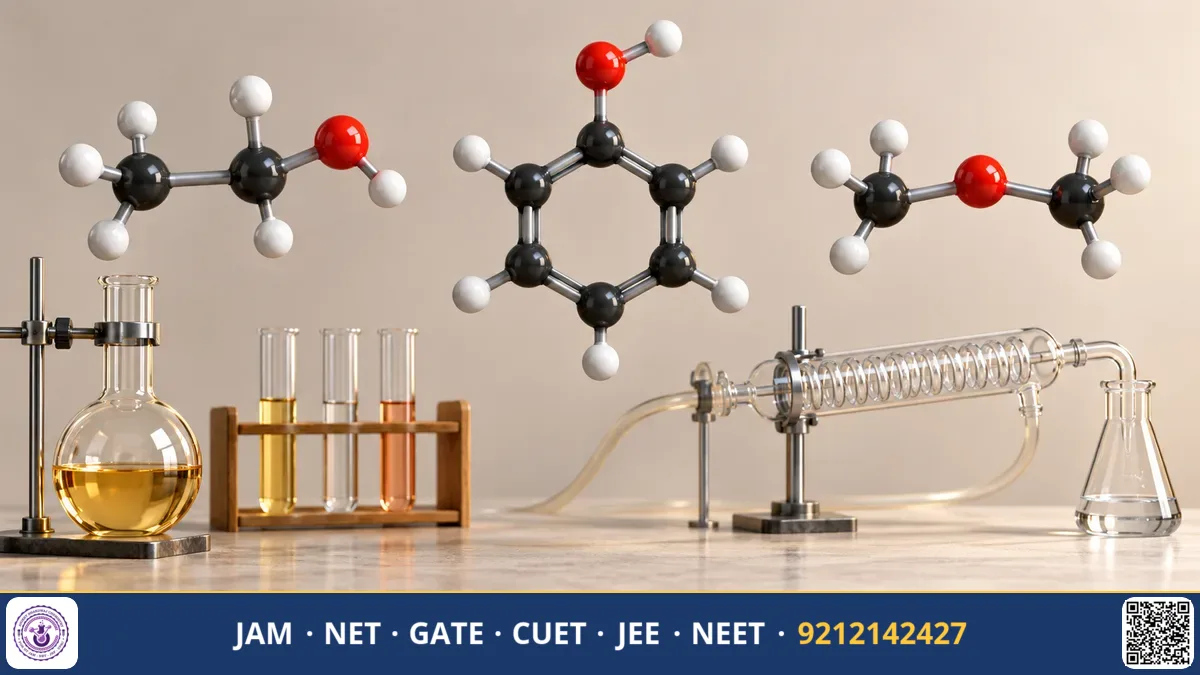
The syllabus combines three functional groups into one unit. An alcohol contains a hydroxyl group (-OH) attached to an aliphatic carbon, which is an open-chain carbon structure. A phenol has the hydroxyl group bonded directly to an aromatic benzene ring. An ether features an oxygen atom bonded between two alkyl or aryl groups. Each group follows distinct reaction rules.
A major difficulty is distinguishing bond cleavage patterns. Alcohols undergo reactions involving oxygen-hydrogen (O–H) bond cleavage in esterification and reactions with active metals. They undergo carbon-oxygen (C–O) bond cleavage when reacting with hydrogen halides or dehydrating into alkenes. Phenols rarely undergo C–O cleavage because resonance stabilises the bond between oxygen and the ring. Without a structured map, students confuse reagents and lose marks in conversion questions.
Building a single visual reaction map for the chapter
A reaction map is a visual diagram placing chemical compounds at central nodes connected by directed arrows. Each arrow specifies the exact reagent, temperature, and conditions required for the conversion. Instead of flipping through pages in the NCERT textbook, the student views the entire chapter as a connected roadmap.
To construct an effective map, students should divide a chart into three sectors:
- The aliphatic alcohol core: Position primary, secondary, and tertiary alcohols at the centre. Inward arrows show preparation routes, including acid hydration of alkenes, hydroboration-oxidation, and reduction of carbonyl compounds. Outward arrows show oxidation pathways: mild reagents like pyridinium chlorochromate convert primary alcohols to aldehydes, while acidified potassium permanganate yields carboxylic acids.
- The phenol junction: Place phenol in the top section. Trace preparation from cumene and from aniline via diazonium salts. Branch outward to highlight electrophilic aromatic substitutions, including carboxylation with carbon dioxide to produce salicylic acid, and formylation with chloroform to yield salicylaldehyde.
- The ether bridge: Place symmetrical and unsymmetrical ethers in the lower section. Connect them to primary alkyl halides and sodium alkoxides through nucleophilic substitution. Add pathways showing acidic cleavage using hydrogen iodide under cold and hot conditions.
Working with this layout trains the brain to recognize synthetic pathways quickly during board examinations.
Reagent pathways and worked conversion examples
Board examinations regularly present conversion questions requiring students to connect functional groups in two or three steps. Without a map, students guess reagents without understanding the mechanism. The table below compares essential reaction pathways frequently tested in Class 12 assessments.
| Starting molecule | Reagents and conditions | Target product | Underlying principle |
|---|---|---|---|
| Alkene (propene) | Diborane, then alkaline hydrogen peroxide | propan-1-ol | Hydroboration-oxidation attaches the hydroxyl group to the less substituted carbon atom. |
| Alkene (propene) | Dilute sulphuric acid | propan-2-ol | Acid hydration places the hydroxyl group on the more substituted carbon atom. |
| Aromatic phenol | Sodium hydroxide, carbon dioxide, then acid | salicylic acid | Electrophilic substitution introduces an ortho-carboxyl group onto the phenoxide ring. |
| Aromatic phenol | Zinc dust, heat | benzene | Direct reduction removes the phenolic oxygen atom completely. |
| Sodium methoxide with 2-chloro-2-methylpropane | Heat in solvent | 2-methylpropene | Ether synthesis fails with tertiary halides because elimination predominates. |
Worked conversion: turning propan-1-ol into propan-2-ol
- Step 1 (Dehydration to alkene): Heat propan-1-ol with concentrated sulphuric acid at 443 K to produce propene.
- Step 2 (Hydration to secondary alcohol): Treat propene with dilute sulphuric acid. The proton adds to form the secondary carbocation, followed by water addition to yield propan-2-ol.
Moving a functional group to an adjacent carbon requires elimination followed by addition.
The study routine for students in Dwarka and Gurugram
Students residing in Dwarka sectors such as Sector 6 and Sector 10, as well as nearby localities like Janakpuri, face demanding timetables. Many travel long distances to attend coaching centres across Delhi NCR. Families along sectors in Gurugram, including Sector 108 through Sector 113, also note that evening travel consumes valuable study hours.
Organic chemistry requires active problem solving on paper rather than passive listening. Late travel leaves students tired, leading them to read mechanisms casually without writing intermediate structures from memory.
A disciplined home routine resolves this problem. Parents should set aside a ninety-minute chemistry block three evenings each week. Students must focus on solving NCERT exercises and writing reaction pathways from memory. The final ten minutes should be reserved for tracing new reactions onto their master map.
How a verified home tutor structures organic chemistry
In a classroom, a teacher cannot monitor how every student draws organic mechanisms. One student may struggle with the turbidity test using concentrated hydrochloric acid and zinc chloride to differentiate alcohol classes. Another student may misunderstand why ether cleavage changes under hot versus cold conditions.
One-to-one home tuition addresses these gaps directly at the student's study desk. A tutor observes problem solving in real time, corrects improper electron-pushing arrows, and reinforces foundational mechanisms. Great Home Tutors helps parents connect with experienced educators matched to the student's board syllabus.
Parents can request a home tutor by entering the student's class, subject, board, and locality, whether in Dwarka, Janakpuri, or Gurugram sectors. Great Home Tutors evaluates every prospective educator through an identity check, qualification verification, and an in-depth teaching conversation. Educators who pass receive a Verified mark. An introductory first class allows the student and parent to evaluate the tutor before establishing a weekly schedule.
Key takeaways
- A visual reaction map integrates disconnected reactions into a clear network of functional group transformations.
- Contrasting reagent pairs allows precise control over alcohol synthesis from alkenes.
- Ether synthesis from alkoxides requires primary alkyl halides because tertiary halides undergo elimination to form alkenes.
- One-to-one home tuition in Dwarka and Gurugram eliminates commute fatigue, allowing students to focus on handwritten practice.
Frequently asked questions
How does a reaction map help with Class 12 board conversions?
Board conversion questions require students to link functional groups in two or three steps. A reaction map displays intermediate compounds on a single page, helping students identify the shortest synthetic pathway without hesitation.
Why does ether synthesis fail when using a tertiary alkyl halide?
Alkoxide ions act as strong bases as well as nucleophiles. When an alkoxide reacts with a tertiary alkyl halide, it abstracts a proton rather than attacking the carbon atom. This causes elimination, producing an alkene rather than an ether.
How does Great Home Tutors screen chemistry home tutors?
Great Home Tutors checks each educator through an identity verification, qualification review, and a direct teaching conversation before listing them. Tutors who complete this assessment carry a Verified mark on the platform.
Can families in Dwarka and Gurugram schedule an introductory first class?
Yes. After parents submit their class, subject, board, and locality details, a representative calls to discuss academic requirements. A first class is arranged at home so the family can confirm the teaching fit before fixing any schedule.
What to do next. Try it yourself on the page below.
Great Home Tutors — home tuition at your home · 4AB →