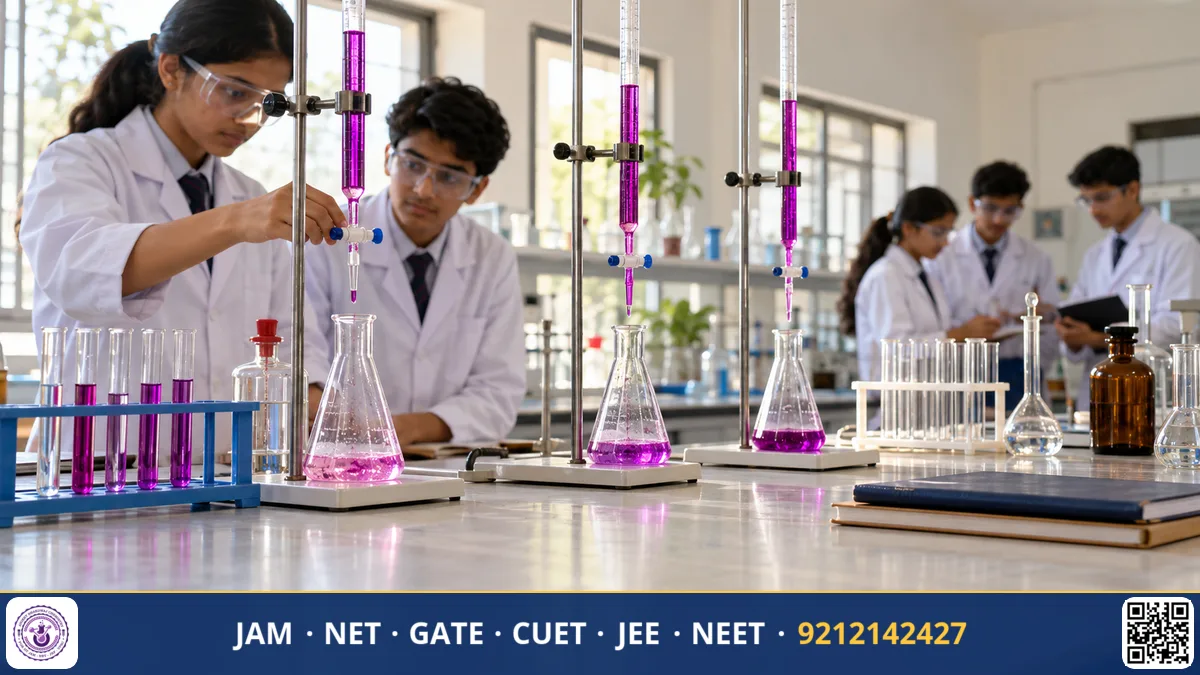
Class 11 Salt Analysis Practical: Tutor Tips, Gurugram
This guide explains how Class 11 chemistry students master inorganic salt analysis practicals, record laboratory observations accurately, and prepare for viva questions. Parents in Gurugram and Dwarka will also see how regular home tutoring builds laboratory confidence.
Syllabus pain points in Class 11 qualitative analysis
Class 11 chemistry introduces qualitative analysis, which is the experimental identification of ions in an unknown substance. Students test a simple inorganic salt containing one acidic radical and one basic radical. An acidic radical is an anion, which is a negatively charged ion such as carbonate or chloride. A basic radical is a cation, which is a positively charged ion such as ammonium or lead.
Class 11 demands a systematic analytical sequence governed by the NCERT practical syllabus. Students must follow a logical path rather than mixing reagents at random. Testing for basic radicals before identifying acidic radicals or omitting group reagents leads to false precipitates and wasted lab time.
Schools in Gurugram, including Sector 108, Sector 109, and Sector 110, operate on tight laboratory periods. Students share workbenches and reagent bottles. Limited access to burners can cause hurried heating and careless washing of test tubes. Many students struggle to complete practical notebook entries during lab hours, memorising steps blindly rather than understanding reactions.
Systematic procedure for anion and cation detection
A student must approach salt analysis with a disciplined routine. The procedure begins with physical examination, noting the colour, smell, and state of the dry salt. Blue indicates copper, light green indicates ferrous iron, and an ammoniacal odour on warming suggests ammonium.
The chemical sequence starts with acidic radical identification, divided into three analytical groups:
- Dilute acid group: Treated with dilute sulphuric acid. Carbonate releases colourless carbon dioxide gas turning lime water milky. Sulphide releases hydrogen sulphide gas smelling of rotten eggs. Nitrite produces brown nitrogen dioxide fumes.
- Concentrated acid group: Treated with concentrated sulphuric acid. Chloride releases hydrogen chloride gas giving dense white fumes with ammonia. Nitrate produces brown nitrogen dioxide gas, intensified by copper turnings.
- Independent group: Sulphate and phosphate do not react with sulphuric acid. Sulphate is identified by adding barium chloride solution, forming a white precipitate of barium sulphate insoluble in dilute hydrochloric acid.
After finding the acidic radical, the student prepares the original solution by dissolving the salt in distilled water or dilute hydrochloric acid. Basic radicals are then separated into analytical groups using selective reagents in order.
Observations and confirmatory tests
Students must connect visible changes with definite chemical reactions. The table below lists standard tests, observations, and chemical inferences for common radicals in the NCERT syllabus.
| Radical | Analytical group | Reagent added | Observed result | Chemical inference |
|---|---|---|---|---|
| Carbonate | Dilute acid group | Dilute sulphuric acid | Brisk effervescence | Carbon dioxide gas turns lime water milky |
| Chloride | Concentrated acid group | Concentrated sulphuric acid | Pungent colourless fumes | Dense white fumes form with ammonia |
| Nitrate | Concentrated acid group | Ferrous sulphate, sulphuric acid | Brown ring at junction | Brown nitroso ferrous complex forms |
| Sulphate | Independent group | Barium chloride solution | White precipitate | Insoluble barium sulphate precipitate forms |
| Ammonium | Zero group | Sodium hydroxide solution, heat | Pungent gas | Ammonia turns moist red litmus blue |
| Lead | First group | Dilute hydrochloric acid | White precipitate | Lead chloride dissolves in hot water |
Viva readiness and theoretical principles
The viva voce is an oral examination conducted by practical evaluators to test a student grasp of chemical theory. Many Class 11 students record accurate results in their notebooks but stumble during viva questioning because they rely on rote recall.
Examiners routinely ask why reagents are added in a specific order. A student must explain the common ion effect, which is the suppression of the dissociation of a weak electrolyte by adding a strong electrolyte containing a common ion. When separating metal hydroxides, ammonium chloride is added before ammonium hydroxide. The common ammonium ions suppress the ionisation of ammonium hydroxide, keeping the hydroxyl ion concentration low enough to precipitate only less soluble metal hydroxides.
Another fundamental concept is the solubility product, which is the product of dissolved ion concentrations in a saturated solution. Precipitation occurs only when the ionic product exceeds the solubility product. In acidic medium, hydrochloric acid provides hydrogen ions that suppress hydrogen sulphide ionisation. This limits sulphide ion concentration, allowing only sulphides with very low solubility products to precipitate. In alkaline medium, the concentration of sulphide ions increases, precipitating more soluble metal sulphides.
How home tuition builds practical confidence
School teachers manage large classes during lab periods, leaving little time to explain why a test failed at an individual desk. A home tutor provides personal academic support at the student study table. In areas such as Sector 111, Sector 112, and Sector 113 in Gurugram, as well as Sector 6 Dwarka and Sector 10 Dwarka, home tuition bridges the gap between laboratory demonstrations and theoretical comprehension.
A tutor establishes a regular weekly study routine aligned with the school lab calendar. Before a student enters the school laboratory, the tutor reviews the salt testing scheme and balanced chemical equations. After the lab session, the tutor reviews the practical notebook, ensuring that observations match NCERT standards.
Great Home Tutors arranges one-to-one home tuition directly at your home, without coaching centre crowds or group batches. Parents tell Great Home Tutors the class, subject, board, and locality, whether in Gurugram or Dwarka. A person from Great Home Tutors calls back to understand student requirements. Tutors checked by Great Home Tutors carry a Verified mark and are listed first. Families can meet the tutor and take a first class to evaluate the teaching fit before anything is fixed.
Key takeaways
- Follow the systematic sequence by completing acidic radical tests before attempting basic radical group separation.
- Understand core theoretical concepts, including the common ion effect and solubility product, to answer practical viva questions.
- Record distinct observations like precipitate texture and gas behaviour rather than vague colour changes.
- Establish a weekly home study routine to review chemical equations and lab notebook entries alongside school practicals.
- One-to-one home tuition from Great Home Tutors provides individual academic guidance with verified tutors in Gurugram and Dwarka.
Frequently asked questions
Why is the original solution not prepared in concentrated sulphuric acid?
Concentrated sulphuric acid is a strong oxidising and dehydrating agent. It reacts with many anions and cations to form insoluble sulphate precipitates, such as barium sulphate or lead sulphate, which interfere with subsequent cation separation.
What is the role of ammonium chloride before adding ammonium hydroxide?
Ammonium chloride provides ammonium ions that suppress the dissociation of ammonium hydroxide through the common ion effect. This lowers the hydroxyl ion concentration so that only less soluble metal hydroxides precipitate, preventing premature precipitation of other basic radicals.
How can parents in Gurugram arrange home tuition for Class 11 chemistry?
Parents can submit a request on Great Home Tutors specifying the class, subject, educational board, and locality, such as Sector 108 or Sector 109 in Gurugram. A representative calls back to discuss student needs, connects the family with a checked tutor carrying a Verified mark, and arranges a first class at home.
How does viva practice at home improve exam performance?
Oral practice sessions at home help students articulate ionic equations, explain the purpose of specific group reagents, and overcome hesitation. Explaining chemical reasoning out loud ensures that students do not freeze when questioned by practical examiners.
What to do next. Try it yourself on the page below.
Great Home Tutors — home tuition at your home · 4AB →