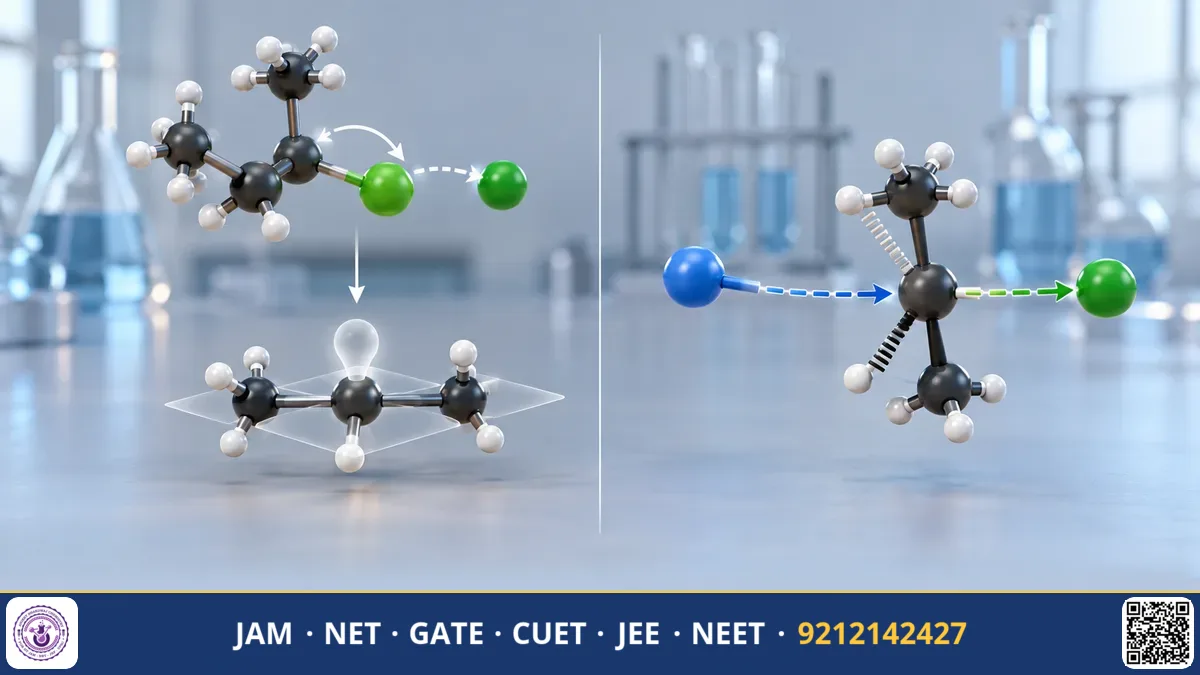
Class 12 haloalkane reactions: SN1, SN2 or elimination? Gurugram
This post is for parents of Class 12 students in Dwarka and Gurugram.
It shows where the chapter on haloalkanes and haloarenes gets difficult, and how to study it step by step.
Why this chapter troubles Class 12 students
Haloalkanes are compounds where a halogen atom (chlorine, bromine or iodine) is attached to an sp3 carbon of an alkyl group. Haloarenes have the halogen attached directly to a benzene ring. The NCERT chapter covers both, along with their preparation, properties and reactions.
Many students learn the chapter as a list of named reactions. That works for a short unit test. It fails when a question asks for the product and the reason. To give the reason, the student must understand the mechanism. A mechanism is the step-by-step path by which bonds break and form.
Three things usually go wrong:
- The student mixes up SN1 and SN2 because both are substitution reactions.
- The student does not know when elimination competes with substitution.
- The student applies haloalkane rules to haloarenes, where they often do not hold.
You can help at home with one simple request. Ask your child to explain, in two or three sentences, why a reaction gives the product it does. If the explanation is clear, the idea is clear. If it is vague, note the gap and take it to the tutor.
SN2 and SN1 side by side
A nucleophile is a species rich in electrons that attacks a carbon carrying a partial positive charge. A leaving group is the halide that departs. In substitution, the nucleophile replaces the halogen.
| Point | SN2 | SN1 |
|---|---|---|
| Steps | One step. Attack and departure happen together. | Two steps. The halide leaves first and forms a carbocation. The nucleophile then attacks. |
| Rate depends on | Both the haloalkane and the nucleophile (second order) | Only the haloalkane (first order) |
| Preferred substrate | Methyl and primary halides | Tertiary halides |
| Stereochemistry | Inversion of configuration | Racemisation, a mixture of both mirror-image forms |
| Why this substrate? | Less crowding lets the nucleophile reach the carbon from the back. | A tertiary carbocation is more stable. |
Secondary halides can go either way. This is where students need the most practice, because the answer depends on the other conditions given in the question.
Substitution or elimination: four checks
In elimination, the halogen leaves along with a hydrogen from the neighbouring carbon. The product is an alkene. A reagent that pulls off a hydrogen is acting as a base. The same reagent can also act as a nucleophile, so the two reactions compete.
Teach your child to run through these checks in order:
- What type of carbon holds the halogen? Primary favours SN2. Tertiary favours SN1, or elimination if a strong base is present.
- Is the reagent a strong base or a good nucleophile? A strong base pushes the reaction towards elimination. Alcoholic potassium hydroxide is the textbook example. Aqueous potassium hydroxide favours substitution.
- What is the solvent? Water or alcohol helps a carbocation form, so it supports SN1. An alcoholic solution of a strong base is the usual sign of elimination in school problems.
- Is the reaction heated? Higher temperature generally favours elimination over substitution.
When elimination can give more than one alkene, the more substituted alkene is the major product. A substituted alkene has more alkyl groups on the carbons of the double bond. Students often write the less stable alkene because they never count the neighbouring hydrogens. Ask your child to draw every possible alkene before choosing one.
A worked example to try
Question: A secondary bromoalkane with four carbons has its bromine on C-2. It is heated with alcoholic potassium hydroxide. What is the major product, and which idea decides it?
Step 1. Alcoholic potassium hydroxide points to elimination, not substitution.
Step 2. The carbon with bromine is C-2. The neighbouring carbons are C-1 (a CH3 group) and C-3 (a CH2 group). Hydrogen can be removed from either side.
Step 3. Removing hydrogen from C-3 gives but-2-ene. Removing it from C-1 gives but-1-ene.
Step 4. But-2-ene has more alkyl groups on the double bond, so it is more stable. It is the major product.
Check: Now change one condition. Ask what happens with aqueous potassium hydroxide instead. The expected answer is substitution, giving butan-2-ol.
Changing one condition and asking for the new product is a good test of real understanding. If your child can do it without hints, the decision rules have settled in.
Haloarenes behave differently
A common mistake is to treat chlorobenzene like a haloalkane. It is much less reactive towards nucleophilic substitution. Two reasons are taught at this level:
- The halogen is attached to an sp2 carbon. The carbon-halogen bond is shorter and stronger than in a haloalkane.
- The lone pair on the halogen takes part in resonance with the ring. This gives the bond some double-bond character.
An electron-withdrawing group such as a nitro group at the ortho or para position makes nucleophilic substitution easier. The negative charge in the intermediate is then stabilised. Ask your child to draw the resonance structures once. That is easier to remember than a memorised statement.
For electrophilic substitution, the halogen makes the ring less reactive but still directs the incoming group to the ortho and para positions. Students should be able to explain both facts together, because the pair is a frequent question.
How a tutor helps, and a routine for home
A tutor can watch where your child actually goes wrong. One student confuses the rate laws. Another cannot identify the type of carbon. A large class cannot fix each gap one by one. In one-to-one home tuition, the tutor can ask your child to speak the reasoning aloud and correct it on the spot.
Great Home Tutors offers home tuition only, with no coaching centre and no group batch. You tell us the class, subject, board and locality. A person from the team calls you back to understand the student. We tell you plainly whether a tutor is verified by us or not yet. A first class lets you see the fit before anything is fixed. This covers families in Dwarka and in Gurugram.
Here is a simple weekly routine for this chapter:
- Day 1: Read the NCERT text on nomenclature and preparation. Write the reactions in a small notebook.
- Day 2: Study SN2 and SN1 with the table above. Draw both mechanisms from memory.
- Day 3: Practise elimination with five or six examples. For each, list all possible alkenes and pick the more substituted one.
- Day 4: Study haloarenes and compare each property with haloalkanes.
- Day 5: Solve the NCERT in-text and end-of-chapter questions without looking at the answers.
- Weekend: Review mistakes with the tutor. Keep a list of errors made twice.
Short daily sessions work better than one long session before a test. Results depend on your child's effort and practice, and no tutor can promise a particular score.
Key takeaways
- Decide the reaction by looking at the carbon type, the reagent, the solvent and the temperature.
- SN2 is one step with inversion. SN1 is two steps through a carbocation, with racemisation.
- An alcoholic strong base signals elimination. Aqueous alkali signals substitution. The more substituted alkene is the major product.
- Haloarenes resist nucleophilic substitution because of the sp2 carbon and resonance.
- Practise by changing one condition at a time and predicting the new product.
Frequently asked questions
Should my child memorise all the named reactions first?
No. Start with the mechanisms. When SN1, SN2 and elimination are clear, most named reactions in this chapter become easier to place and recall.
Why is a tertiary halide not suited to SN2?
The three alkyl groups crowd the carbon, so the nucleophile cannot approach from the back. Tertiary halides prefer SN1 because the tertiary carbocation is stable.
Is NCERT enough for this chapter?
NCERT is the base for the CBSE syllabus, so read it fully and solve its questions. Extra practice on deciding between substitution and elimination is useful, and a tutor can supply it.
Can home tuition be arranged in Dwarka or Gurugram?
Yes. Use the request form on the Great Home Tutors page. Choose Class 12, Chemistry, your board and your locality, and the team will call you back.
What to do next. Try it yourself on the page below.
Great Home Tutors — home tuition at your home · 4AB →