JEE Maths Weak Chapter Recovery: A Four-Week Cycle, Gurugram
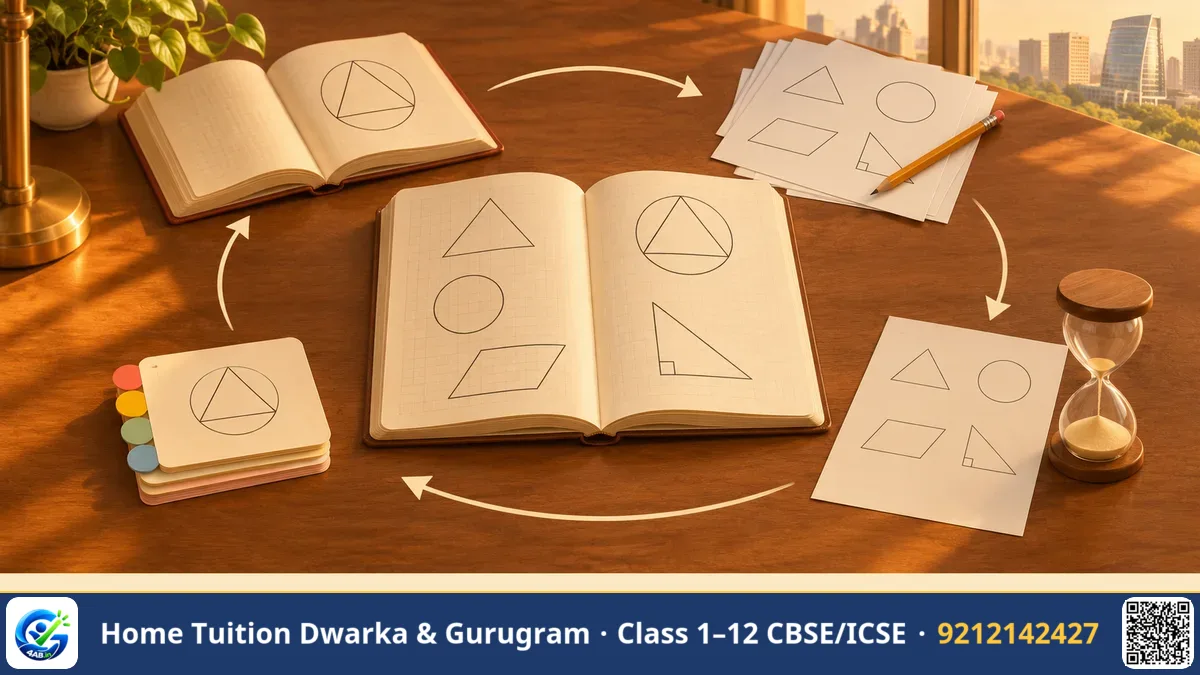
This guide explains how to rebuild a weak JEE Mathematics chapter without disrupting regular school studies. Parents in Gurugram and Dwarka will find a four-week cycle to turn difficult topics into dependable scoring areas.
Why one weak chapter damages JEE Maths preparation
School boards like CBSE often test direct formulas from single chapters. JEE Mathematics combines concepts from multiple areas into one question. A problem in definite integration often demands mastery of functions, trigonometry, and quadratic equations. Definite integration means finding the area under a curve between two set limits. When a student struggles with one topic, they also lose marks on composite questions across other chapters.
Students in Class 11 and Class 12 often try to fix a weak chapter by tackling advanced questions immediately. This causes frustration. Without solid fundamentals, solving difficult problems leads to guesswork. A student must isolate one chapter and follow an orderly process. Trying to revise three chapters at once divides attention and leaves all three unfinished. Repairing one chapter over four weeks builds confidence and provides a clear routine for future revision.
The four-week recovery framework: relearn, practise, test, and review
The recovery loop follows four distinct phases: relearn, practise, test, and review. Each phase lasts one week and addresses a specific learning step.
Week 1 focuses on relearning. The student reviews definitions, standard theorems, and boundary conditions. A boundary condition is the specific boundary value where a mathematical formula or rule applies. The student rewrites derivations and solves basic exercises from NCERT. This step confirms that notation and core principles are clear.
Week 2 focuses on practice. The student transitions from solved textbook examples to unassisted single-concept problems. The goal is pattern recognition, which is the ability to identify the correct identity or method for a problem. The student solves problems without time limits, focusing on clean algebraic steps.
Week 3 introduces timed testing. This involves focused chapter tests completed against a timer rather than unmonitored problem solving. Testing under time limits shows whether a student hesitates over formulas or makes simple arithmetic mistakes.
Week 4 centers on review. The student maintains an error log, which is a written notebook recording every wrong answer, the underlying reason, and the correct solution. Reviewing the log prevents repeating the same mistakes on future exams.
A week-by-week plan to rebuild a difficult chapter
Here is how the four-week recovery cycle works for a challenging chapter such as vectors and three-dimensional geometry. The student dedicates regular study sessions each week to this cycle alongside regular schoolwork.
| Week | Phase | Primary study focus | Weekly milestone |
|---|---|---|---|
| Week 1 | Relearn | Review core theory, rework NCERT exercises, and summarise properties. | Fluency in fundamental formulas and definitions. |
| Week 2 | Practise | Solve graded single-concept problems without consulting notes. | Accurate step-by-step problem solving. |
| Week 3 | Test | Attempt timed chapter tests under exam conditions. | Clear assessment of speed and accuracy. |
| Week 4 | Review | Analyse test mistakes, record entries in the error log, and retest failed problems. | Zero uncorrected mistakes on past test questions. |
Question type: Calculating the area between a parabola and a straight line.
Student mistake: Integrated across incorrect limits due to an algebraic sign error during factorization.
Root cause: Factored the quadratic equation x2 − 3x + 2 = 0 carelessly under time pressure.
Action step: Verify intersection coordinates before sketching curves; re-solve similar questions accurately.
How a one-to-one home tutor accelerates recovery
In large coaching centres or group batches, teachers cannot pause a lecture to revisit earlier chapters for an individual student. A student struggling with quadratic equations during a calculus lecture falls behind quietly.
A one-to-one home tutor solves this problem. Great Home Tutors provides one-to-one tuition at your home, without coaching centre crowds or group batches. When parents request a home tutor, they share the student name, class, subject, and locality. A representative calls back to understand the student's needs before arranging lessons.
During home tuition, the tutor observes pencil-on-paper work directly. Tutors checked by Great Home Tutors carry a Verified mark, showing that their identity, qualifications, and teaching conversations have been vetted. A verified Maths tutor quickly spots whether errors come from calculation slips or gaps in prerequisite knowledge. Prerequisite knowledge refers to earlier concepts, such as coordinate geometry, needed to understand advanced calculus.
The tutor enforces the four-week loop. In Week 1, the tutor explains tough derivations. In Week 2, the tutor selects graded questions. In Week 3 and Week 4, the tutor marks tests and guides error log corrections. Parents can assess compatibility during a first class at home before making any commitments.
Balancing school hours and JEE Maths revision in Gurugram
Students in Gurugram sectors such as Sector 108, Sector 109, Sector 110, Sector 111, Sector 112, and Sector 113 often spend hours commuting to schools across Delhi NCR. Adding an unstructured study plan causes exhaustion.
A four-week cycle succeeds because it relies on steady, daily effort rather than marathon weekend sessions. Reserving dedicated study time each evening keeps recovery manageable alongside school commitments.
Here is an effective weekly routine:
- Monday and Wednesday: Clarify theory and review solved examples with a home tutor.
- Tuesday and Thursday: Complete independent practice, writing out every algebraic step.
- Saturday: Attempt a timed chapter test without distractions.
- Sunday: Review errors with the tutor, record entries in the error log, and re-solve wrong problems.
This steady routine protects school marks while eliminating weak chapters systematically.
Key takeaways
- Focus on one weak JEE Maths chapter at a time to maintain clarity and momentum.
- Follow the four-week loop: relearn theory, practise problems, take timed tests, and review errors.
- Begin theoretical review with NCERT to ensure definitions and notation are secure.
- One-to-one home tuition provides direct observation and personal feedback missing in group batches.
- Keep a detailed error log to prevent repeating algebraic and conceptual mistakes.
Frequently asked questions
Can a student recover two weak JEE Maths chapters simultaneously?
It is better to focus on one chapter at a time. Dividing study hours across two difficult topics fragments attention and leaves misconceptions unresolved.
Why should a student start chapter recovery with NCERT?
NCERT explains standard terminology, fundamental derivations, and core mechanics clearly. Skipping these basics leads to rote memorisation and persistent errors on complex problems.
How does a verified home tutor assist during the review phase?
A verified tutor examines test papers line by line. The tutor determines whether mistakes stem from conceptual gaps or calculation errors, ensuring the student updates their error log accurately.
How do parents in Gurugram request a Maths home tutor?
Parents share their class, subject, and locality, such as Sector 108 or Sector 109 in Gurugram, through the request form. A representative calls back to discuss student needs and arranges a first class at home.
What to do next. Try it yourself on the page below.
Great Home Tutors — home tuition at your home · 4AB →