Linear inequalities Class 11: number line mistakes, Dwarka
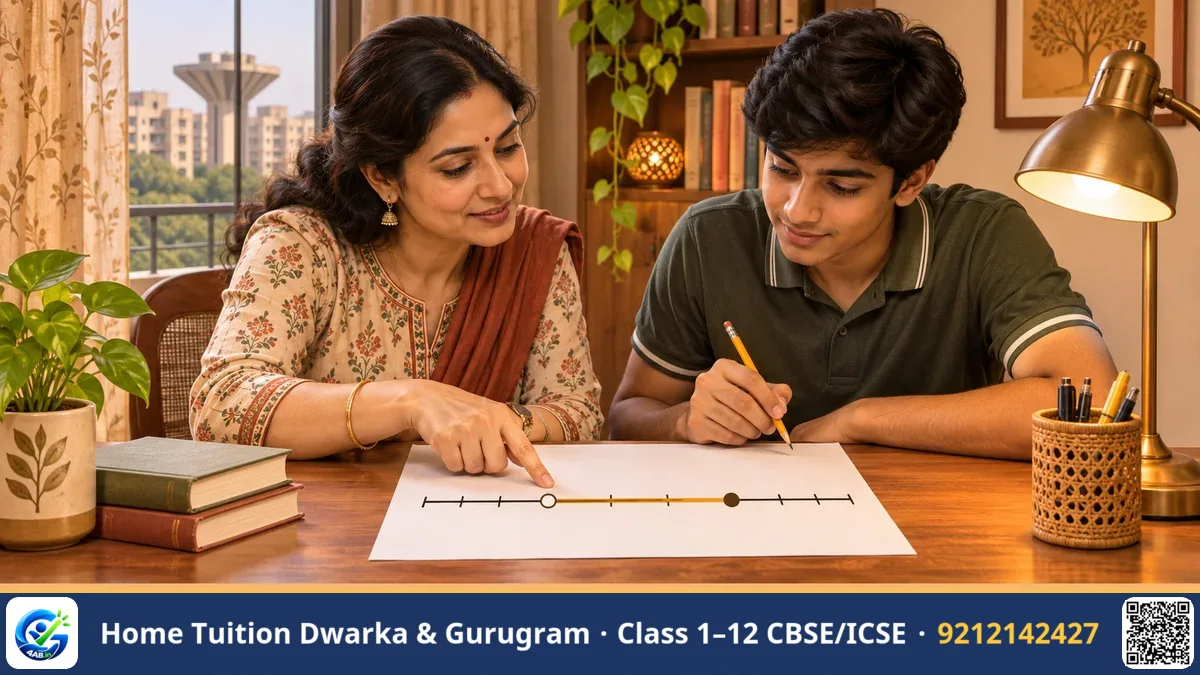
This post shows the three mistakes that cost Class 11 students the most marks in linear inequalities.
You will also get short correction drills and a simple weekly routine you can follow at home.
What the chapter asks and where students slip
A linear inequality is a statement like 3x − 5 < 7, where two sides are compared with <, >, ≤ or ≥ instead of an equals sign. In the CBSE Class 11 NCERT syllabus, this chapter asks students to solve such inequalities, show the answer on a number line, and handle systems of inequalities in one variable.
The steps look like equation solving, so students relax. That is the trap. In an equation, a small slip usually gives a wrong number. In an inequality, one wrong sign gives a wrong set of numbers, and the whole answer is lost.
A child may follow every step of the method and still lose marks. In most such cases the method is fine, and one of the three habits below is the cause. A parent can spot these habits by looking at the notebook for ten minutes, even without knowing the chapter well.
Mistake 1: not flipping the sign
The rule: when you multiply or divide both sides by a negative number, reverse the inequality sign. Adding or subtracting any number never changes the sign. Multiplying or dividing by a positive number never changes it either.
Why it works: take 2 < 5. Multiply both sides by −1 and you get −2 and −5. On the number line, −2 lies to the right of −5, so −2 > −5. The order reverses.
Worked example: Solve −3x + 4 ≤ 13.
- Subtract 4 from both sides: −3x ≤ 9.
- Divide both sides by −3. This is a negative number, so reverse the sign: x ≥ −3.
Common wrong answer: x ≤ −3. A quick check catches it. Put x = 0 in the original: 4 ≤ 13 is true, and 0 belongs to x ≥ −3, not to x ≤ −3.
Teach your child one habit: always test one value from the final answer in the original inequality. It takes ten seconds and catches most sign errors. If the test fails, the sign was not reversed when it should have been, or it was reversed when it should not have been.
Also watch for the opposite error. Some students learn the flip rule and then flip the sign every time they see a minus sign anywhere. A minus sign in front of x does not matter by itself. What matters is whether you multiply or divide both sides by a negative number in that step.
Mistake 2: open and closed circles on the number line
A number line shows every number that satisfies the inequality. The end point needs a mark, and the mark has a meaning.
| Symbol | Is the end point included? | Mark on number line |
|---|---|---|
| < or > | No | Open circle (hollow) |
| ≤ or ≥ | Yes | Filled circle (solid) |
Many students draw the correct shading but the wrong circle. Others shade in the wrong direction because they misread the symbol. For example, they see x ≥ −3 and shade the numbers smaller than −3.
A simple fix: before drawing, say the inequality aloud in full words, naming the symbol. Then shade toward the numbers that match what you said. For x ≥ −3, the numbers that qualify are −3 and everything bigger, so the shading goes to the right.
Another frequent slip is in compound inequalities, such as −2 < x ≤ 4. Here x lies between two limits. The left end is open and the right end is filled. Students often make both ends the same.
Mistake 3: interval notation errors
Interval notation is a short way to write the same solution set using brackets. Round brackets ( ) mean the end point is not included. Square brackets [ ] mean it is included. The brackets follow the same logic as the circles: open circle matches a round bracket, filled circle matches a square bracket.
| Inequality | Interval notation | Typical wrong answer |
|---|---|---|
| x ≥ −3 | [−3, ∞) | [−3, ∞] or (−3, ∞) |
| x < 5 | (−∞, 5) | (−∞, 5] |
| −2 < x ≤ 4 | (−2, 4] | [−2, 4) |
Two rules to fix in memory:
- Infinity (∞) is not a number. It can never take a square bracket. Always write ∞) or (−∞.
- Write the smaller number on the left and the larger on the right. So (4, −2] is always wrong.
Students who mix up the brackets in the third row of the table usually do so because they copy the brackets from left to right without checking each symbol separately. Teach them to look at the two ends one at a time: the left end has a strict symbol, so a round bracket; the right end has a symbol with an equals part, so a square bracket.
Mistakes in systems of inequalities
When two inequalities must both be true, the answer is the part where their solutions overlap. This is called the intersection.
Worked example: Solve x − 1 > 2 and 2x ≤ 14 together.
- First gives x > 3. Second gives x ≤ 7.
- Draw both on one number line. The overlap lies from 3 to 7.
- Answer: 3 < x ≤ 7, or (3, 7] in interval notation.
Students often write the two answers side by side without finding the overlap. Ask your child to shade each inequality in a different pencil colour on the same line. The part with both colours is the answer. If the two shaded parts do not meet at all, the system has no solution, and your child should write that clearly instead of forcing an interval.
Correction drills a tutor gives
A good correction drill is short and targets one error at a time. Here is a set you can try at home. Do one block per day.
- Sign-flip drill. Solve five inequalities where you divide by a negative number. After each, test one value from the answer.
- Circle drill. Write six inequalities, mixing <, >, ≤ and ≥. Draw only the number line, with the right circle and shading. No solving needed.
- Bracket drill. Convert six number lines into interval notation. Then convert six intervals back into inequalities.
- Find-the-error drill. Take a solved question with one deliberate mistake. Your child finds and fixes it. Spotting errors teaches more than repeating correct work.
- Overlap drill. Solve two systems and colour the overlap on one number line.
Ask your child to keep a small mistake notebook. Each wrong answer is copied once, with the correct version and one line on why it went wrong. Reading it before a test is more useful than rereading the chapter.
A simple weekly routine
- Monday to Thursday: one drill from the list above, about ten to fifteen minutes.
- Friday: five mixed questions from the NCERT exercises, solved without looking at notes.
- Weekend: check the answers, update the mistake notebook, and redo only the questions that went wrong.
This is where one-to-one home tuition helps. A tutor sitting beside the student sees the exact step where the sign is dropped and corrects it on the spot. Great Home Tutors offers home tuition only, with no coaching centre and no group batch. You tell us the class, subject, board and your locality, and a person from Great Home Tutors calls you back to understand the student. The first class is a trial to see the fit before anything is fixed.
Key takeaways
- Reverse the inequality sign only when multiplying or dividing by a negative number.
- Open circle for < and >. Filled circle for ≤ and ≥.
- Round bracket excludes the end point. Square bracket includes it. Infinity always takes a round bracket.
- Test one value from your answer in the original inequality before moving on.
- Keep a mistake notebook and do one short drill daily.
Frequently asked questions
Why does the sign flip only for negative numbers?
Multiplying by a negative number reflects every number to the other side of zero on the number line. That reverses their order, so the sign must reverse too. A positive number keeps the order unchanged.
Is x ≥ 2 the same as 2 ≤ x?
Yes. Both say the same thing, read from different sides. Many students find it easier to rewrite so that x comes first before drawing the number line.
How long should my child practise each day?
Ten to fifteen minutes of focused drill is enough for this chapter. Regular short practice helps more than one long session before the test.
Should my child solve NCERT first or extra books?
Start with the NCERT exercises and examples, since they cover what the CBSE syllabus asks. Move on to extra questions only after the NCERT work is clean and error-free.
Do you offer home tuition for Class 11 Maths in Dwarka and Gurgaon?
Great Home Tutors lists Class 11 Maths home tuition for Dwarka and also covers Gurgaon. Tutors we have checked ourselves carry a Verified mark and are listed first.
What to do next. Try it yourself on the page below.
Great Home Tutors — home tuition at your home · 4AB →