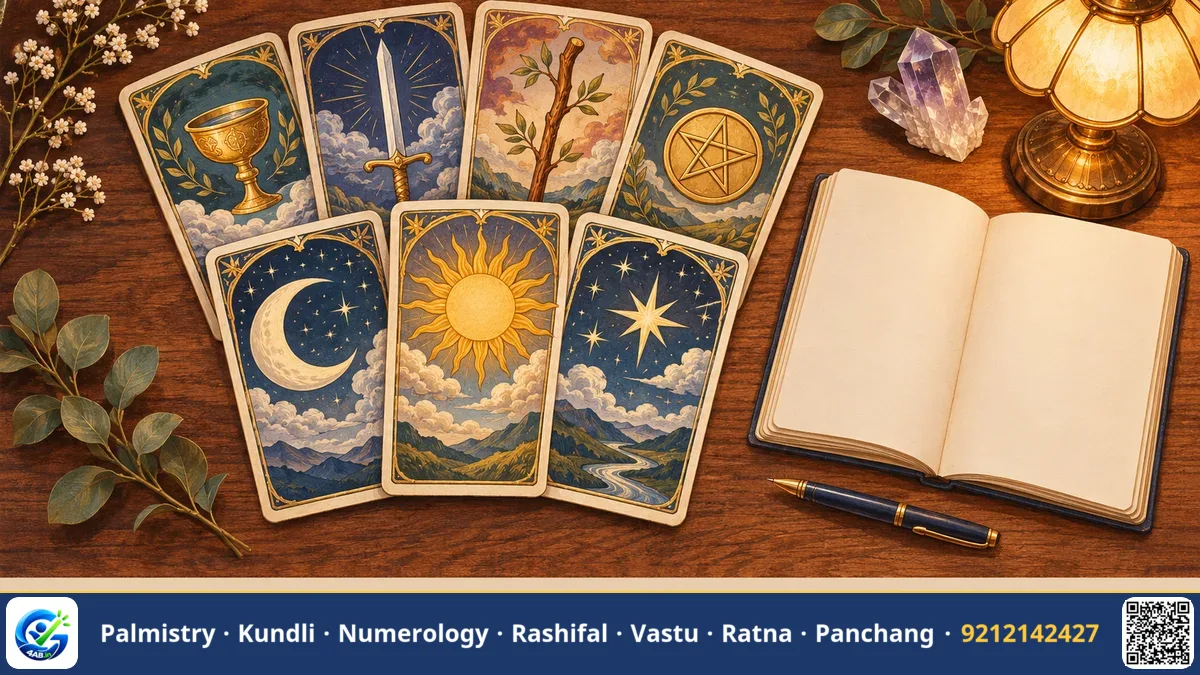
How a three-card tarot spread works
This post shows you how a three-card tarot spread is laid out and how to read each position.
You will also learn how to frame a question and how to keep the reading useful.
What a spread is and why three cards
A spread is a fixed layout for the cards you draw. Each place in the layout has a meaning given before you turn the card over. This is what stops a reading from becoming random guessing.
A traditional tarot deck has 78 cards. Twenty-two are the Major Arcana, which carry the big themes. The other 56 are the Minor Arcana, in four suits: Wands, Cups, Swords and Pentacles. Arcana means "secrets" or "hidden things". Here it is simply the name for the two groups of cards.
Three cards are a good start because the layout is small. You can hold three images in your mind at once. You can also see how one card leads to the next. A single card gives you one idea. A large layout such as the Celtic Cross has many positions, and a beginner can easily get lost in it.
Tarot is a symbolic and reflective practice. There is no scientific evidence that cards predict events. Treat the spread as a way to organise your own thinking.
As a teacher, I ask students to set up the page before they begin writing. A spread works the same way. You decide the structure first, and then the content fills it.
The classic positions: past, present, direction
The most common three-card layout is past, present and future. Here is how each position is read.
- First card: what led to the situation. Ask what has already shaped this.
- Second card: where things stand now. Ask what is actually in front of you today.
- Third card: the direction the situation is moving. Ask where this is heading if nothing changes.
Notice the wording of the third card. It is a direction, not a fixed result. Think of a road sign, not a destination you must reach. You can change course after reading it.
| Position | Question to ask | How to treat it |
|---|---|---|
| Card 1 | What led here? | Look back honestly, without blame |
| Card 2 | Where do things stand? | Describe the situation as it is |
| Card 3 | Which way is it moving? | Treat it as a direction to examine |
Read the three together. The second card is understood in light of the first, and the third in light of the second. Most of the insight in a spread comes from this link between cards, not from any one card alone.
Other ways to use three cards
Past, present and future is not the only layout. A three-card situation reading is also explained among the common spreads. Here the positions are named for the situation itself, not for time. For example, you may name them the situation, the obstacle and the advice.
Choose the layout before you shuffle. Do not change the meaning of the positions after you see the cards. If you do, you are fitting the cards to what you already wanted to hear.
Pick the layout that matches your question:
- Use past, present and direction when you want to understand how a situation developed.
- Use a situation reading when you feel stuck and want to look at the problem from three sides.
Whichever you pick, write the position names on paper before you draw. This small step keeps you honest.
How to frame your question first
A reading usually begins with a question. The process of tarot reading typically starts with forming a question, and then drawing and interpreting cards. The question decides how useful the reading feels. A weak question gives a vague reading.
Follow these steps:
- Write your question in one line before you draw.
- Make it open. Start with words like "what" or "how" instead of "will".
- Avoid yes or no questions for your first spread. They leave little to reflect on.
- Keep one question per spread. Mixing two questions makes the cards confusing.
A teacher asks a student to read an exam question twice before answering. The same habit works here. A clear question gives you a clear place to start thinking.
A worked example of reading three cards
Situation: A reader feels stuck in a daily routine and wants to understand why.
Suppose the three cards drawn are the Eight of Pentacles, the Four of Swords and the Ace of Wands. These are only an illustration. The meanings below are the commonly given ones, and different readers may see them differently.
- Card 1, Eight of Pentacles (what led here): traditionally linked with steady, repeated effort. It prompts you to look at how long you have worked on the same thing.
- Card 2, Four of Swords (where things stand): traditionally linked with rest and pause. It prompts you to ask whether you are tired and need a break more than a new plan.
- Card 3, Ace of Wands (direction): traditionally linked with a fresh spark or new beginning. It prompts you to think about one small new thing you could try after resting.
Read together, the story is long effort, then tiredness, then a possible fresh start. You do not say that this will happen. You say that the cards invite you to think about whether rest should come before a new start.
See how the three cards form one connected story. This is what the spread is designed to give you.
Reversed cards
A card can fall upside down. This is called a reversed card. Some readers use reversals and some do not. The tarot page has an option called "Include reversed cards", so you can choose.
If you are new, leave reversals out. Learn the upright meanings first. Once you are comfortable, add reversals. Many readers treat a reversed card as a blocked, softer or more inward version of the card. This is a common approach, not a fixed rule.
Common mistakes to avoid
- Reading one card alone. The three cards are meant to be read as a set.
- Redrawing until you like the answer. This defeats the purpose. If you want to try again, ask a new question.
- Treating the result as fact. It is a prompt for thought, nothing more.
- Using a reading for big decisions. Never use a reading to make a medical, legal or financial decision.
- Paying to remove a curse. Anyone charging to remove a curse or avert misfortune is following a known scam pattern, not a tradition.
Trying a spread on the page
On the tarot page you can choose the spread, decide whether to include reversed cards, and press Shuffle & Draw. The shuffle is genuinely random across a 78-card deck. You can use Draw again for a new draw. Write your question first, then draw, then reflect on what the cards ask you to think about.
Key takeaways
- A spread gives each card a fixed position and meaning before you draw.
- In the past, present and future layout, card one is what led here, card two is where things stand, and card three is the direction of movement.
- Write an open question first and keep to one question per spread.
- Read the three cards as one connected story, framed as prompts and not as predictions.
- Never use a reading for medical, legal or financial decisions.
Frequently asked questions
How many cards are in a tarot deck?
A traditional deck has 78 cards. Twenty-two are Major Arcana and 56 are Minor Arcana, divided into four suits: Wands, Cups, Swords and Pentacles.
Does the third card tell me what will happen?
No. It is read as the direction things are moving. There is no scientific evidence that cards predict events, so use it as a question to think about.
Should beginners use reversed cards?
You can start without them. Learn the upright meanings first, then add reversals when you feel ready.
Can I draw again if I dislike the cards?
Redrawing on the same question to get a better answer defeats the practice. If you draw again, ask a new question or a different part of the same one.
Can a spread help me decide on money, health or legal matters?
No. Tarot is a reflective practice. Never use a reading to make a medical, legal or financial decision.
What to do next. Try it yourself on the page below.
Tarot — Card Meanings, Spreads & a Genuinely Random Draw →