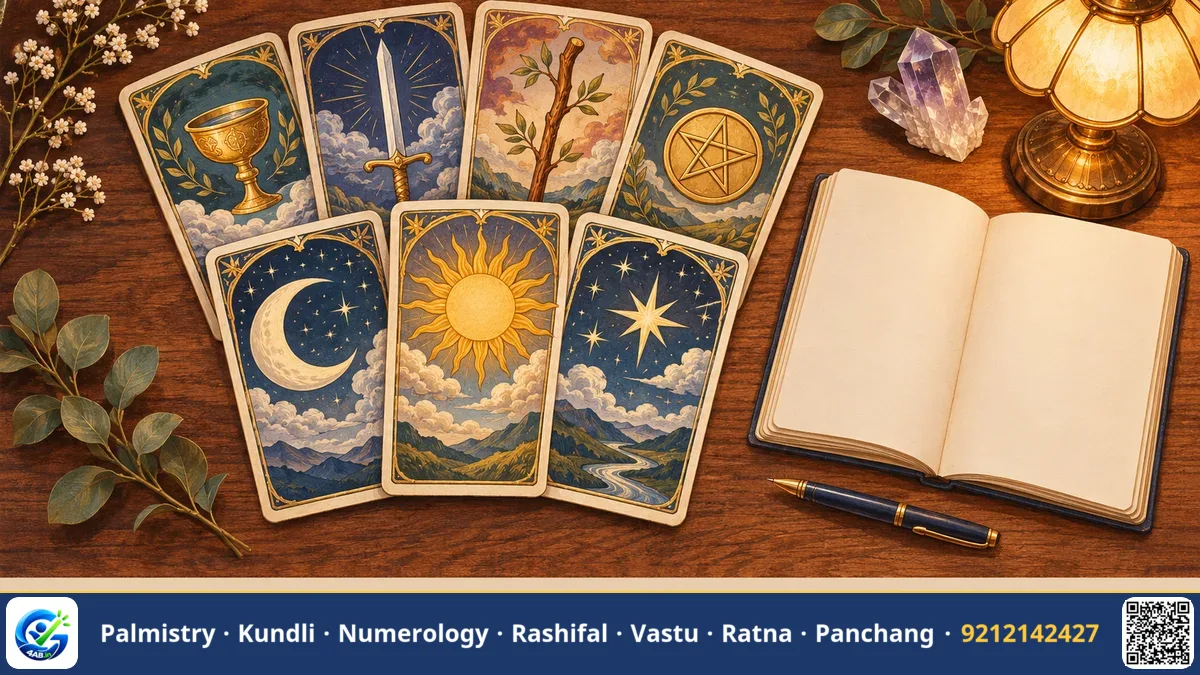
Journaling after a tarot reading: prompts that help
You have drawn your cards. Now what? This post shows you how to write about them in a notebook.
You will get a simple routine, ready prompts for one-card and three-card spreads, and a way to handle reversed cards.
Why writing helps after a reading
Tarot, as offered here, is a symbolic and reflective practice. It is not a way to know the future. There is no scientific evidence that cards predict events. So the value of a reading lies in what it makes you think about.
That thinking fades fast. You close the cards, pick up your phone, and the thought is gone. A notebook holds it still.
Writing also slows you down. When you must put a sentence on paper, you cannot stay vague. You have to decide what the card really made you notice.
Cards are prompts for thinking a situation through. Journaling is simply the step where you do that thinking in writing.
A simple routine to follow after every draw
Keep it short and the same each time. A routine you can repeat is better than a long one you skip.
- Write the date and your question. Use an open question about your own studies, work or habits. Avoid yes/no questions about fate. Tarot readings usually begin with a question, so it helps to write it down first.
- Note the spread and the cards. Write the spread name, each card, and whether it came up upright or reversed.
- Describe before you interpret. Write what you actually see on the card: colours, figures, objects, mood. This keeps you honest.
- Write the traditional meaning. Read the card's explanation and note it in one line. Mark it clearly as the card's meaning, not your own view.
- Write your own response. Say how the card connects to your life right now. If it seems to have no link, write that. It is still a useful note.
- End with one small action. Choose something you can do in the next few days.
Step three matters most for beginners. If you jump straight to the printed meaning, you only copy. If you describe first, you start reading the image yourself.
Prompts for a single card
A single-card draw is the easiest place to begin. It gives you one image and one idea to sit with. Use two or three of these prompts, not all of them.
- What is the first thing I notice in this card, and why?
- Which feeling comes up when I look at it? Where have I felt it before this week?
- If this card were a question, what is it asking me?
- What would I do differently today if I took this card seriously?
- What in this card do I disagree with?
The last prompt is useful. Disagreement shows you what you already believe. Write it down without arguing with yourself.
Prompts for a three-card spread
A spread is a fixed layout where each position has a role. In a three-card past–present–future spread, the first card is read as what led to the situation. The second is read as where things stand. The third is read as the direction things are moving.
The word "direction" does not mean a fixed outcome. Read the third card as a possible path to think about, not a promise. Then use a different prompt for each position.
| Position | How it is read | Journaling prompt |
|---|---|---|
| First card | What led to the situation | What events or habits brought me here? What part did I play? |
| Second card | Where things stand | What is true right now, without excuses? What am I avoiding? |
| Third card | The direction things are moving | If I continue as I am, what might follow? What could I change? |
| All three together | One connected story | What single theme runs through all three cards? |
Worked example. Suppose a student writes a question about how to plan revision this month. The cards come up in this order: first card, a figure carrying a heavy load; second card, a person standing at a crossroad; third card, a plain open path.
The student might write three short lines. For card one: too many subjects are being carried at once, with no plan. For card two: it is hard to choose which chapter to begin. For card three: the path looks clear when only one thing is picked. The theme could be too many choices, not too little time.
The action line could be a single step: list the chapters tonight and pick the first one for tomorrow. Nothing here claims a result. The cards simply helped the student name a problem and take a small step.
Handling reversed and uncomfortable cards
A reversed card is a card that appears upside down in the draw. On the Tarot page, the option "Include reversed cards" lets you add these to a draw. Many readers use them. Others skip them. Either choice is fine, but keep it the same within one journal so your notes stay comparable.
If you read reversed cards, do not treat them as bad news. A common way to read them is as the same theme turned inward, blocked, or delayed. Write both: the upright idea, and how it might be held back in your life.
Some cards will feel heavy. The page itself says to read cards as questions to sit with, not as statements about what will happen. When a card feels heavy, use these prompts:
- What is the fear behind my reaction to this card?
- Is this card describing me, or someone else in my life?
- What would I say to a friend who drew this card?
Please remember that a reading must never be the basis for a medical, legal or financial decision. If a card stirs up worry about health, money or a legal matter, write the worry down, then speak to a qualified person. Also be careful of anyone who charges money to remove a curse or avert misfortune. That is a known scam pattern, not a tradition.
Review your journal after a few weeks
A single entry is only a note. A set of entries becomes something you can learn from. Set a day each month to read back through your pages.
Use these questions during your review:
- Which cards or themes appeared more than once?
- Which of my action lines did I actually do?
- Where did I read a card one way, and later see it differently?
- What did I worry about that did not matter much?
The "Draw again" button on the page deals a fresh draw. Treat each new draw as a new entry. Do not keep drawing until you get a card you like. If you do that, you are looking for comfort, not reflection. Write about the first draw, even when it is hard.
You can also notice how often you ask the same question. Repeated questions usually point to something unresolved in real life. That is a task for conversation, planning or rest, not for more cards.
Key takeaways
- Tarot here is a reflective practice, not a prediction. Journaling is where the reflection happens.
- Describe the image first, then the traditional meaning, then your own response.
- Use a different prompt for each position in a spread, such as past, present and future.
- Read reversed and heavy cards as questions to sit with, not as bad news.
- End each entry with one small action, and review your notes after some weeks.
Frequently asked questions
How long should a journal entry be?
Short is fine. A few lines for each card is enough. What matters is that you write the same way each time, so you can compare entries later.
Do I need a full 78-card deck to journal?
A traditional deck has 78 cards: 22 Major Arcana and 56 Minor Arcana in four suits, namely Wands, Cups, Swords and Pentacles. You can also use the draw tool on the Tarot page, where the shuffle is genuinely random, and then write in your own notebook.
Can journaling tell me what will happen?
No. There is no scientific evidence that cards predict events. Journaling helps you understand your own thinking and choose a next step. It does not guarantee any result.
What if I do not know the card's meaning?
Start with what you see on the card and how it makes you feel. Then read the card's explanation and write it as a separate line. Over time you will remember more of the meanings.
Should I write the same question every time?
Not necessarily. But noting your question each time helps you spot patterns. If the same question keeps coming back, that is worth discussing with someone you trust.
What to do next. Try it yourself on the page below.
Tarot — Card Meanings, Spreads & a Genuinely Random Draw →