Vastu for bathroom and toilet: right location and fixes
This guide explains how to identify the correct orientation for your bathroom and toilet using traditional Vastu Shastra principles.
You will learn recommended directional zones, understand why certain areas are avoided, and discover practical non-structural remedies for existing spaces.
Understanding bathroom and toilet zoning in Vastu Shastra
Vastu Shastra is the traditional Indian philosophy of orienting a home or workplace to light, air and direction. In classical planning, bathing and waste elimination are treated as two distinct functions. A bathing space involves clean water and morning renewal. In contrast, a toilet commode involves waste elimination and drainage. Historically, latrines were built as detached outhouses to prevent moisture and foul air from entering living quarters.
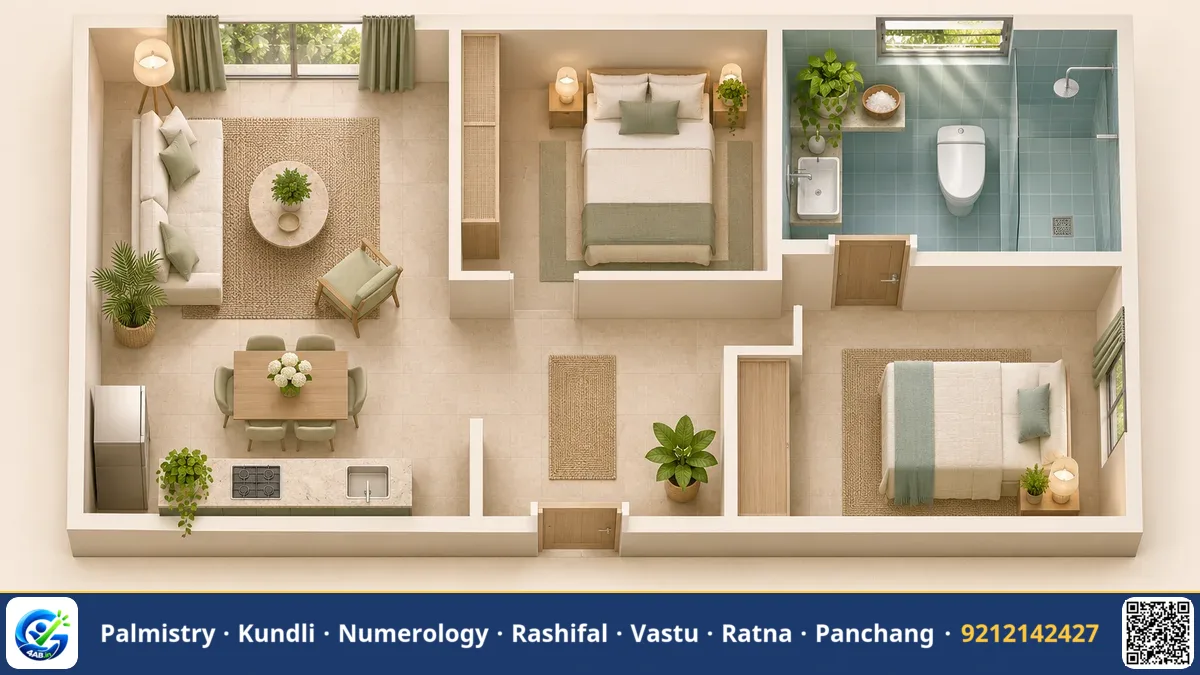
Modern homes combine showers and commodes inside an attached enclosure. When assessing a floor plan through the Vastu Purusha Mandala—the traditional grid representing spatial balance—homeowners must balance water intake and waste disposal within that shared boundary. Vastu Shastra provides a traditional cultural design philosophy for personal guidance, not modern architecture or civil engineering.
Recommended directions for toilets and bathing spaces
When mapping your floor plan against cardinal directions, evaluate the bathing area and the commode as separate functions.
For bathing areas, eastern and northern sectors are traditionally favoured. The east receives gentle morning sunlight, providing natural warmth that dries wet tiles quickly. The north links with water flow and mental clarity, making it suitable for washbasins, showers, and tubs.
For toilets, traditional guidelines recommend the west or north-west sectors. The north-west relates to the air element (Vayu) and continuous movement, which tradition connects with swift disposal. The west sector provides a stable placement that keeps waste drainage away from morning light pathways. Inside the room, align the commode along a north-south axis so that a person faces north or south while seated.
| Directional sector | Traditional element | Toilet commode suitability | Bathing area suitability |
|---|---|---|---|
| North-East (Ishaan) | Water, morning light | Unfavourable; avoided | Favourable for clean bathing |
| East | Solar energy, air flow | Unfavourable; drains vitality | Recommended; catches morning sun |
| South-East (Agni) | Fire element, warmth | Unfavourable; clashes with water | Neutral; requires good ventilation |
| South | Rest, grounding | Acceptable in southern sector | Neutral; drain toward north |
| South-West (Nairutya) | Earth element, stability | Unfavourable; drains stability | Unfavourable; keep quadrant dry |
| West | Water collection | Favourable for waste drainage | Acceptable for showers |
| North-West | Air element, movement | Recommended; aids elimination | Acceptable; ensure rapid drying |
| Centre (Brahmasthan) | Core balance, space | Strictly avoided; blocks core | Strictly avoided; must stay open |
Sensitive zones to keep clear of waste pipes
Certain zones of a house perform spatial roles that conflict directly with waste drainage.
The primary restricted area is the north-east corner, traditionally known as the Ishaan sector (22.5° to 67.5°). Named after the deity Ishana, tradition keeps this corner light, open, and clean for worship and morning meditation. Installing a commode here introduces sewage into the primary path of morning sunlight. It is traditionally held (माना जाता है) that locating a toilet in the north-east causes mental heaviness and restlessness.
The second prohibited zone is the Brahmasthan, the exact geometric centre of the home. Traditional planning leaves this central zone open to allow light and air to circulate freely. Constructing an enclosed bathroom or running heavy drainage pipes through the centre traps moisture and foul air in the core of the dwelling.
The third zone to avoid for toilets is the south-west quadrant (Nairutya). Representing the earth element, this corner requires weight and stability. Sinking drainage cavities here is traditionally held to undermine household stability.
Worked example: checking your layout with a compass
Step 1: Check your entrance bearing. Stand at your main door facing outward and note the direction using a phone compass or the Direction & Placement Finder tool (0–360 degrees). Suppose your entrance faces 50°. This lies in the north-east sector (22.5° to 67.5°), the Ishaan corner.
Step 2: Enter room locations. In the Room by Room tool, enter your spaces. Suppose an attached bathroom and toilet sits in the north-east corner of your apartment.
Step 3: Interpret the summary result. The tool marks this placement as "Differs". Remember that "Differs" simply means tradition usually prefers another direction; it is not an irreparable defect, and most modern apartments differ somewhere due to shared plumbing shafts.
Step 4: Apply non-structural remedies. Rather than breaking walls, implement low-cost non-structural adjustments to manage humidity and airflow.
Practical non-structural fixes for existing bathrooms
In built homes, moving structural walls is neither practical nor recommended. Any structural change belongs strictly with a licensed architect or structural engineer. Traditional Vastu suggests low-cost, non-structural adjustments: light, colour, placement, and keeping a zone clear.
- Keep doors closed: An open door allows dampness and odours to travel into living spaces. Keep the door shut. A solid wooden door is traditionally preferred over glass or metal.
- Use natural salt bowls: Place a small ceramic bowl of unrefined rock salt on a high shelf away from water spray. Salt absorbs ambient humidity and is traditionally held to neutralise stale energy. Replace the salt weekly.
- Select balanced wall colours: Avoid painting bathroom walls in deep red, black, or dark brown. Choose light, neutral shades such as off-white, cream, or light beige to reflect ambient light.
- Position mirrors thoughtfully: Mount mirrors on northern or eastern walls to reflect light. Avoid hanging a mirror directly opposite the commode seat.
- Maintain strong ventilation: Run an exhaust fan after every shower to remove dampness promptly and keep the floor dry.
Key takeaways
- The west and north-west sectors are traditionally preferred for toilets, while the east and north suit dedicated bathing areas.
- The north-east corner (Ishaan, 22.5° to 67.5°) and the central Brahmasthan must remain free of commodes and sewage lines.
- A floor plan result marked "Differs" reflects a variation from traditional preference, not a structural defect.
- Never undertake structural demolition for Vastu alignment; rely on low-cost non-structural corrections like salt bowls, neutral colours, and closed doors.
- Always consult a licensed architect or structural engineer before altering any walls or plumbing systems.
Frequently asked questions
Can a bathroom and toilet be combined in one room under Vastu Shastra?
Traditional Vastu Shastra preferred separating bathing from waste disposal for hygiene. In modern homes with combined bathrooms, tradition suggests zoning the interior: place the shower or tub in the north or east, and install the commode in the west or north-west.
What is the recommended remedy if my toilet sits in the north-east?
Do not attempt structural demolition. Apply non-structural remedies: keep the door closed, place a ceramic bowl of rock salt on a dry shelf, paint walls off-white, and use an exhaust fan to keep the room dry.
Which direction should you face while using the commode?
Classical guidelines recommend aligning the commode along a north-south axis so that a person faces north or south while seated, avoiding facing the eastern sunrise during elimination.
Does an unaligned bathroom guarantee negative life outcomes?
No. Vastu Shastra is a traditional cultural practice and design philosophy, not a predictive system. It makes no guarantees regarding health, wealth, or specific life outcomes. A layout that differs from traditional ideals simply calls for regular cleaning, good ventilation, and sensible non-structural adjustments.
What to do next. Try it yourself on the page below.
Vastu Shastra — Directions, Rooms & Remedies →