North Indian vs South Indian kundli: how to read both charts
A kundli can be drawn in two common styles, and beginners often think they are two different charts. They are not.
In this post you will learn what stays fixed in each layout, how to find the first house, and how to read one chart both ways.
One birth chart, two ways of drawing it
A kundli (also called Janam Kundli or birth chart) is a map of the sky at the moment and place of your birth. It shows twelve signs, called rashis, and twelve houses, called bhavas. It also shows where each planet stood.
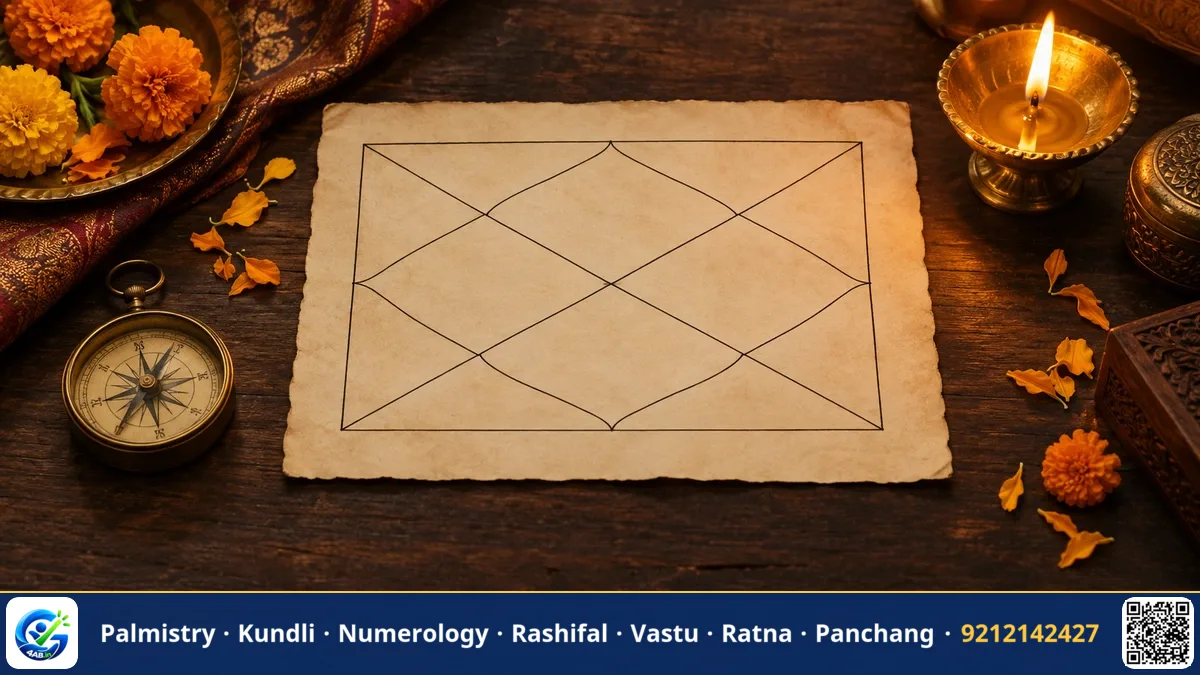
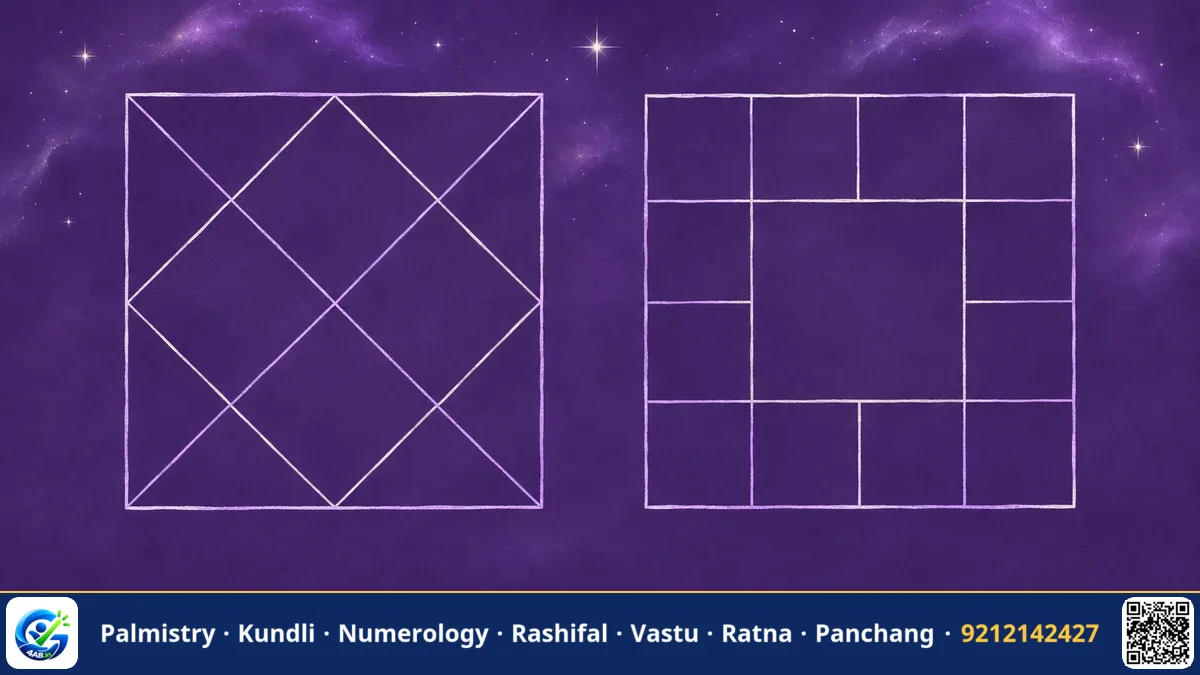
Once the calculation is done, the result has to be drawn on paper. Two drawing styles are in common use in India. The North Indian style is a square split into triangles and diamonds. The South Indian style is a square split into a grid of boxes.
The calculation does not change. Only the drawing changes. If you learn what is fixed in each style, you can read any chart you meet.
Before you start, know two terms. The lagna (ascendant) is the sign that was rising on the eastern horizon at birth. It becomes the first house. The free Janam Kundli on this website uses the sidereal (Lahiri) zodiac and whole-sign houses. In whole-sign houses, the entire lagna sign is the first house, the next sign is the second house, and so on.
In this post, signs are counted by number, from 1 to 12, in the order of the zodiac. Sign 1 is the first sign of the zodiac and sign 12 is the last. Numbers keep the layout easy to follow.
How the North Indian diamond chart is laid out
In the North Indian chart, the houses are fixed. House 1 is always the diamond at the top centre. You never have to hunt for it.
The houses then run anticlockwise (against the direction of clock hands) around the chart. Here is how to remember the shape:
- The four diamonds are houses 1, 4, 7 and 10. These are the top, left, bottom and right centres.
- The eight triangles are the remaining houses: 2, 3, 5, 6, 8, 9, 11 and 12.
- House 2 is the triangle just left of the top diamond. Count anticlockwise from there.
What changes from chart to chart is the sign number written in each house. The number in the top diamond is your lagna sign. The numbers then go up by one in each house as you move anticlockwise, and after 12 they return to 1.
Planets are written inside the house they occupy. So to find a planet's house, you only see which space it sits in.
Houses 1, 4, 7 and 10 are called kendras (angles). They are traditionally held to be the main pillars of a chart. In the North Indian style these are the four diamonds, so they stand out at a glance. This is one reason many readers like this layout for judging house strength.
How the South Indian box chart is laid out
In the South Indian chart, the signs are fixed. Each sign always sits in the same box. The houses are what you must find.
The chart is a square of 4 × 4 boxes with the middle left empty. That leaves twelve boxes around the edge, one for each sign. The signs run clockwise (in the direction of clock hands). Here are the sign numbers, box by box:
- Top row, left to right: signs 12, 1, 2, 3.
- Right side, going down: signs 4, 5.
- Bottom row, right to left: signs 6, 7, 8, 9.
- Left side, going up: signs 10, 11.
Since the signs never move, you can learn this pattern once and use it for every chart. Sign 1, the first sign of the zodiac, is always the second box in the top row.
The lagna is shown by a mark in one box, often a short diagonal line. That box is your first house. Count clockwise from it to find house 2, house 3 and so on. Because the lagna box is different for each person, always look for the mark first.
The same chart in both styles: a worked example
Take a person whose lagna is sign 3. Here is how the key houses look in each style.
Lagna in sign 3, whole-sign houses
- House 1 is sign 3, house 2 is sign 4, house 3 is sign 5, house 4 is sign 6, house 7 is sign 9 and house 10 is sign 12.
- North Indian: the top diamond carries the number 3. The next house, anticlockwise, carries 4, then 5, and so on. The diamond on the left (house 4) carries 6.
- South Indian: the box for sign 3 (top right corner) carries the lagna mark. Counting clockwise, sign 4 is house 2, sign 5 is house 3, and sign 6 (bottom right corner) is house 4.
Now say Jupiter stands in sign 9. That is house 7 in both charts. In the North Indian chart you find it in the bottom diamond. In the South Indian chart you find it in the bottom-left box.
Notice that the answer is the same. Only the route to the answer is different.
Side-by-side comparison
| Point | North Indian | South Indian |
|---|---|---|
| Shape | Square with diamonds and triangles | Square grid of boxes |
| What is fixed | Houses | Signs |
| What moves | Sign numbers (the lagna sign sets them) | House positions (counted from the lagna mark) |
| Direction of counting | Anticlockwise | Clockwise |
| How to find house 1 | Always the top centre diamond | The box with the lagna mark |
| Easy to spot | The kendra houses (the four diamonds) | A planet's sign (the box never changes) |
A simple memory aid: North fixes the houses, South fixes the signs.
Reading both styles on the Janam Kundli page
The free Janam Kundli page shows your chart in North and South Indian styles. Follow these steps:
- Enter your date, exact time and place of birth. A PIN code is optional and only helps find the place.
- Press Generate Kundli.
- Open the Charts tab.
- Choose North Indian or South Indian to switch the layout.
- Look at the Rashi (D1) chart first. This is the main birth chart.
Flip between the two styles a few times. Pick one planet, say the Moon, and find it in both. Check that its sign and house match. This small exercise trains your eye faster than reading rules.
The page also lists other charts, such as Navamsa (D9), Dashamsa (D10), the Moon Chart and the Sun Chart. Start with D1 only. The other charts can be viewed in the same two styles, so what you learn here carries over.
Use the Planets and Houses tabs alongside the picture. Each comes with a plain explanation, so you can confirm your reading.
Common mistakes beginners make
- Counting in the wrong direction. North Indian is anticlockwise. South Indian is clockwise. Check this every time.
- Treating the number in a North Indian house as the house number. The houses are fixed. The number inside is the sign.
- Looking for sign 1 as house 1. House 1 is the lagna sign, whichever sign that is. Sign 1 is house 1 only when the lagna falls in sign 1.
- Skipping the lagna mark in the South Indian chart. Without it you cannot count houses.
- Reading meaning too early. First learn to locate signs, houses and planets. Interpretation comes after.
Remember that astrology is a traditional, belief-based system. A chart is a starting point for understanding and conversation, not a verdict, and it does not replace professional medical, legal or financial advice.
Key takeaways
- The two chart styles show the same data in two layouts.
- North Indian: houses are fixed, house 1 is the top diamond, counting is anticlockwise.
- South Indian: signs are fixed, sign 1 is the second box in the top row, counting is clockwise from the lagna mark.
- With whole-sign houses, the lagna sign is house 1 and each next sign is the next house.
- Practise by switching the chart style on your own kundli and tracing one planet in both.
Frequently asked questions
Is the North Indian chart different from the South Indian chart?
No. Both are drawings of the same birth chart. The planets, signs and houses are the same. Only the layout and the way you count differ.
Which chart style should a beginner learn first?
Either works. If you want fixed signs and a pattern you can memorise once, start with the South Indian style. If you want fixed houses and an easy view of the kendras, start with the North Indian style. Then learn the other, since you will meet both.
How do I find the first house in each style?
In the North Indian chart, it is always the top centre diamond. In the South Indian chart, it is the box that carries the lagna mark.
What data do I need to see my kundli in both styles?
You need your date of birth, exact time of birth and place of birth. The Janam Kundli page then shows your chart in North and South Indian styles.
Does the choice of style change what the chart is said to indicate?
No. The style is only a way of drawing. Any traditionally held meaning comes from the signs, houses and planets, which are the same in both.
What to do next. Try it yourself on the page below.
Free Kundli — Birth Chart, Dasha, Transits & Analysis →