Planetary aspects (drishti) in Vedic astrology explained

Understanding planetary aspects helps you see how planets interact across your birth chart. In this guide, you will learn how each planet casts its glance, how to count aspects house by house, and how to interpret these influences.
What planetary aspect means in Vedic astrology
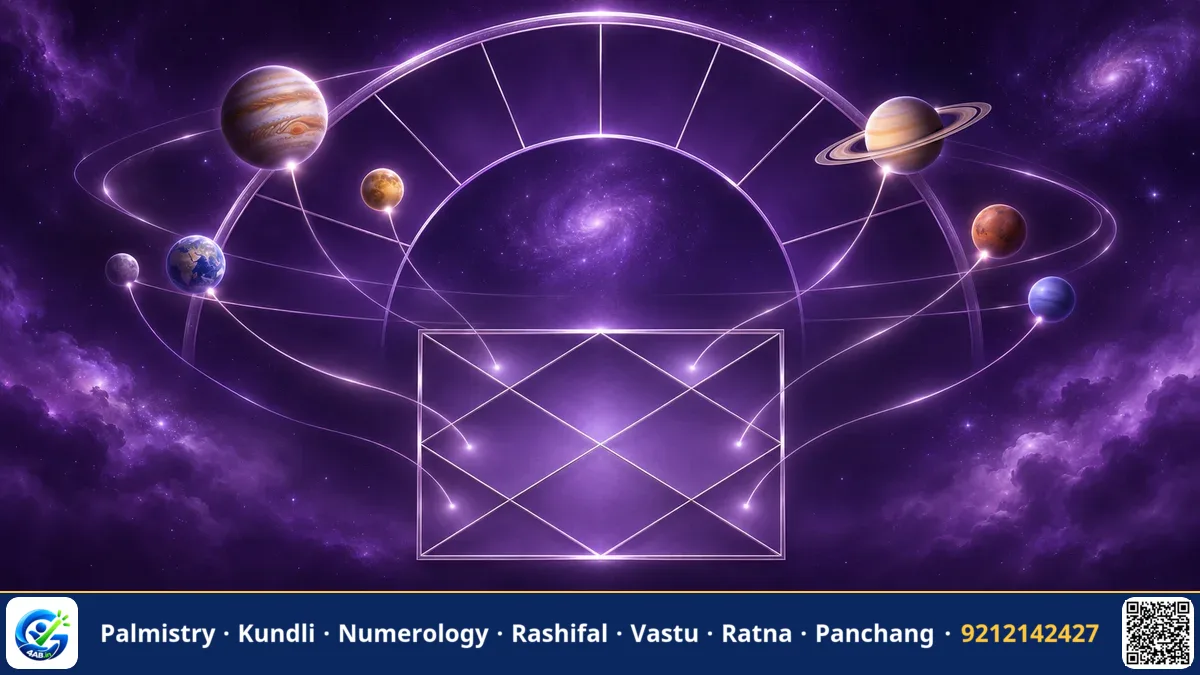
In Vedic astrology, known as Jyotisha, planetary positions do not tell the whole story on their own. While a planet occupies a specific house (bhava), it is traditionally held to project its energy across the birth chart. This planetary glance is called drishti in Sanskrit, which means sight or vision.
Astrological tradition holds that each celestial body radiates an energy field. Through drishti, a planet influences houses and other planets located several signs away from its placement. An empty house in your birth chart is therefore rarely inactive. If a planet casts its glance upon that house, it imparts its natural traits and house rulership themes to that area of life.
When two planets cast full aspects on each other, they form a mutual aspect. Classical tradition classifies this mutual glance as a primary form of planetary relationship, known as sambandha.
The core differences between Vedic and Western aspects
If you are familiar with Western astrology, you must set aside its aspect rules when reading a Vedic birth chart. Classical Indian astrology calculates aspects using three fundamental principles:
- Sign-to-sign calculation: Western astrology measures aspects degree to degree with specific orbs. Traditional Vedic astrology counts aspects from whole sign to whole sign. A planet in your first house aspects the entire seventh house, regardless of degrees.
- Asymmetrical influence: Western aspects are always mutual. In Vedic astrology, aspects can be one-sided. For example, Jupiter in the first house casts a full aspect on Mars in the ninth house, but Mars in that position casts only a partial aspect back on Jupiter.
- Nature over geometry: Western astrology classifies geometric angles as inherently harmonious or disharmonious. Vedic astrology evaluates an aspect based on the natural and functional qualities of the aspecting planet. Furthermore, an aspect of any planet on its own sign is traditionally held to strengthen that house.
| Feature | Vedic astrology | Western astrology |
|---|---|---|
| Calculation basis | Sign to sign (whole house) | Degree to degree with orbs |
| Reciprocity | Often one-sided or unequal | Always mutual and identical |
| Aspect nature | Based on planet qualities and rulership | Based on geometric angle |
| Aspect on own sign | Traditionally held to fortify the house | Not assessed by sign ownership |
General aspects and special planetary glances
In traditional Indian astrology, all seven classical planets cast aspects across different distances. While classical theory defines partial aspects—at one-fourth, one-half, and three-fourths strength—astrologers traditionally focus on full aspects because their influence is dominant.
The universal rule applies to all seven planets: the Sun, the Moon, Mars, Mercury, Jupiter, Venus, and Saturn cast a full aspect on the seventh house from their placement. This represents a direct glance across the chart (180 degrees).
In addition to this seventh-house aspect, three planets possess special full aspects, known as vishesh drishti:
- Mars: Casts full aspects on the 4th, 7th, and 8th houses from its placement. Mars is traditionally associated with courage, vitality, and focused drive.
- Jupiter: Casts full aspects on the 5th, 7th, and 9th houses from its placement. This trine glance is traditionally held to bring wisdom, expansion, and protection.
- Saturn: Casts full aspects on the 3rd, 7th, and 10th houses from its placement. Saturn is traditionally associated with discipline, patience, and structure.
The lunar nodes, Rahu and Ketu, are shadow points. While some traditions assign them trine aspects, traditional practice focuses mainly on their sign placement and conjunctions.
How to count drishti in your birth chart step by step
To evaluate planetary aspects in your chart, use this simple step-by-step method:
- Identify the starting house: Treat the house where the planet sits as house 1.
- Count forward sequentially: Count houses in zodiacal order around the chart.
- Check the seventh house: Count to house 7 to find the direct opposite house that every planet fully aspects.
- Apply special aspects: For Mars, check houses 4 and 8. For Jupiter, check houses 5 and 9. For Saturn, check houses 3 and 10.
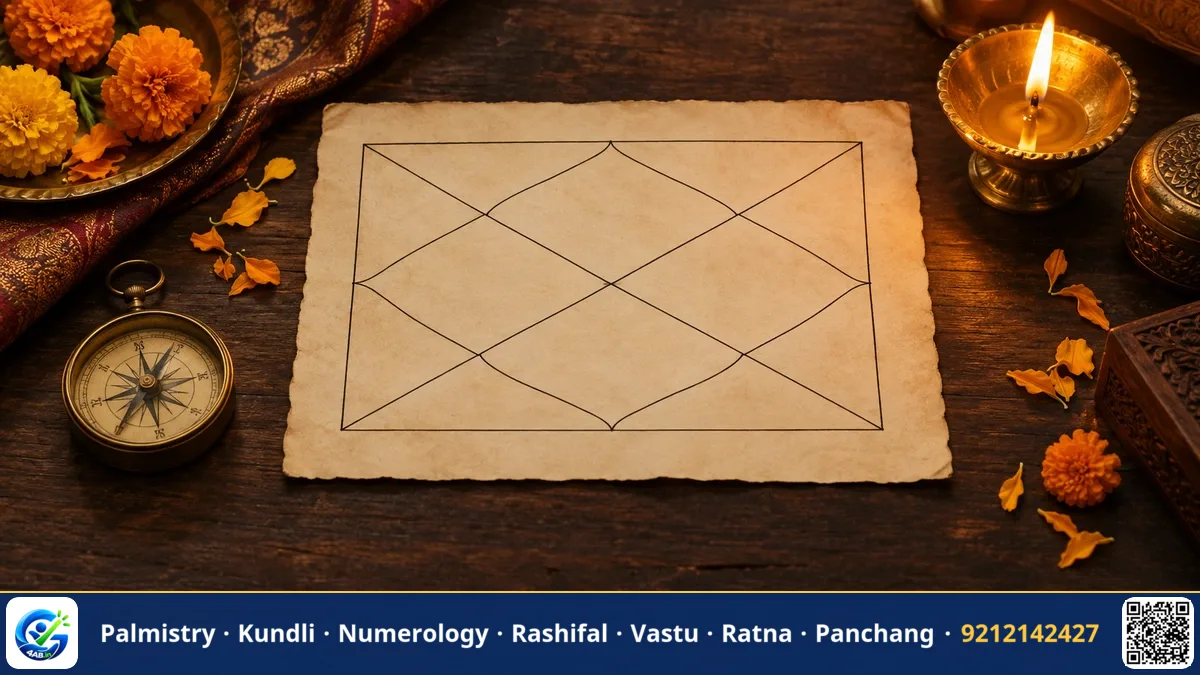
Suppose you generate your Janam Kundli using a sidereal Lahiri calculation. Jupiter sits in your 1st house (Ascendant), and Saturn sits in your 4th house.
- Jupiter's glance: Counting house 1 as 1, Jupiter casts full aspects on your 5th, 7th, and 9th houses. Tradition holds that these houses receive supportive influences.
- Saturn's glance: Counting house 4 as 1, Saturn's 3rd aspect reaches house 6 (4, 5, 6). Its 7th aspect reaches house 10. Its 10th aspect reaches house 1 (counting 10 houses forward lands on house 1).
- The interaction: Saturn looks directly at Jupiter in house 1 through its 10th aspect. But Jupiter does not aspect Saturn in house 4. This illustrates how aspects can be one-sided in Vedic astrology.
Interpreting benefic and malefic planetary aspects
Once you identify which houses receive aspects, examine the nature of the aspecting planet. Astrological tradition categorises planets into two main groups:
- Natural benefics: Jupiter, Venus, a waxing Moon, and an unafflicted Mercury are traditionally held to produce supportive, constructive influences. Their aspect on a house is believed to nourish its affairs.
- Natural malefics: The Sun, Mars, and Saturn are traditionally held to produce challenging, testing influences. Their aspect often requires effort, discipline, or caution.
However, functional rulership modifies these effects. When a natural malefic rules auspicious trine houses (the 5th or 9th), it can act as a beneficial ruler (yogakaraka), producing positive outcomes through disciplined work. Conversely, if a natural benefic rules difficult cadent houses (the 6th, 8th, or 12th), its positive influence is traditionally held to be tempered.
Finally, remember the rule of sign ownership: when any planet aspects its own sign, tradition holds that it strengthens and protects that house, regardless of its natural temperament.
Key takeaways
- Planetary aspect (drishti) describes how planets influence houses and other planets across the birth chart.
- Vedic astrology counts aspects from whole sign to whole sign, unlike Western degree-based methods.
- All planets fully aspect the 7th house, while Mars (4th and 8th), Jupiter (5th and 9th), and Saturn (3rd and 10th) have special full aspects.
- A planet casting an aspect onto its own sign is traditionally held to protect and fortify that house.
Frequently asked questions
Does an aspect from a malefic planet always cause harm?
No. In classical astrology, it is traditionally held that the outcome depends on house rulership. If a naturally challenging planet rules auspicious houses or aspects its own sign, tradition holds that it can bring stability, resilience, and protection rather than disruption.
Do Rahu and Ketu have aspects in Vedic astrology?
Tradition varies on the lunar nodes because they are mathematical points rather than physical bodies. Many astrologers assign full aspects on the 5th, 7th, and 9th houses from Rahu, while others interpret Rahu and Ketu primarily through their house placement and conjunctions.
What is a mutual aspect between two planets?
A mutual aspect occurs when two planets sit in positions where they directly aspect each other, such as two planets placed seven houses apart. Classical texts consider this mutual glance to be a major form of planetary relationship (sambandha) that blends their energies.
How do I check planetary aspects in my Janam Kundli?
Generate your birth chart using a sidereal engine with the Lahiri ayanamsa. Note the house placement of each planet, and count forward house by house using the standard seventh aspect and the special rules for Mars, Jupiter, and Saturn.
What to do next. Try it yourself on the page below.
Free Kundli — Birth Chart, Dasha, Transits & Analysis →