Eschenmoser fragmentation: cleavage of epoxyketones
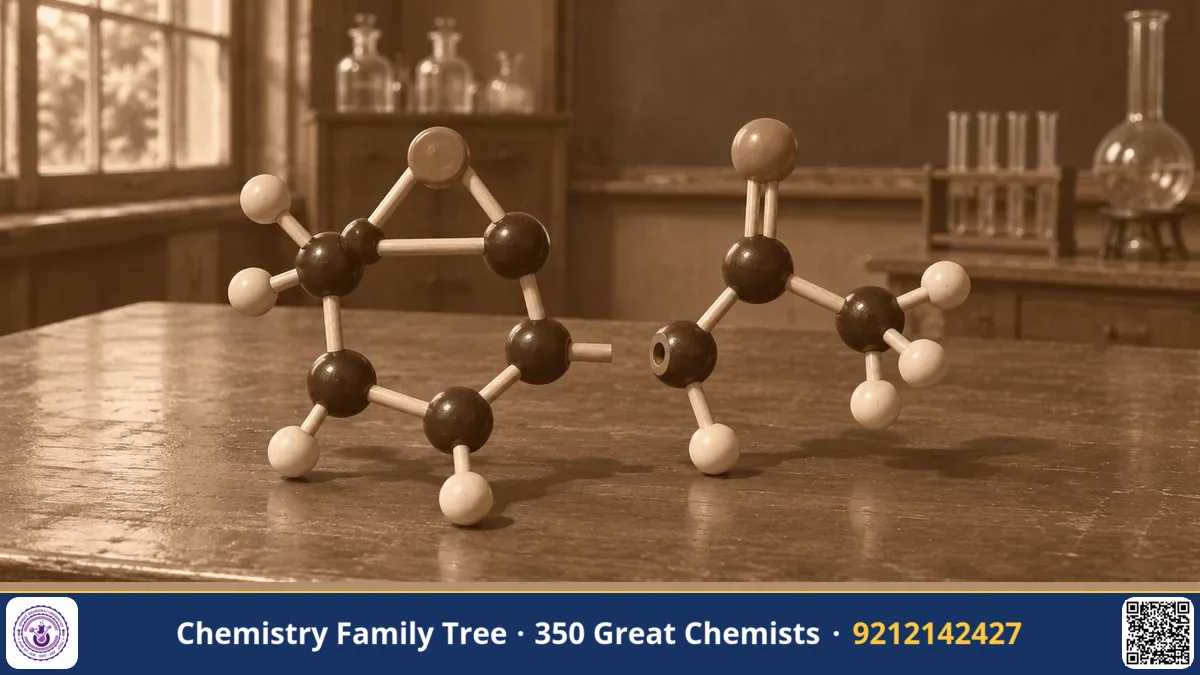
This post shows you how an α,β-epoxyketone breaks into an alkyne and a carbonyl compound.
You will also see why the shape of the molecule decides the result, and how the idea passed from teacher to student.
What the reaction does
An α,β-epoxyketone is a ketone with an epoxide (a three-membered ring with oxygen) on the two carbons next to the C=O. Write the carbons as C(=O), then Cα, then Cβ. The epoxide sits across Cα and Cβ.
You add an aryl sulfonylhydrazine. A common one is p-toluenesulfonylhydrazide. The reaction was first published in 1967. The products are an alkyne and a carbonyl compound.
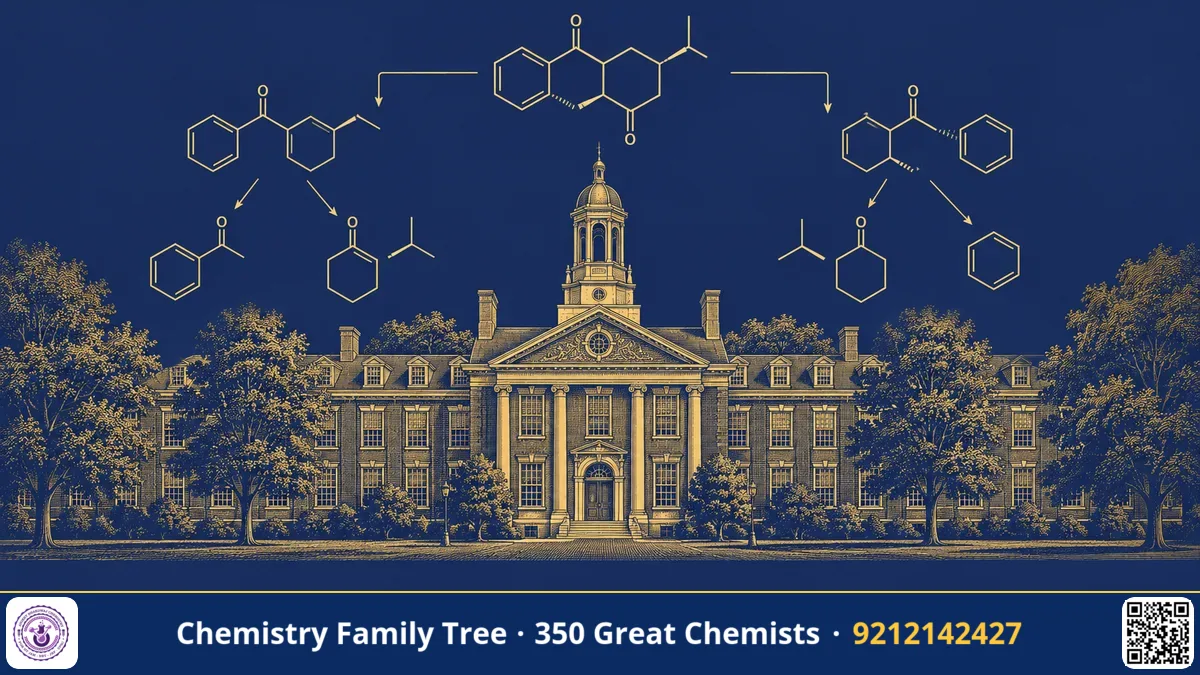
Look at what happens to the carbon chain. The bond between Cα and Cβ is cut. The old ketone carbon and Cα end up joined by a triple bond. Cβ becomes the carbonyl carbon of the second product.
In a ring, this is very useful. Cutting the ring bond opens the ring into a long chain. That chain has a triple bond at one end and a carbonyl group at the other.
The mechanism, step by step
Follow these steps in your notebook. Draw each intermediate before you move on.
- Condensation. The sulfonylhydrazine reacts with the ketone and water is lost. You get a hydrazone, which has C=N–NH–SO2Ar.
- Triggering. The hydrazone can be protonated at the epoxide oxygen. It can also be deprotonated at the sulfonamide nitrogen. So the reaction can be catalysed by acids or by bases. A common choice is acetic acid in dichloromethane.
- Proton transfer. This gives an intermediate in which the epoxide has started to open.
- Fragmentation. The key step splits the molecule into the alkyne and the carbonyl compound. Nitrogen is lost along the way.
The driving force is the formation of molecular nitrogen. N2 is very stable and escapes as a gas. That makes the last step effectively one-way. In the usual textbook picture, the arylsulfinate group leaves in the same sequence. Check your own class notes for the exact electron-pushing arrows your syllabus uses.
The stereoelectronic idea
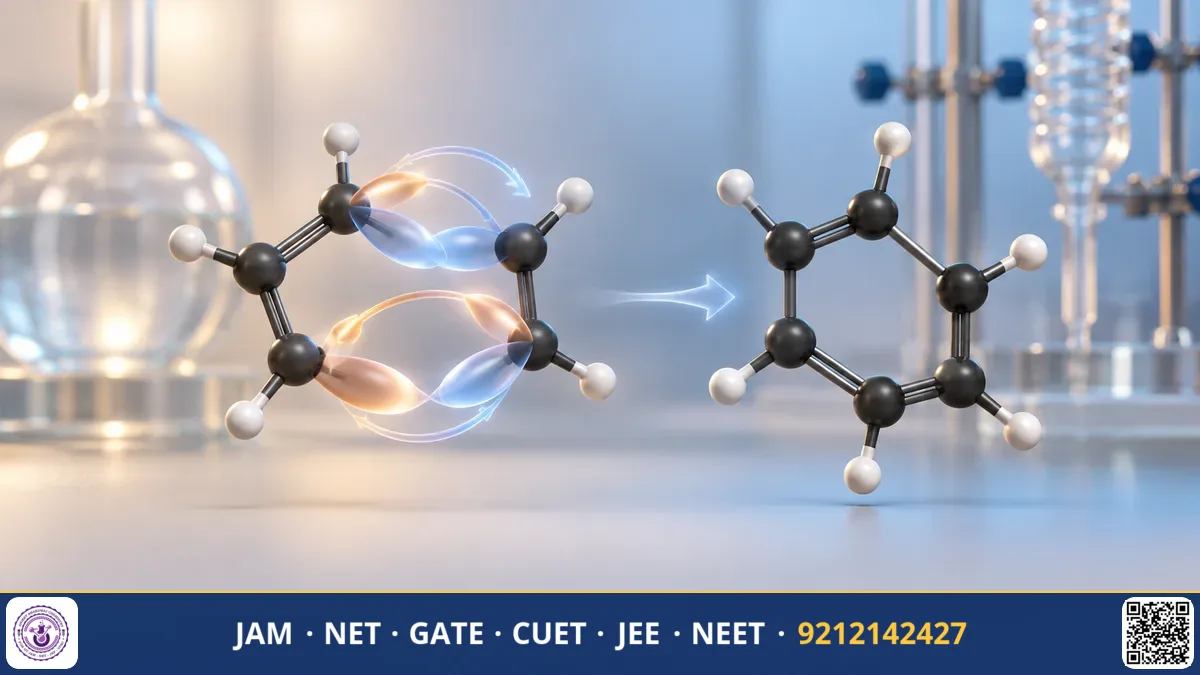
Stereoelectronic means that the 3D arrangement of orbitals decides whether a reaction can happen. A bond can only help push out a leaving group if its orbital overlaps well with the orbital of the leaving group.
The best overlap comes when the breaking sigma bond lies anti to the leaving group. That means they point in opposite directions, like two sides of a straight line. You may know the same rule from the E2 elimination, where the H and the leaving group must be anti.
The Eschenmoser fragmentation is a close cousin of the Grob fragmentation. In Grob fragmentation, a neutral chain breaks into three pieces: a positive fragment, a neutral unsaturated fragment, and a negative fragment. In cyclic substrates, the bond that drives out the leaving group prefers to be anti to it.
So when you analyse a ring example, do this:
- Draw the ring in its chair or half-chair shape.
- Mark the bond that will break and the group that will leave.
- Ask whether the two can sit anti. If they cannot, the fragmentation will be slow or it will take another path.
Treat this as a way of reasoning, not as a promise for every substrate. Real molecules may need the other conditions or variants described below.
Eschenmoser, Ohloff and Tanabe
The reaction has more than one name. This tells you something about how science works.
Albert Eschenmoser devised it in collaboration with an industrial research group led by Günther Ohloff. They applied it to make muscone and related macrocyclic musks. A macrocycle is a very large ring. Muscone is a ring ketone, so opening and re-forming large rings is exactly the problem they wanted to solve.
In the same year, Masato Tanabe independently published an article on the reaction. For this reason you will see three names in books and papers: Eschenmoser–Ohloff, Eschenmoser–Tanabe, or just Eschenmoser fragmentation. Two groups reached the idea at about the same time. Both names are fair, and the debate about naming is a good reminder that credit in chemistry is often shared.
Naming disputes also appear in related work. In the Grob fragmentation, Eschenmoser had studied base-catalysed fragmentation of certain β-hydroxy ketones in 1952. Grob's own work came in 1955. The name Grob fragmentation was chosen with little regard for these earlier contributions, according to later reviewers. So the story of this reaction family is partly a story of who is remembered.
The teacher-student thread
Eschenmoser began as a graduate student in the laboratory of Leopold Ružička at ETH in Zurich. Ružička was awarded the Nobel Prize in Chemistry in 1939 for work on androsterone and testosterone. Eschenmoser's early work on cyclisation of unsaturated, conjugated hydrocarbons helped terpene chemistry and gave insight into steroid biosynthesis.
Later he became Professor of General Organic Chemistry at ETH. In the early 1960s he began work on vitamin B12 in collaboration with Robert Burns Woodward at Harvard. A team of almost one hundred students and postdoctoral workers worked on it for many years. Both the Harvard/ETH and the ETH routes were completed in 1972.
See the pattern. A training in terpenes and ring chemistry led to a sharp sense of how rings can be built and also cut. The fragmentation fits that habit of thought. You can trace such links on the Chemistry Family Tree, which has a "Find a chemist" box where you can type a name such as Liebig and see teachers and students.
Comparing the two fragmentations
| Point | Eschenmoser fragmentation | Grob fragmentation |
|---|---|---|
| Starting material | α,β-Epoxyketone plus aryl sulfonylhydrazine | Neutral aliphatic chain with an electrofuge and a nucleofuge |
| Products | Alkyne and carbonyl compound | Three fragments: positive ion, neutral unsaturated piece, negative ion |
| Driving force | Loss of stable N2 | Stability of the cation and a good leaving group |
| Geometry rule | Anti alignment, as in the Grob case | Breaking sigma bond anti to the leaving group in cyclic substrates |
A variant for hindered substrates
The classical route can give low yields when the substrate is crowded around the reacting centre. A radical variant avoids making the epoxide. It uses 1,3-dibromo-5,5-dimethylhydantoin in sec-butanol with the matching p-tolylhydrazone. It has been used to prepare exaltone (cyclopentadecanone) and muscone.
It is called the Fehr–Ohloff–Büchi variant. The point for you is simple: if one step causes trouble, chemists redesign the route and skip it.
Key takeaways
- An α,β-epoxyketone plus an aryl sulfonylhydrazine gives an alkyne and a carbonyl compound.
- The hydrazone forms first, then acid or base triggers the fragmentation.
- Release of N2 is the driving force.
- Anti alignment of the breaking bond and the leaving group is the stereoelectronic idea to check in rings.
- Eschenmoser, Ohloff and Tanabe all feature in the naming; Eschenmoser's roots lie in Ružička's laboratory.
Frequently asked questions
What are the products of the Eschenmoser fragmentation?
An alkyne and a carbonyl compound. When the starting material is a ring, both functional groups end up in one open-chain molecule.
Why does the reaction go to completion?
Stable molecular nitrogen forms and leaves. This is the driving force named for the reaction.
Which conditions are common?
Treatment with acetic acid in dichloromethane is the most common. Acids or bases can both catalyse the fragmentation.
Why is it also called Eschenmoser–Tanabe?
Masato Tanabe independently published an article on the reaction in the same year as Eschenmoser's work with Ohloff's group.
Is the reaction used outside the laboratory?
Yes. It has been applied to produce muscone and related macrocyclic musks, and it is also carried out on an industrial scale.
What to do next. Try it yourself on the page below.
Chemistry Family Tree — who taught whom among 350 great chemists →