Markovnikov Rule in Alkene Addition Reactions

This guide explains how Vladimir Markovnikov deduced his addition rule for alkenes and why carbocation stability controls product formation. You will study the reaction mechanism and trace Markovnikov's scientific connection to Alexander Butlerov.
The origin of the rule in 1870
Vladimir Markovnikov formulated his empirical rule in 1870. An alkene is an unsaturated hydrocarbon containing a carbon–carbon double bond. When the two double-bonded carbons hold different numbers of hydrogen atoms, the molecule is an asymmetric alkene.
Markovnikov studied the addition of hydrogen halides, such as hydrogen chloride and hydrogen bromide, to asymmetric alkenes. In his original definition, the halogen atom attaches to the carbon with fewer hydrogen atoms, while the hydrogen atom adds to the carbon with more hydrogen atoms.
This preference creates regioselectivity, meaning the reaction favors one constitutional isomer over another. Rather than yielding an equal mixture of products, the reaction forms a single major isomer. To understand why this happens, you must examine the structural chemistry that guided Markovnikov's work.
How structural theory guided Markovnikov
Vladimir Markovnikov did not discover his rule by chance. He trained under Alexander Butlerov (1828–1886), who pioneered the theory of chemical structure. Butlerov established that the chemical reactivity of a compound depends on the arrangement and mutual influence of its constituent atoms.
Guided by Butlerov's ideas, Markovnikov viewed the double bond as an electronically responsive site. He recognized that unequal alkyl substitution alters the chemical behavior of double-bonded carbons. This structural foundation helped Markovnikov organize scattered addition data into a single predictive principle.
You can see this teacher and student link on the Chemistry Family Tree. Select Find a chemist. In the search box displaying Type a name, e.g. Liebig, enter Alexander Butlerov. Every chemist has a page with teachers, students, a discovery post and a biography. On the page for Alexander Butlerov, you can see his student Vladimir Markovnikov.
The carbocation mechanism and intermediate stability
Modern organic chemistry explains Markovnikov's rule through an electrophilic addition mechanism. An electrophilic addition is a reaction where an electron-rich double bond breaks to attach new atoms, initiated by an electron-seeking reagent. The reaction proceeds through a positively charged intermediate called a carbocation.
When an asymmetric alkene reacts with a hydrogen halide, addition occurs in two steps:
- Proton addition: The pi electrons of the alkene attack the electrophilic proton (H+). The double bond breaks, and hydrogen attaches to one carbon. This leaves the adjacent carbon with an empty orbital and a positive charge, forming a carbocation intermediate.
- Halide attack: The halide ion (X−) acts as a nucleophile. It attacks the positive carbon, forming a covalent bond that yields the alkyl halide product.
Because the proton can attach to either alkene carbon, two distinct carbocations can form. Carbocations are classified by the number of carbons attached to the positive carbon: primary (1°), secondary (2°), and tertiary (3°). Stability follows the order tertiary > secondary > primary.
This stability order arises from the inductive effect and hyperconjugation. The inductive effect is the shift of electron density along sigma bonds; alkyl groups push electron density toward the positive carbon, partially dispersing the positive charge. Hyperconjugation involves the stabilizing overlap of adjacent carbon–hydrogen sigma bonds with the empty p orbital of the carbocation. The major product forms from the more stable intermediate.
Worked example with propene and hydrogen bromide
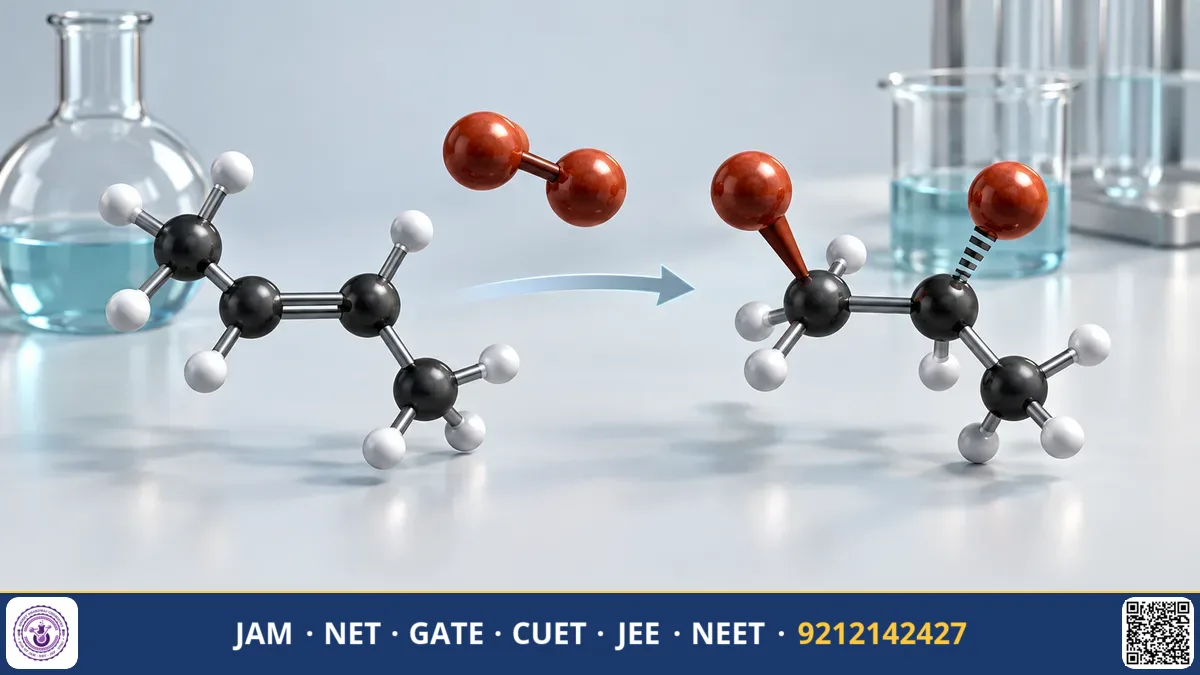
Consider the reaction of propene with hydrogen bromide. Propene (CH3-CH=CH2) is an asymmetric alkene with a terminal double bond.
Reaction: CH3-CH=CH2 + HBr → ?
Step 1: Proton addition. The double bond links C1 (two hydrogens) and C2 (one hydrogen, one methyl group). Electrophilic attack by H+ gives two possible routes:
- First route (H+ adds to C1): Hydrogen attaches to C1, forming a secondary (2°) isopropyl carbocation (CH3-CH+-CH3).
- Second route (H+ adds to C2): Hydrogen attaches to C2, forming a primary (1°) propyl carbocation (CH3-CH2-CH2+).
Step 2: Evaluate stability. The secondary carbocation has six adjacent C-H sigma bonds providing hyperconjugation, whereas the primary carbocation has only two. Because the secondary carbocation is more stable, it forms preferentially and dominates the reaction.
Step 3: Halide capture. The bromide ion (Br−) attacks the secondary carbocation at C2 to form 2-bromopropane as the major product. The primary carbocation yields 1-bromopropane only as a minor product.
Peroxides and the Kharasch effect
Under specific conditions, addition across an asymmetric alkene yields the opposite isomer. When hydrogen bromide reacts with an alkene in the presence of peroxides, bromine attaches to the less substituted carbon. This outcome is an anti-Markovnikov addition, also known as the Kharasch effect after Morris S. Kharasch.
Peroxides change the reaction from an ionic carbocation mechanism to a free-radical chain process. A free radical is a chemical species with an unpaired electron. The weak oxygen–oxygen bond in peroxides homolyzes under heat or light, generating radicals that react with HBr to form bromine free radicals (Br•).
The bromine radical attacks the alkene first, bonding to the terminal carbon to leave the unpaired electron on the more substituted carbon. This step forms a stable secondary radical, stabilized by hyperconjugation from adjacent alkyl groups. The secondary radical then abstracts a hydrogen atom from another HBr molecule, yielding 1-bromopropane.
| Reaction parameter | Markovnikov addition (ionic) | Anti-Markovnikov addition (radical) |
|---|---|---|
| Reagents | Alkene and HX without peroxides | Alkene and HBr with peroxides |
| Initiating species | Electrophilic proton (H+) | Bromine free radical (Br•) |
| Intermediate | Carbocation | Carbon radical |
| Stability sequence | Tertiary > Secondary > Primary | Tertiary > Secondary > Primary |
| Major product with propene | 2-Bromopropane | 1-Bromopropane |
Key takeaways
- Vladimir Markovnikov published his empirical addition rule in 1870, showing that acidic hydrogen adds to the alkene carbon holding more hydrogen atoms.
- Markovnikov applied chemical structure theory learned from his teacher Alexander Butlerov (1828–1886) to explain addition reactions.
- Electrophilic addition proceeds through the most stable carbocation intermediate, which controls the major product.
- Carbocation stability follows the order tertiary > secondary > primary due to the inductive effect and hyperconjugation.
- Adding peroxides to HBr triggers a free-radical mechanism discovered by Morris S. Kharasch that yields the anti-Markovnikov product.
Frequently asked questions
What was Markovnikov's original definition in 1870?
Markovnikov stated that when a hydrogen halide adds to an unsymmetrical alkene, the halide attaches to the carbon with fewer hydrogen atoms, while the hydrogen attaches to the carbon with more hydrogen atoms.
Why does carbocation stability govern the product outcome?
The reaction that forms the more stable carbocation intermediate occurs preferentially because alkyl groups stabilize this intermediate through inductive electron donation and hyperconjugation.
Does the rule apply to the acid-catalyzed hydration of an alkene?
Yes. In acid-catalyzed hydration, an alkene reacts with water to form an alcohol. The proton adds first to yield the more stable carbocation, after which water attacks the positive carbon, placing the hydroxyl group on the more substituted carbon.
How do you find Vladimir Markovnikov and Alexander Butlerov on the Chemistry Family Tree?
Go to the Chemistry Family Tree and select Find a chemist. In the search box displaying Type a name, e.g. Liebig, enter Alexander Butlerov. Every chemist has a page with teachers, students, a discovery post and a biography, where you can see his student Vladimir Markovnikov.
What to do next. Try it yourself on the page below.
Chemistry Family Tree — who taught whom among 350 great chemists →