Who Discovered Oxygen? Scheele, Priestley and Lavoisier Compared
In this guide, you will examine how three eighteenth-century investigators isolated and identified the gas that sustains life.
You will learn who isolated it first, who published the earliest report, and who explained its true elemental nature.
The puzzle of combustion and the phlogiston hypothesis
Before modern chemistry developed, natural philosophers explained combustion using the phlogiston hypothesis. Phlogiston was viewed as an undetectable, weightless substance present inside every combustible material. When wood, charcoal, or sulfur burned, thinkers believed it released phlogiston into the surrounding air. When a flame died inside a sealed bell jar, they assumed the trapped air was saturated with phlogiston and could absorb no more.
This model created an obvious contradiction during calcination. Calcination is the process of heating a metal strongly in air until it forms a powdery residue, known today as a metallic oxide. Under the phlogiston hypothesis, heating should have driven phlogiston out, leaving a residue lighter than the starting metal. Yet careful weighing showed that the residue consistently weighed more.
When studying chemical reactions in your coursework, always pay attention to mass discrepancies. When an accepted hypothesis cannot account for measured changes in weight, you must question the underlying assumptions.
Carl Wilhelm Scheele and the first laboratory isolation
Carl Wilhelm Scheele worked as an apothecary, conducting experiments in his laboratory during his spare hours. He systematically tested how intense heat altered different chemical salts and minerals.
Scheele produced the new gas by heating several compounds, including potassium nitrate, silver carbonate, and red mercuric oxide. Mercuric oxide is a dense red powder composed of mercury and oxygen. When heated inside a glass retort, the compound decomposed into liquid mercury droplets and released an invisible gas into an attached bladder.
When Scheele placed a burning candle or glowing charcoal into the collected gas, combustion occurred with extraordinary intensity. Because the gas supported fire so actively, he named it fire air.
Although Scheele isolated the gas before his contemporaries, his manuscript languished with his printer for several years. By the time his book reached readers, other scientists had already announced their findings. Remember this practical lesson: laboratory success must be paired with timely communication, or priority in the scientific community will be lost.
Joseph Priestley and the burning glass experiment
Joseph Priestley worked as an independent investigator who devised creative techniques to manipulate gases. He collected gases over liquid mercury in a pneumatic trough, preventing water-soluble vapours from dissolving during collection.
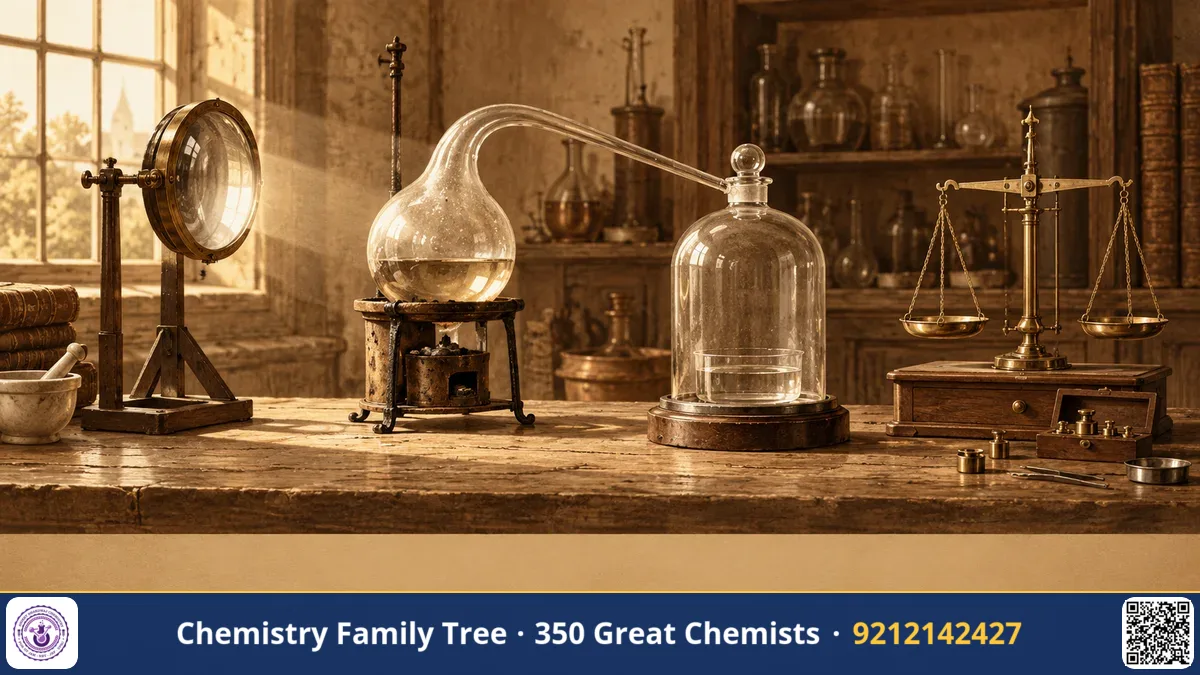
Priestley placed red mercuric oxide inside an inverted glass cylinder filled with mercury. Using a large convex lens, called a burning glass, he focused sunlight onto the red powder. As the sample heated, it released an unknown gas that displaced the mercury downward.
Priestley observed that a candle burned in this gas with an enlarged, brilliant flame. He placed mice in containers of the gas and noticed they survived twice as long as mice in regular air. He breathed the gas himself and recorded that his lungs felt light and clear.
However, Priestley remained committed to the phlogiston concept. He reasoned that because the gas supported combustion so well, it must lack phlogiston entirely, allowing it to absorb large amounts from burning materials. He therefore named it dephlogisticated air. He published his experiments promptly and described his technique directly to Antoine Lavoisier during a visit.
Antoine Lavoisier and the quantitative proof of oxygen
Antoine Lavoisier recognized that qualitative observations were insufficient to settle chemical debates. He introduced rigorous quantitative measurements, using precise balances to track every reactant and product.
Guided by Priestley's report, Lavoisier heated liquid mercury in a sealed glass retort connected to a bell jar for twelve continuous days. A red crust of mercuric oxide formed on the mercury, while the volume of air inside the vessel decreased by about one fifth. He then collected this red powder and heated it at a higher temperature, recovering the exact volume of gas that the air had lost.
Lavoisier realized that atmospheric air is not an element, but a mixture. Combustion is not the release of an imaginary phlogiston; it is the chemical combination of a fuel with a specific reactive gas from the atmosphere. He named this component oxygen, meaning acid-former, because he believed all acids required it.
In your NCERT studies, this milestone illustrates the law of conservation of mass. By proving that matter is neither created nor destroyed during chemical change, Lavoisier established modern chemistry.
Comparing the three chemists across key criteria
To determine who discovered oxygen, you must compare how each investigator contributed across laboratory synthesis, public reporting, and theoretical explanation.
| Investigator | Name given to gas | Experimental method | Theoretical view | Historical contribution |
|---|---|---|---|---|
| Carl Wilhelm Scheele | Fire air | Heating potassium nitrate and mercuric oxide | Phlogiston supporter | First to isolate the gas in a laboratory |
| Joseph Priestley | Dephlogisticated air | Heating mercuric oxide with a burning glass | Phlogiston supporter | First to publish results and study respiration |
| Antoine Lavoisier | Oxygen | Heating mercury in sealed retorts with mass tracking | Overthrew phlogiston; mass conservation | Proved oxygen is an element and named it |
Apply these distinctions when answering questions on historical discoveries:
- Scheele achieved experimental priority: He prepared the gas first, but publication delays hindered his recognition.
- Priestley achieved public priority: He isolated it independently, published first, and shared his method openly.
- Lavoisier achieved conceptual priority: He explained what the gas was, demolished the phlogiston doctrine, and named the element.
To trace how these scientists connect across generations of research, examine the Chemistry Family Tree on this site. You can use Find a chemist or browse All chemists to follow their academic lineage.
Key takeaways
- Carl Wilhelm Scheele isolated oxygen first by heating mercuric oxide and nitrates, but publication delays cost him historical priority.
- Joseph Priestley prepared the gas independently using a solar burning glass, published promptly, and demonstrated that it supports respiration.
- Priestley and Scheele interpreted the gas within the phlogiston hypothesis, naming it dephlogisticated air and fire air.
- Antoine Lavoisier used quantitative mass balances to prove that oxygen is an elemental component of air, establishing the law of conservation of mass.
- Modern chemistry credits all three: Scheele for preparation, Priestley for early publication, and Lavoisier for chemical interpretation.
Frequently asked questions
Who is officially credited with discovering oxygen?
Credit is shared among all three investigators. Scheele isolated it first in his laboratory, Priestley published the earliest independent report, and Lavoisier identified it as a chemical element and explained combustion.
Why did Scheele lose historical priority to Priestley?
Scheele finished his laboratory work before Priestley, but his publisher delayed printing his book for several years. Priestley published his findings immediately, so the scientific community learned of the gas through him first.
What was dephlogisticated air?
Dephlogisticated air was Priestley's name for oxygen. Because he believed in phlogiston, he assumed the gas supported combustion so vigorously because it lacked phlogiston entirely, allowing it to absorb phlogiston rapidly from burning substances.
Why did Lavoisier name the gas oxygen?
Lavoisier derived the name from Greek roots meaning acid-former. He believed that oxygen was a necessary constituent of all acids. Although chemists later found that hydrogen is the defining element of acids, the name remained.
What to do next. Try it yourself on the page below.
Chemistry Family Tree — who taught whom among 350 great chemists →