Td point group: finding tetrahedral symmetry in methane
This post shows you how to find every symmetry element of methane, CH4, and why together they make the Td point group.
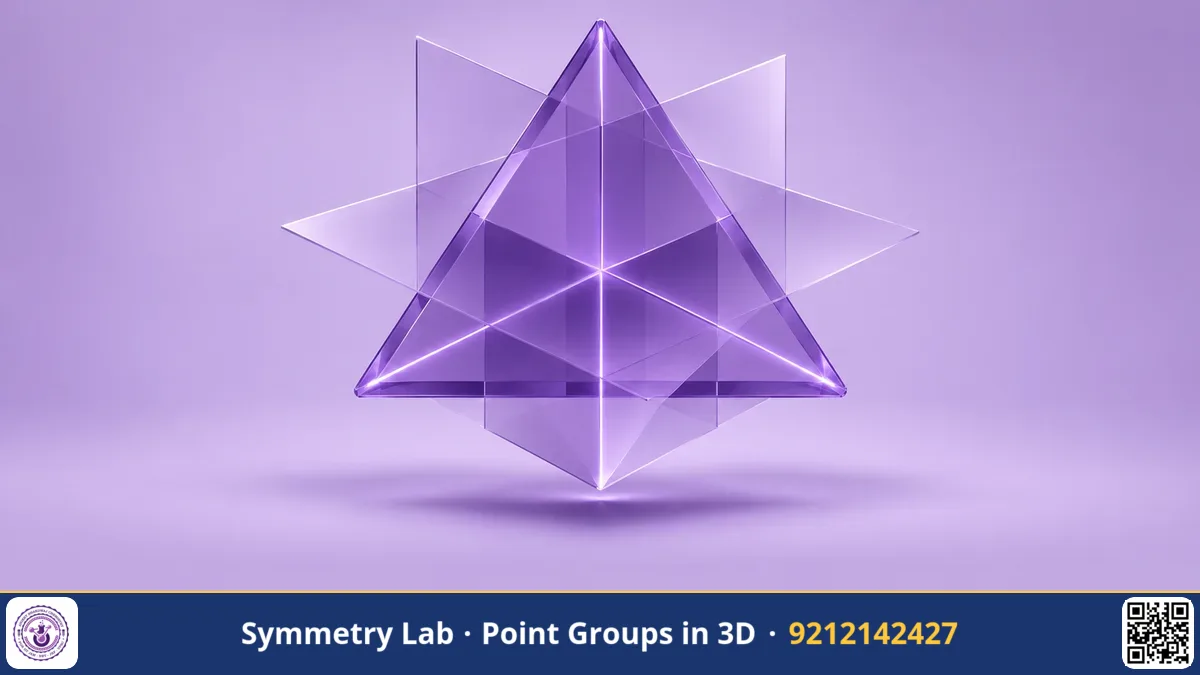
You will also learn how to check each element on a rotating 3D model in the Symmetry Lab.
What a point group is, in one minute
A symmetry operation moves a molecule so that it looks exactly the same afterwards. A rotation, a reflection and an inversion are all operations. One point stays fixed during every operation, so the full set is called a point group.
Each operation is carried out using a symmetry element. The element is the thing you can draw: an axis, a plane or a point. Rotating about an axis is the operation. The axis itself is the element.
Here are the symbols you need for methane:
- E: the identity. It does nothing, and every molecule has it.
- Cn: a rotation about an axis that repeats n times in one full turn. C3 is a one-third turn. C2 is a half turn.
- σ: a reflection in a mirror plane. A plane marked σd is a dihedral plane. It bisects the angle between two C2 axes.
- Sn: an improper rotation. You rotate by one n-th of a turn and then reflect in the plane at right angles to the axis.
- i: inversion through a centre.
Why Td is the group for a regular tetrahedron
To find a point group, ask the same questions in the same order. Is the molecule linear? Is it one of the high-symmetry shapes? A regular tetrahedron is Td. An octahedron or a cube is Oh. An icosahedron is Ih.
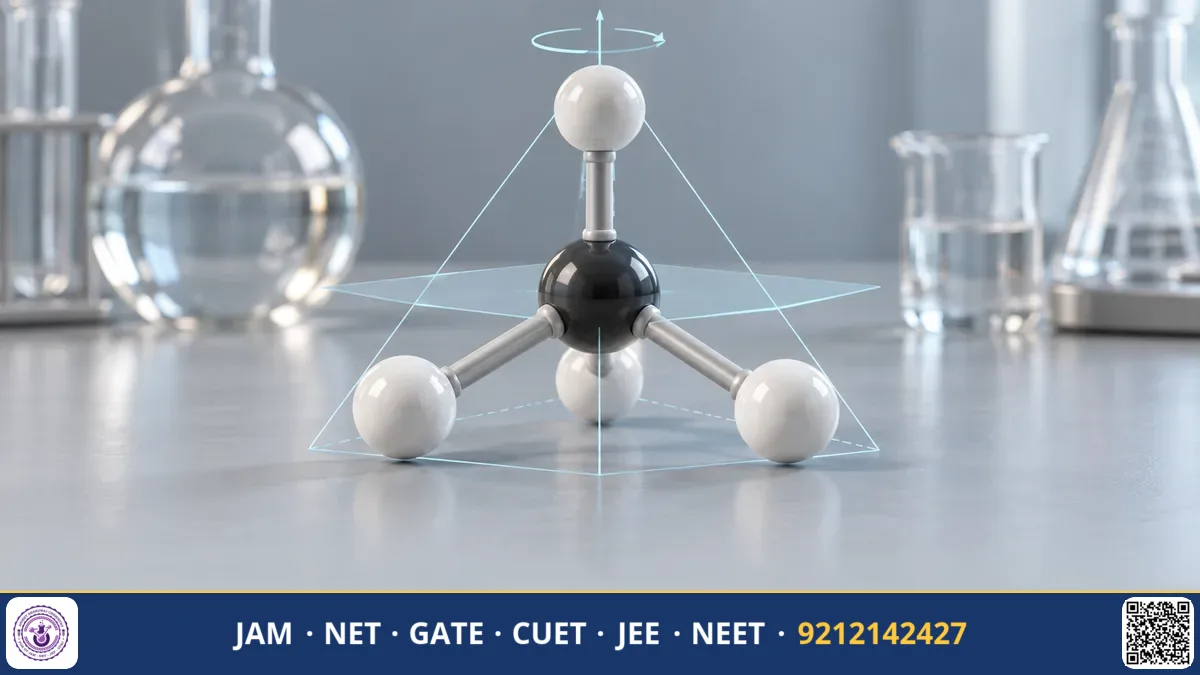
Methane passes the second test at once. Carbon sits at the centre. The four hydrogen atoms sit at the corners of a regular tetrahedron. All four C–H bonds are equal, and all six H–C–H angles are equal. So you can name the group before you count a single axis.
Counting the axes is still worth doing. It makes the group real for you, and it is what an examiner asks you to show.
The four C3 axes
Take one C–H bond. Draw a line along it, through carbon, and out the other side. That line passes through one hydrogen and through the middle of the opposite triangle formed by the other three hydrogens.
Hold the molecule by this line and turn it by one-third of a full turn. The three hydrogens in the triangle swap places. The hydrogen on the axis does not move. The molecule looks unchanged, so this line is a C3 axis.
There are four C–H bonds, so there are four C3 axes. Each axis allows two turns: one-third of a turn and two-thirds of a turn. That gives eight C3 operations, written 8C3.
A common mistake is to stop after finding one C3 axis. A molecule such as PCl3 has just one and is C3v. Methane has four equal bonds, so it has four equal axes.
The three C2 axes and the S4 axes
Now look for axes that pass through no hydrogen. Each C2 axis goes through the midpoints of two opposite edges of the tetrahedron. It runs through carbon, between a pair of hydrogens on one side and between the other pair on the opposite side.
A half turn about this line swaps the two hydrogens in each pair. The molecule looks the same. A tetrahedron has six edges, which make three opposite pairs. So methane has three C2 axes, written 3C2.
These same three lines are also S4 axes. Make a quarter turn, then reflect in the plane at right angles to the axis. The result matches the starting molecule, although the quarter turn alone does not. Each axis gives two S4 operations, so there are six in total, written 6S4. Students miss this most often. A tetrahedron has no C4 axis, yet it does have S4 axes.
The six dihedral planes
Pick any two hydrogens. Together with the carbon atom they define a plane. That plane holds C and those two H atoms. It splits the other two hydrogens into a mirror pair, one on each side. So it reflects the molecule onto itself.
Count the ways to choose two hydrogens from four. There are six pairs, so there are six planes, written 6σd. Each plane also contains one of the C2 axes and bisects the angle between the other two. That is why they are called dihedral planes.
Methane has no centre of inversion. Take any hydrogen and pass it through carbon to the other side. It lands where there is no hydrogen. This is a quick way to tell a tetrahedron from an octahedron such as SF6, which does have a centre.
All operations of Td in one table
| Operation | How many | Where to find it in CH4 |
|---|---|---|
| E | 1 | Do nothing |
| C3 | 8 | Along each C–H bond, two turns per axis, four axes |
| C2 | 3 | Through midpoints of opposite H···H edges |
| S4 | 6 | Along the same three C2 lines, two per axis |
| σd | 6 | Each plane holds C and two H atoms |
Add the numbers: 1 + 8 + 3 + 6 + 6 = 24. The order of Td, which is the total number of operations, is 24. Use this count to check your own work.
Worked example: assign the point group of CH4 step by step
- Linear? No. The four hydrogens are not in a line.
- High-symmetry shape? Yes. Four equal bonds around carbon form a regular tetrahedron.
- A regular tetrahedron is Td, so you stop here.
- Check: four C3, three C2 (also S4) and six σd all fit Td, and there is no centre of inversion.
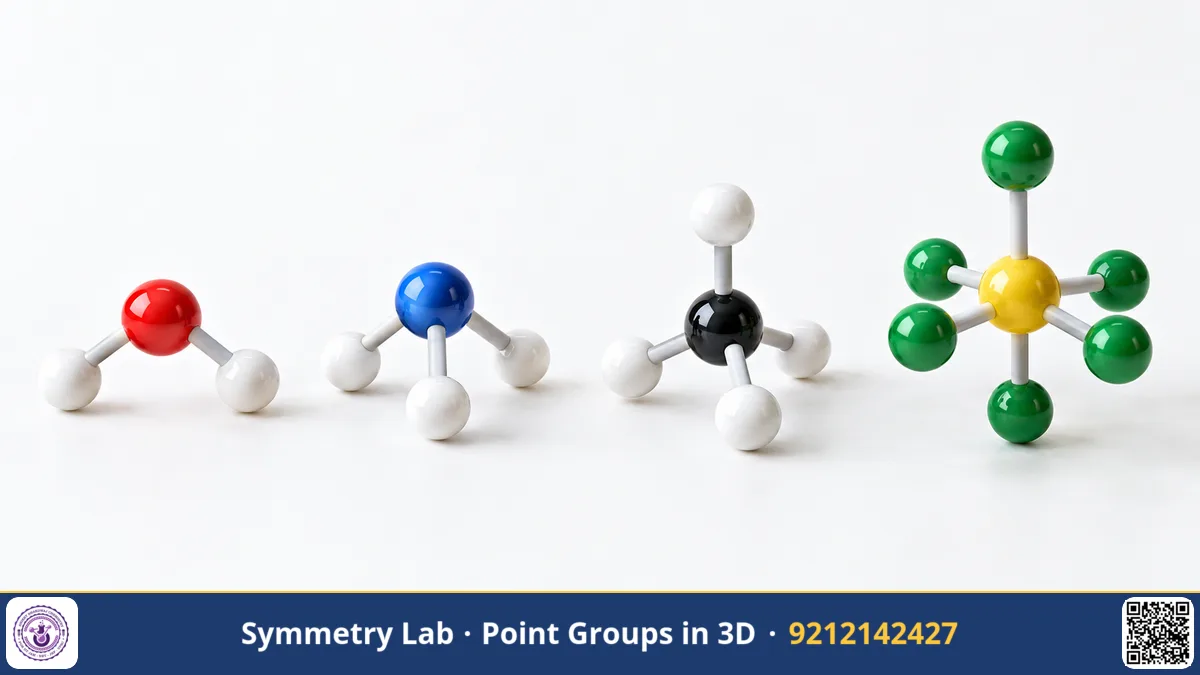
Compare NH3. It is pyramidal, with only one C3 axis and three vertical planes, so it is C3v. H2O is C2v.
How to find it with the Symmetry Lab
Reading about axes is not the same as seeing them. Use the Symmetry Lab to check each element yourself.
- Open the Symmetry Lab and find the Search by formula box.
- Type CH4, ch4 or CH₄. All three forms are accepted. You can also search by a point group such as Td.
- Select the molecule. The model loads in 3D. Drag it to rotate it, and use Reset to return to the starting view.
- Switch each axis, plane or centre on, one at a time. Start with the axes. See which one passes through a hydrogen and which one does not.
- Now switch on the planes. Rotate the model until you can see one plane holding carbon and two hydrogens.
- Try different styles. Ball & stick shows the bonds clearly, and Wire keeps the view uncluttered. Labels help you follow which hydrogen goes where.
The page also lists the questions to ask every time you assign a point group. Follow them in order, from the linear test to the mirror planes. The lab builds each molecule from its bond lengths and angles, and each symmetry element shown has been checked against the molecule's own coordinates.
When you feel ready, try the Symmetry challenge. A molecule appears with its name and point group hidden. You turn it, find the elements and choose the group. The explanation comes after you answer.
Other molecules in the same family
Methane is not the only member of the tetrahedral family. In the Point groups index, the family is listed as T, Th and Td. Open the Td page to see its definition, its operations and the full list of molecules. Open a few of them in 3D. Each one should show the same set of elements that you found in methane.
Notice what Td does not cover. A molecule with a lone pair on the central atom, such as NH3, is no longer a regular tetrahedron. The lab can show lone pairs with the Lone pairs control. The shape of the atoms, and not only the count of electron pairs, decides the group.
Key takeaways
- CH4 is a regular tetrahedron, so its point group is Td, with 24 operations.
- It has four C3 axes (one along each C–H bond), three C2 axes that are also S4 axes, and six σd planes.
- There is no centre of inversion and no C4 axis.
- Change the atoms so that the four are no longer identical, and the four C3 axes are lost.
- In the Symmetry Lab, type CH4 in Search by formula and switch on each element one by one.
Frequently asked questions
How many C3 axes does methane have?
It has four, one along each C–H bond. Each gives two operations, so there are eight C3 operations.
Does methane have a centre of inversion?
No. A hydrogen passed through carbon would land where no hydrogen sits. Td has no inversion centre.
Why does a tetrahedron have an S4 axis but no C4 axis?
A plain quarter turn does not bring the hydrogens onto each other. A quarter turn followed by a reflection in the plane at right angles does. That combined operation is S4.
What is the order of Td?
The order is 24. The operations are E, 8C3, 3C2, 6S4 and 6σd.
How do I find CH4 in the Symmetry Lab?
Use the Search by formula box. Type CH4, ch4 or CH₄. You can also search by a point group such as Td.
What to do next. Try it yourself on the page below.
Symmetry Lab — point groups of 277 molecules in 3D →