Germanium: Atomic Mass 72.63, Metalloid Properties and Uses
This post gives you the key facts about germanium (Ge), read from the periodic table.
You will also learn its history, its uses, three common mistakes, and one worked example.
Germanium data at a glance
Start with the numbers. Keep this table beside you while you study. A metalloid is an element with properties between those of metals and nonmetals.
| Property | Germanium |
|---|---|
| Symbol | Ge |
| Atomic number | 32 |
| Atomic mass | 72.63 |
| Category | Metalloid |
| Family | Carbon group |
| Neighbours by atomic number | Gallium (69.723) before it, arsenic (74.922) after it |
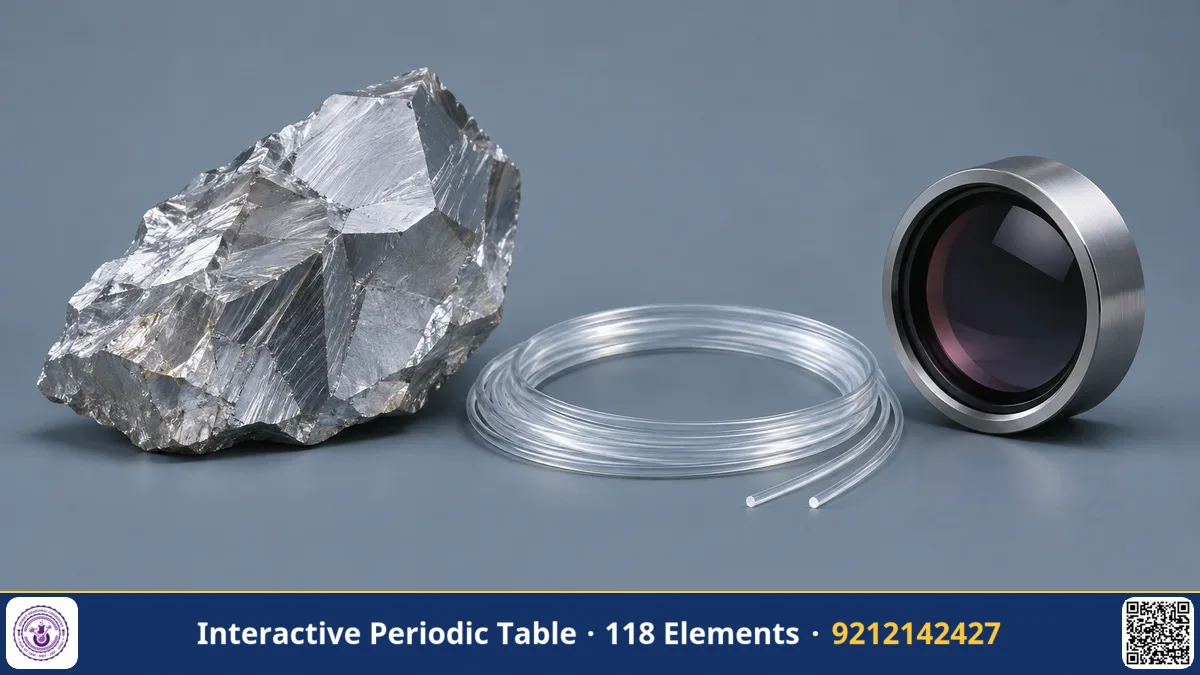
| Appearance | Lustrous, hard, brittle, grayish-white |
Atomic number is the number of protons in the nucleus. For germanium it is 32, so the neutral atom has 32 electrons. Atomic mass is the average mass of an atom of the element, compared with one-twelfth of a carbon-12 atom. The unit is u.
How to investigate germanium with the Category filter
Do this activity once. It takes five minutes and fixes the idea of a metalloid in your mind.
- Open the interactive periodic table and find the Category control above the tiles.
- Choose Metalloid. You can also tap the Metalloid card in the element families section to filter the table.
- Look at where the metalloid tiles sit. They form a staircase between the metals and the nonmetals.
- Tap the germanium tile. The quick-view card shows its atomic mass, electron configuration, physical state and oxidation states.
- Now switch to Post-transition metal and look again. Germanium is not in that group. Switch to Reactive nonmetal and check the same thing.
Why this works: an element's chemistry follows from where it sits in the table. The filter lets you see the whole metalloid set at once, instead of memorising a list.
History: a prediction that came true
In 1869, Dmitri Mendeleev noticed a gap in the carbon family, between silicon and tin. He called the missing element ekasilicon. He estimated its atomic weight at 70, and later revised it to 72.
In mid-1885, a mine near Freiberg gave a new mineral. It was named argyrodite because of its high silver content. The chemist Clemens Winkler analysed it. He found silver, sulfur and a new element, and isolated the element in 1886.
At first Winkler found the element similar to antimony. Its place in the table was debated, because it also resembled arsenic. Its match with Mendeleev's ekasilicon settled the question. Winkler named it germanium, after Germany, his homeland.
He also found an atomic weight of 72.32 by analysing germanium tetrachloride. The modern value, 72.63, is close to both Mendeleev's revised estimate of 72 and Winkler's measurement.
Here is the lesson. Mendeleev left a gap instead of forcing the element into the wrong column. When germanium was found, it fitted that gap.
Germanium as a semiconductor
A semiconductor conducts electricity better than an insulator but worse than a metal. Its conduction can be controlled, which is why it suits electronic devices. Elemental germanium is used in transistors and other devices for this reason.
Historically, the first decade of semiconductor electronics was based entirely on germanium. Silicon, the element just above it in the carbon group, later became the more common material for chips. The two elements are chemically similar, so comparing them is a good way to revise group trends.
Uses of germanium today
- Fibre-optic systems: a mixture of silicon dioxide and germanium dioxide (GeO2) is used for optical fibres. Changing the ratio gives precise control of the refractive index, which tells you how strongly the glass bends light.
- Infrared optics: germanium and its oxide glass are transparent to infrared light. They are made into windows and lenses for night-vision technology and thermographic cameras.
- Solar cells and LEDs: both are among the major end uses today.
- Catalysts: germanium compounds are used as polymerization catalysts. Polymerization is the joining of small molecules into long chains.
- Coloured glass: germanium dioxide is used as a colorant in borosilicate glass for lampworking.
Commercially, germanium is mined mainly from sphalerite, the main ore of zinc. It is also recovered from silver, lead and copper ores. It seldom appears in high concentration, which is why it was found comparatively late.
Three common misconceptions
Misconception 1: shiny means metal. Germanium is lustrous, but lustre alone does not decide the category. It is hard and brittle, not malleable like a true metal. It is classed as a metalloid, and some sources even treat it as a nonmetal. Use the Category filter to see where it sits.
Misconception 2: germanium runs today's electronics. Germanium led the first decade of semiconductor electronics, but that is history. Today its major uses are fibre-optic systems, infrared optics, solar cells and LEDs. Always read the time frame in a question.
Misconception 3: 72.63 is the mass of every germanium atom. It is not. Atomic mass is an average, which is why it is not a whole number. Do not round it to 72 in a calculation unless the question tells you to. Mendeleev's early estimate was 70, then 72. The accepted figure is 72.63.
Worked example
Question A. How many moles are there in 36.315 g of germanium? Use atomic mass 72.63.
Step 1. Molar mass of germanium = 72.63 g/mol.
Step 2. Moles = mass ÷ molar mass = 36.315 ÷ 72.63.
Step 3. 72.63 × 0.5 = 36.315, so the answer is 0.5 mol.
Question B. Gallium is 69.723 and arsenic is 74.922. How close is their average to germanium's mass?
Step 1. Sum = 69.723 + 74.922 = 144.645.
Step 2. Average = 144.645 ÷ 2 = 72.3225, or about 72.32.
Step 3. Difference from 72.63 = 72.63 − 72.3225 = 0.3075, or about 0.31 u.
The average of the two neighbours lands within 1 u of germanium's mass. Treat this as a rough check, not a rule. It does not work for every element.
How to study germanium for exams
Learn it as part of a set: silicon, germanium, arsenic, antimony and tellurium are the usual metalloids in school lists. Ask three questions about each. Where does it sit? What is it used for? What is its atomic mass?
For germanium, your answers are: carbon group, semiconductors and optics, 72.63. Add the story of ekasilicon, because it shows why Mendeleev's table was trusted. Check your NCERT chapter on classification of elements for the exact wording your exam expects.
Key takeaways
- Germanium (Ge) has atomic number 32 and atomic mass 72.63. It is a metalloid in the carbon group.
- Mendeleev predicted it as ekasilicon in 1869. Winkler isolated it in 1886 and named it after Germany.
- The first decade of semiconductor electronics used germanium alone. Today it serves fibre-optic systems, infrared optics, solar cells and LEDs.
- Atomic mass is an average, so 72.63 is not a whole number. Do not round it casually.
- Use the Category filter on the interactive table to see the metalloid set for yourself.
Frequently asked questions
What is the atomic mass of germanium?
It is 72.63, as shown on the periodic table tile for germanium (atomic number 32).
Is germanium a metal or a nonmetal?
It is a metalloid. It looks lustrous like a metal, but it is brittle. Some sources even consider it a nonmetal.
Why is germanium called a semiconductor?
Its electrical conduction lies between that of a metal and an insulator, and it can be controlled. This is why it was used in the first decade of semiconductor electronics.
Who discovered germanium?
Clemens Winkler isolated it in 1886 from the mineral argyrodite. Mendeleev had already predicted it in 1869 as ekasilicon.
Is germanium needed by living things?
It is not thought to be essential for any living organism. Natural germanium compounds tend to be insoluble in water and so have little oral toxicity. Some synthetic compounds are harmful, so handle any chemical only as your teacher instructs.
What to do next. Try it yourself on the page below.
Interactive Periodic Table — All 118 Elements →