Ahmed Zewail and Femtochemistry Laser Pulses

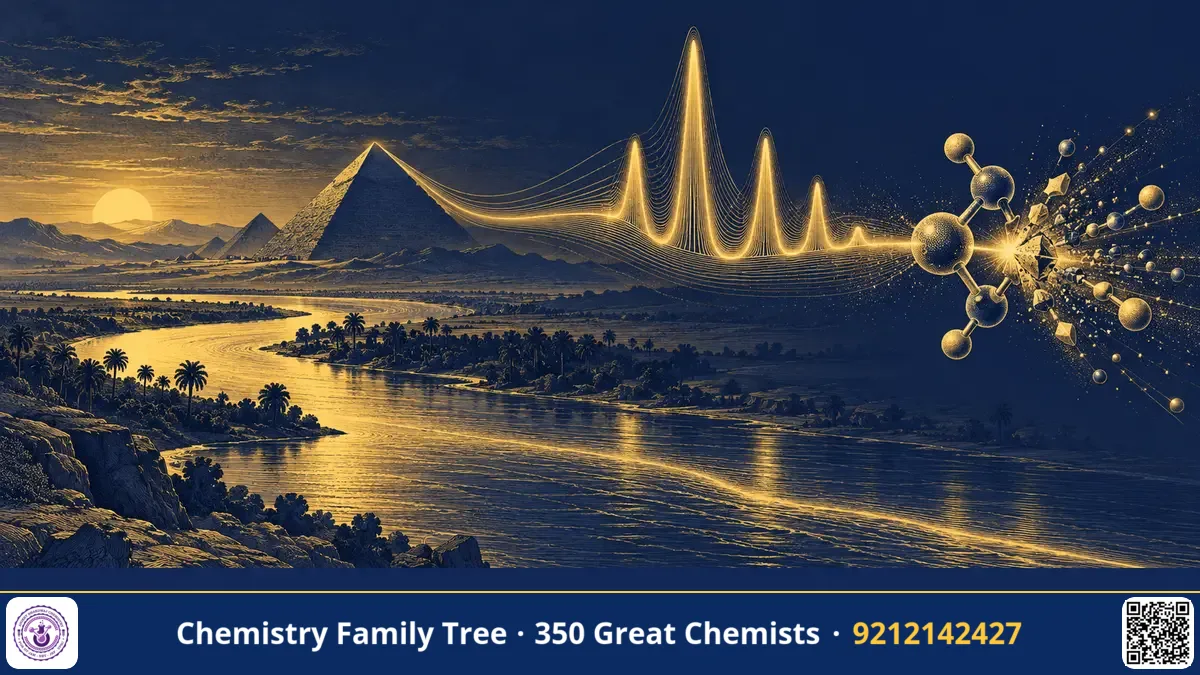
This post explains how Ahmed Zewail used very short laser flashes to watch a chemical bond break.
You will also see where scientists still disagree, and how to trace his teachers on the Chemistry Family Tree.
Why a breaking bond was hard to see
In class, you write a reaction as reactants on the left and products on the right. The arrow hides everything in between. In that gap, bonds stretch, break and form.
The middle stage is the transition state. It is the short-lived, high-energy arrangement of atoms that the reacting molecules pass through. Textbooks draw it with an energy diagram. For a long time, nobody could watch it directly.
The problem was speed. Atoms inside molecules move very fast. An ordinary camera, or an ordinary measurement taken over seconds or even microseconds, sees only the start and the end. You need a "shutter" that is shorter than the motion itself.
Zewail's field is built around one unit of time: the femtosecond. One femtosecond is 10-15 second. Femtochemistry is the part of physical chemistry that studies reactions on this timescale. It studies the very act of atoms rearranging to form new molecules.
According to the source record, Zewail used the word "femtochemistry" in a 1988 article in the journal Science. In 1999 he received the Nobel Prize in Chemistry for showing that you can see how atoms move during a reaction using flashes of laser light.
How the pump–probe method works
The simplest and still most common method is pump–probe spectroscopy. Spectroscopy means studying matter by how it interacts with light. Here, you use two light pulses with a controlled gap between them.
| Step | What it does | Everyday comparison |
|---|---|---|
| Pump pulse | Starts the reaction by breaking a bond or exciting a reactant | The starter's pistol |
| Time delay | You set a gap between the two pulses | The stopwatch reading you choose |
| Probe pulse | Checks how far the reaction has progressed at that moment | A flash photograph of the runner |
| Scan the delay | Repeat with longer and longer gaps | Putting the photos in order to make a film |
As the reaction moves forward, the sample responds differently to the probe pulse. By scanning the delay and recording that response, researchers rebuild the reaction as a function of time. You do not watch one long movie. You build the movie from many snapshots, each taken after a different delay.
The key idea for your exam notes: the time resolution comes from the pulse length and the delay, not from a fast detector.
A worked example: turning delay into distance
Question: The two pulses travel along paths of different lengths. How much extra path gives a delay of 1 fs?
Step 1. Light travels about 3 × 10⁸ m/s.
Step 2. Distance = speed × time = 3 × 10⁸ m/s × 10-15 s = 3 × 10⁻⁷ m.
Answer: About 0.3 micrometre of extra path gives a 1 fs delay. This is why pulse timing is controlled by moving optical parts by tiny, precise amounts.
This calculation uses standard textbook physics. It shows why a gap of a few hundred femtoseconds is still a very small movement in the lab.
Bromine breaking apart, step by step
One reported example is the dissociation of bromine. Dissociation means a molecule splits into smaller parts, here two bromine atoms. A 400 nm laser pulse was used to dissociate it, and the stages were followed in time.
| Time after the pulse | What was observed |
|---|---|
| 140 fs | Electrons completely localise onto the individual atoms |
| 160 fs | The two Br atoms are 6.0 Å apart |
The angstrom (Å) is 10-10 m, a common unit for atomic distances. Notice what this shows. The bond does not simply vanish. The electron distribution changes first, and the atoms then move apart. A single "before and after" picture cannot tell you this.
Zewail also made important contributions to ultrafast electron diffraction. This uses short pulses of electrons instead of light to study how reactions proceed. The idea is the same as before: very short pulses give very short snapshots.
The debate: seeing versus controlling
Here the story needs care. Watching a reaction is one claim. Steering it is another.
Many publications have discussed controlling chemical reactions with ultrafast pulses. That idea remains controversial. If you are writing about it in an answer or an essay, do not present control as settled fact.
There is a second difficulty. Some reaction steps happen on the femtosecond scale, and some on the attosecond scale (1 attosecond is 10-18 s). Reactions may also form intermediate products. You cannot always work out these intermediates by looking only at the starting materials and final products. That is exactly why time-resolved methods matter, and also why the interpretation needs care.
A good way to hold both ideas:
- Well established: femtosecond pulses can show how atoms move during a reaction.
- Still argued over: whether the same approach can reliably control which products form.
Tracing Zewail's teachers on the family tree
Ideas in chemistry travel through teachers and students. Zewail's own path shows this. He studied chemistry at Alexandria University, then moved to the United States for his PhD. His doctoral supervisor was Robin M. Hochstrasser.
After the PhD he did postdoctoral research under Charles B. Harris. In 1976 he took up a faculty position at Caltech, where he later held the first Linus Pauling Chair in Chemical Physics. So the line runs from his teachers, to his own research group, to the field of femtochemistry.
You can follow such lines on the Chemistry Family Tree page. Here is a simple method:
- Use the "Find a chemist" box and type a name, for example Zewail.
- Open the chemist's page and note the teachers and students listed there.
- Move to a teacher's page and repeat, going one step back each time.
- Try the "Longest lineage" control on the page to see how far a chain of documented teacher links can run.
Keep one rule in mind. The tree includes only well-established links, so some chemists appear without teachers. A missing link means "not documented here", not "no teacher existed".
If you feel stuck, "Surprise me" on the same page opens a chemist you might not have searched for. It is a useful way to meet new names before a test.
Key takeaways
- Femtochemistry studies reactions on a timescale of about 10-15 second.
- In pump–probe work, the pump starts the reaction and the probe checks it after a chosen delay.
- Scanning the delay lets researchers rebuild a reaction like a film made from snapshots.
- Controlling reactions with laser pulses remains controversial, even though observing them is accepted.
- Zewail's line runs from Hochstrasser (PhD) and Harris (postdoctoral) to Caltech.
Frequently asked questions
What is a femtosecond?
It is 10-15 second, one millionth of a billionth of a second. Femtochemistry is named after this unit.
What did Zewail win the Nobel Prize for?
He received the 1999 Nobel Prize in Chemistry for his pioneering work in femtochemistry. It showed that laser flashes can reveal how atoms in a molecule move during a reaction.
What do the pump and probe pulses do?
The pump pulse starts the reaction by breaking a bond or exciting a reactant. The probe pulse checks the progress after a set delay. Repeating this with different delays gives the full time course.
Can femtosecond pulses control chemical reactions?
Many publications have discussed this possibility, but it remains controversial. Treat it as an open question, not a proven method.
Who were Zewail's teachers?
His PhD supervisor was Robin M. Hochstrasser, and his postdoctoral supervisor was Charles B. Harris. You can follow such links using the Chemistry Family Tree page.
What to do next. Try it yourself on the page below.
Chemistry Family Tree — who taught whom among 350 great chemists →