Albrecht Kossel and the Nitrogenous Bases of Nucleic Acids
This post follows how Albrecht Kossel worked out the nitrogenous bases hidden inside nucleic acids.
You will see the order of the discoveries, where scientists still disagree, and how to revise the topic for your UG exams.
What was known before Kossel started
Friedrich Miescher found a new substance in cell nuclei at the University of Tübingen in 1869. He called it nuclein. Nobody knew what it really was.
Here is the first point of debate. Depending on how you read his results, nuclein can be seen either as a complex of nucleic acid with histone proteins, or as the nucleic acid itself. Modern writers describe it both ways. So Miescher found the material, but he did not settle its chemistry.
That is where Kossel enters. His entry in the Chemistry Family Tree lists him as a biochemist (1853–1927). His work is a good example of chemistry applied to living material: break a complex substance into simple parts, then identify each part.
Step one: making the nucleic acid purer
In the early 1880s, Kossel purified the nucleic acid substance further. He also found that it is strongly acidic. This matters. The name "nucleic acid" records two facts: the material was first found in the nucleus, and it contains phosphate groups, which are related to phosphoric acid.
Why does purification come first? If your sample is a mixture, every product you isolate later is doubtful. A cleaner sample gives cleaner evidence. I ask my students to remember this logic: purify, break down, identify.
Step two: naming the bases
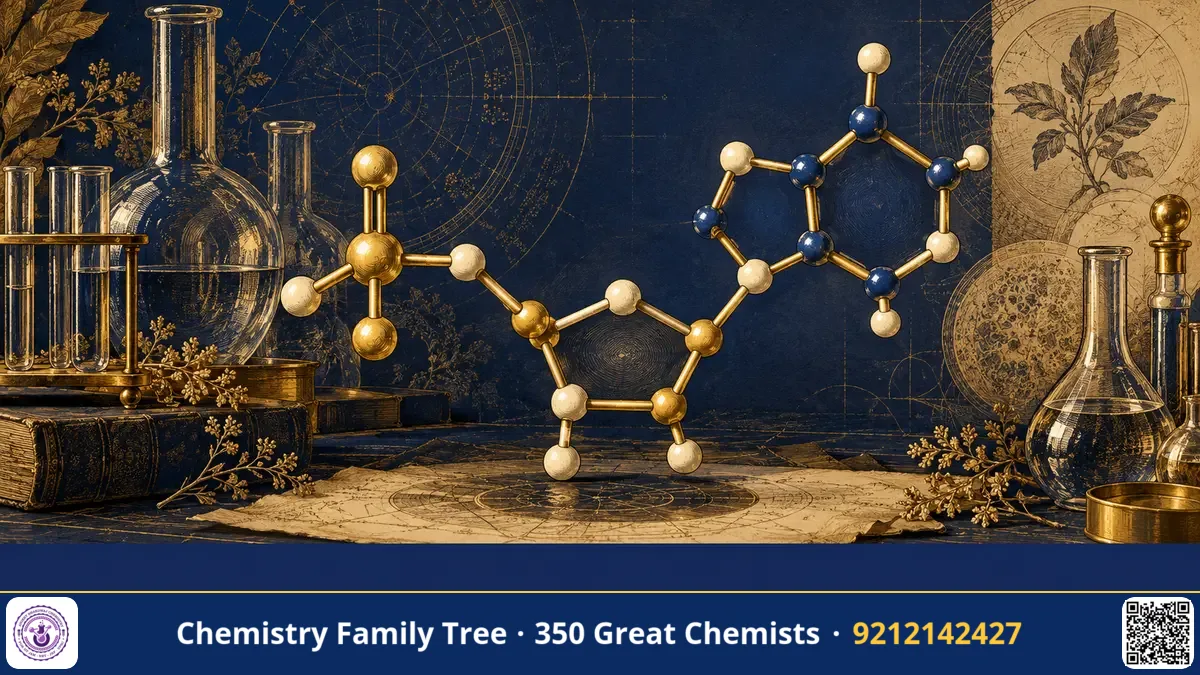
Kossel later identified the nucleobases. To follow this, you need to know how a nucleic acid is built. It is a polymer, meaning a long chain of repeating units called nucleotides. Each nucleotide has three parts:
- a five-carbon sugar (ribose or deoxyribose),
- a phosphate group, and
- a nitrogenous base.
If the sugar is ribose, the polymer is RNA. If it is deoxyribose, the polymer is DNA.
A nitrogenous base is a ring compound with nitrogen atoms in the ring. Chemists call such rings heterocyclic, because the ring contains an atom other than carbon.
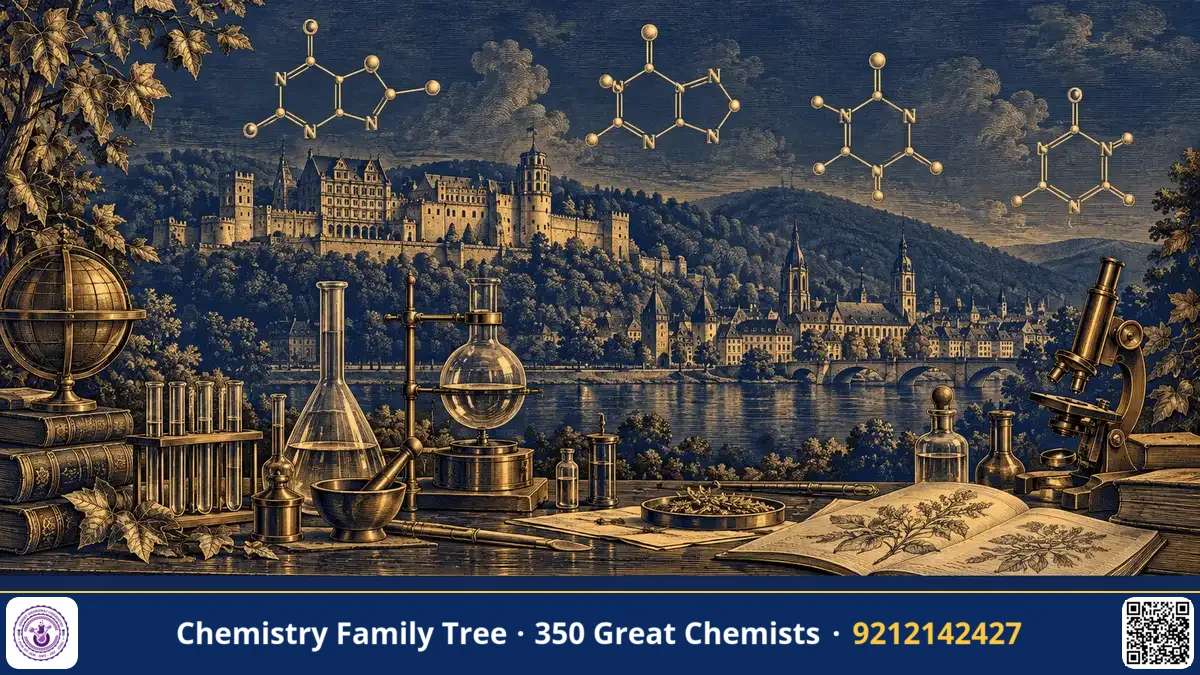
The five bases you must know are adenine, cytosine, guanine, thymine and uracil. Thymine occurs only in DNA. Uracil occurs only in RNA.
Purines and pyrimidines: the two families
By ring structure, the five bases fall into two groups. A purine has two fused rings. A pyrimidine has a single six-membered ring. Use this table for revision.
| Base | Family | Ring type | Found in |
|---|---|---|---|
| Adenine | Purine | Two fused rings | DNA and RNA |
| Guanine | Purine | Two fused rings | DNA and RNA |
| Cytosine | Pyrimidine | One ring | DNA and RNA |
| Thymine | Pyrimidine | One ring | DNA only |
| Uracil | Pyrimidine | One ring | RNA only |
A simple memory aid: the two purines are A and G, the first and last letters of "AG". The other three, C, T and U, are pyrimidines. Note that "pyrimidine" and the single ring go together, and the purines are the larger two-ring bases.
Why the bases matter: a worked example
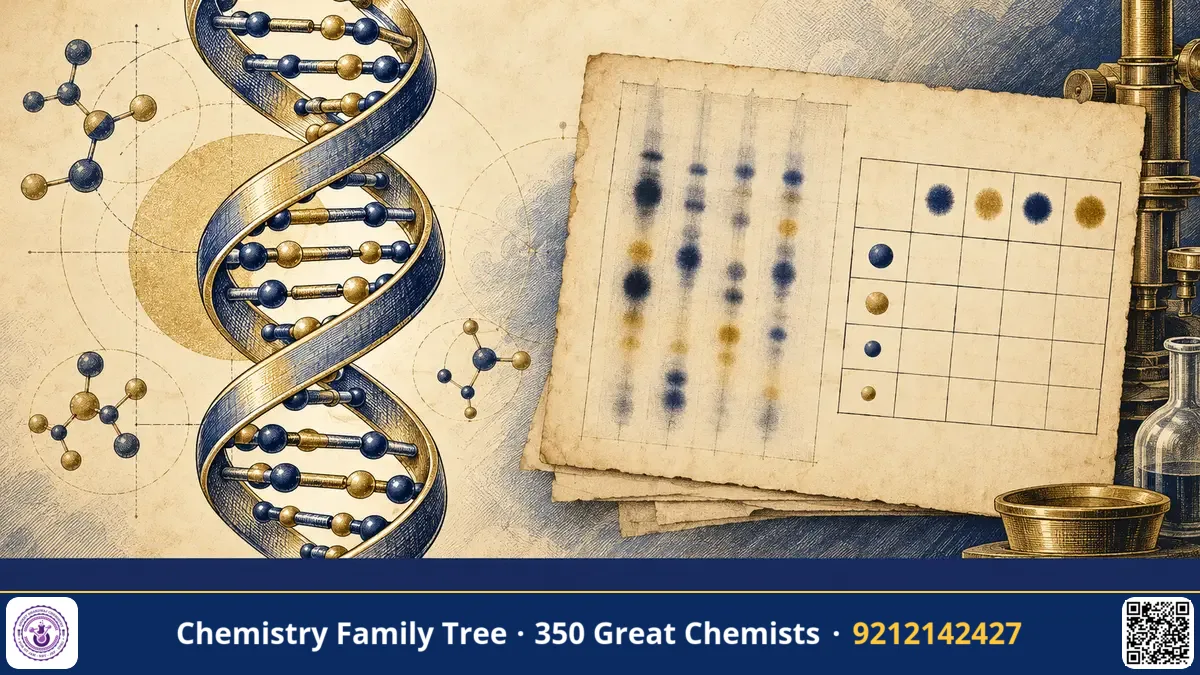
Kossel could not know how the bases would be used. That came later. In 1953 Watson and Crick proposed the double-helix structure of DNA, and base pairing is central to it. A purine pairs with a pyrimidine: adenine with thymine, and guanine with cytosine. In RNA, uracil takes the place of thymine.
Worked example. One DNA strand reads A–T–G–C–C. Write the complementary strand.
- Pair each base: A goes with T, T with A, G with C, C with G, C with G.
- The complementary strand reads T–A–C–G–G.
- Check: every pair has one purine and one pyrimidine. The check passes.
If the question asks for RNA made from the first strand, replace T with U in the new strand.
Notice what this shows. The order of the bases carries the information. That is why identifying them mattered so much.
A timeline you can write in an exam
Dates are given only where they are recorded. Keep the order clear.
- 1869: Miescher discovers nuclein in cell nuclei.
- Early 1880s: Kossel purifies the nucleic acid substance and finds it highly acidic.
- Later: Kossel identifies the nucleobases.
- 1889: Richard Altmann creates the term nucleic acid. At that time DNA and RNA were not told apart.
- 1938: Astbury and Bell publish the first X-ray diffraction pattern of DNA.
- 1944: The Avery–MacLeod–McCarty experiment shows DNA carries genetic information.
- 1953: Watson and Crick propose the double helix.
Phoebus Levene determined the basic structure of nucleic acids. So the credit is shared: Miescher found the material, Kossel purified it and identified its bases, Levene worked on its structure, and later experiments linked it to heredity.
How to study this topic
Do not memorise the history as a list of names. Link each step to a chemical reason.
- Draw the nucleotide: sugar, phosphate, base. Mark where the nitrogen is.
- Draw one purine and one pyrimidine ring and count the rings.
- Write the DNA-to-RNA swap (T becomes U) on the same page.
- Practise the complementary-strand question until it feels automatic.
You can also look up Kossel in the Chemistry Family Tree. Use the "Find a chemist" box and type a name. Every chemist there has a page with teachers, students, a discovery post and a biography. The tree helps you see how work passes from one scientist to the next.
Key takeaways
- Miescher found nuclein; Kossel purified the nucleic acid substance and later identified its nitrogenous bases.
- The five bases are adenine, guanine, cytosine, thymine and uracil. Thymine is only in DNA, uracil only in RNA.
- Adenine and guanine are purines (two rings). Cytosine, thymine and uracil are pyrimidines (one ring).
- Base pairing is A with T (or U in RNA) and G with C.
- Remember the method: purify, break down, identify.
Frequently asked questions
What is a nitrogenous base?
It is a ring-shaped compound containing nitrogen that forms one part of a nucleotide. The other two parts are a five-carbon sugar and a phosphate group.
Did Kossel discover DNA?
No. Miescher first found nuclein in 1869. Kossel purified the nucleic acid substance, found it highly acidic, and later identified the nucleobases.
Which bases are in DNA and which in RNA?
Adenine, guanine and cytosine are in both. Thymine is found only in DNA. Uracil is found only in RNA.
Why is nucleic acid called an acid?
It was first found in the nucleus, and it contains phosphate groups, which are related to phosphoric acid.
Was it known in Kossel's time that DNA carries heredity?
No. That link came later, in the Avery–MacLeod–McCarty experiment of 1944. The double-helix model followed in 1953.
What to do next. Try it yourself on the page below.
Chemistry Family Tree — who taught whom among 350 great chemists →