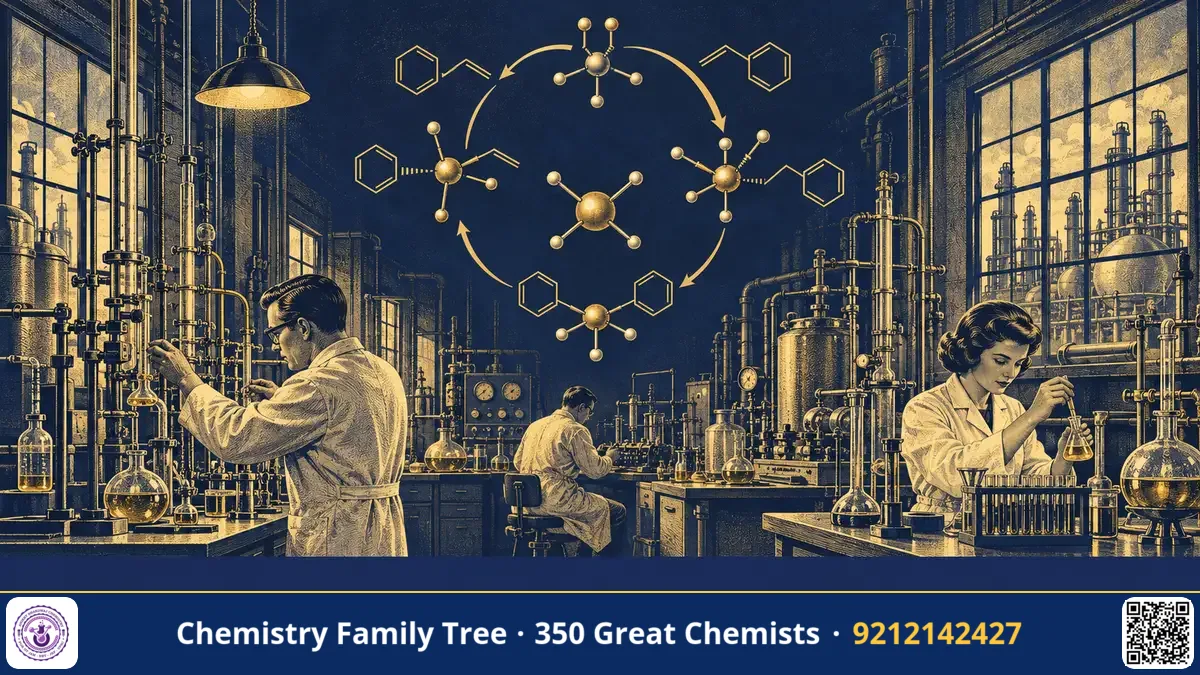
Suzuki coupling: how the boronic acid cross-coupling cycle works

This post walks you through the Suzuki coupling cycle, one step at a time.
You will also see how chemists argued over the role of the base, and how to write the answer in an exam.
What the reaction does
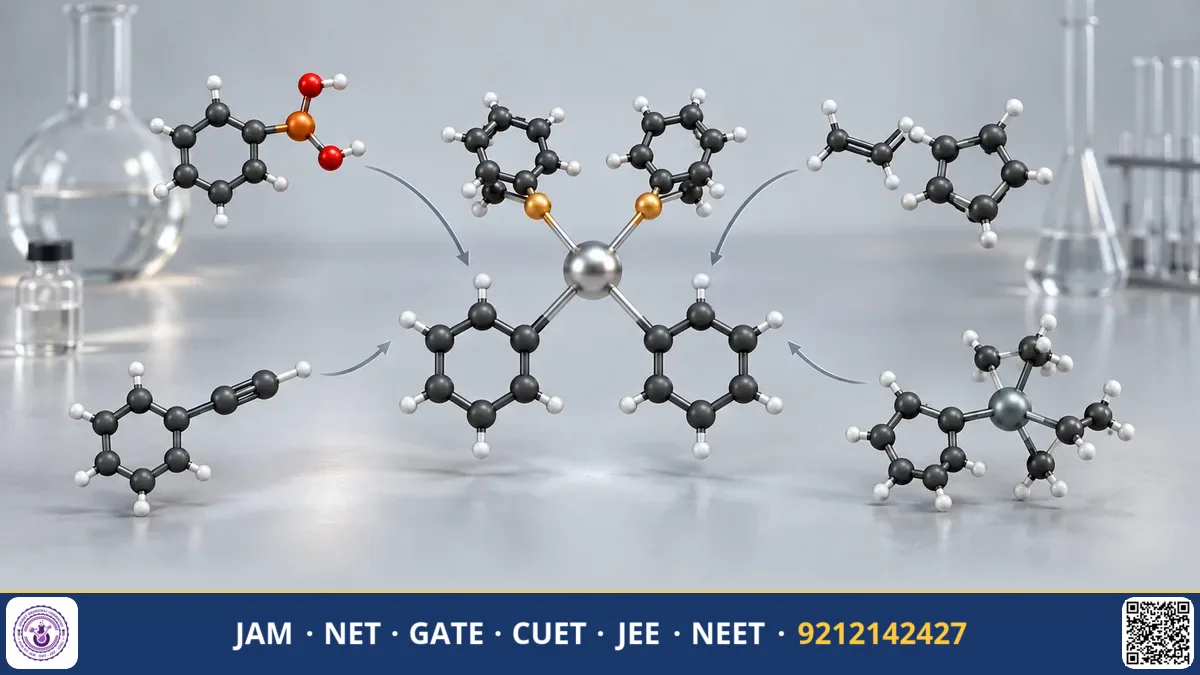
A cross-coupling reaction joins two different organic fragments. Often a metal catalyst is needed. The Suzuki coupling is a well-known example.
The two partners are different in character:
- The organohalide is an organic compound carrying a halogen such as Br or I. It is the electrophile, the partner that accepts electrons.
- The boronic acid has the formula R–B(OH)2. It is like boric acid, B(OH)3, with one –OH replaced by an organic group R. It supplies the second fragment.
The catalyst is a palladium complex. A complex here means a palladium atom held by attached molecules called ligands. The reaction is widely used to make substituted biphenyls, styrenes and polyolefins.
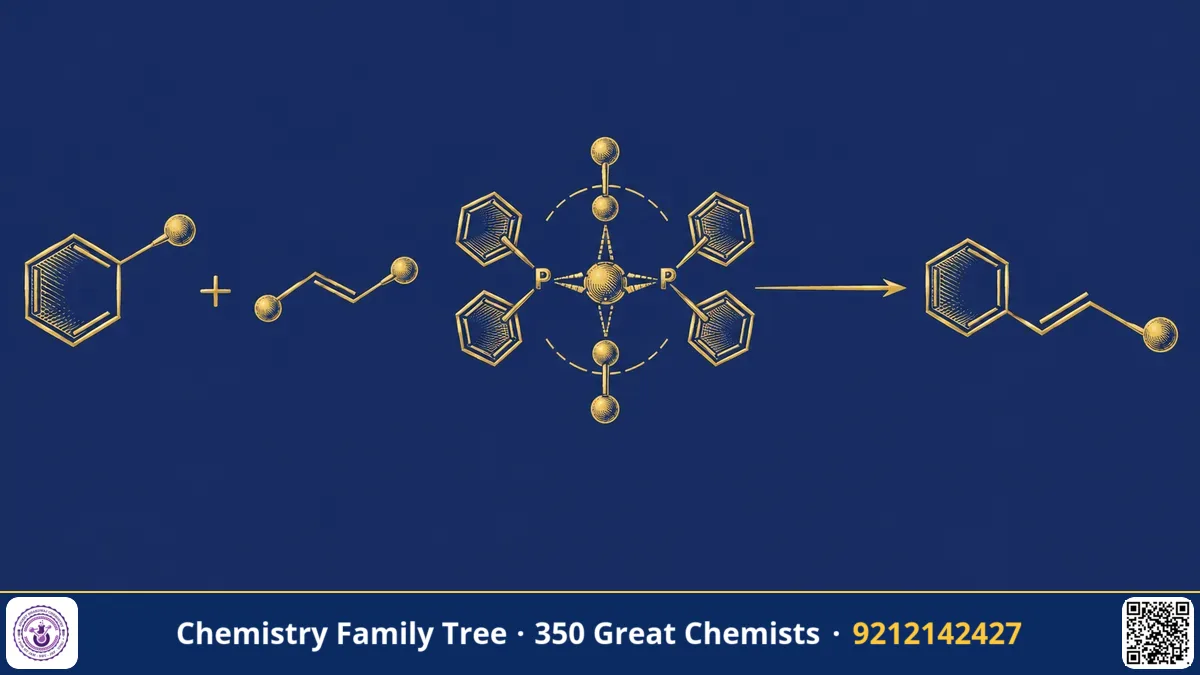
Start your own answers with the general equation: R1–X + R2–B(OH)2 → R1–R2, with Pd catalyst and base.
How the idea was built, one piece at a time
The story is useful because it shows that a mechanism is built slowly, not given in one stroke.
- Boronic acids came first. Edward Frankland was the first to report the preparation and isolation of a boronic acid. He made ethylboronic acid. Nobody was thinking of palladium then.
- Suzuki joined the pieces. Akira Suzuki published the palladium-catalysed coupling of a boronic acid with an organohalide.
- The base became a puzzle. Chemists kept asking one question: what exactly does the base do?
- The Nobel Prize in Chemistry. Suzuki shared it with Richard F. Heck and Ei-ichi Negishi for palladium-catalysed coupling reactions.
Akira Suzuki, born 1930, is listed in our directory as an organic chemist. His profile page in the All chemists directory shows his teachers and students, with a discovery post and a biography. To reach it quickly, use the "Find a chemist" box and type a name.
The catalytic cycle, step by step
A catalytic cycle is a loop in which the catalyst takes part, changes form, and returns unchanged. The easiest way to follow the Suzuki cycle is to watch the palladium atom.
- Oxidative addition. Active Pd(0) inserts itself into the carbon–halogen bond of R1–X. The C–X bond breaks. Palladium is now bound to both R1 and X. Its oxidation state rises from 0 to +2, which is why the step is called oxidation.
- Reaction with the base. The base replaces the halide on palladium. This gives a new palladium intermediate. The base also reacts with the boronic acid to form a boron-ate complex. This is a boron centre carrying an extra negative group, which makes the organic group on boron more ready to move.
- Transmetalation. This term means ligands are transferred from one species to another. Here the organic group R2 moves from boron to palladium. Palladium now holds both R1 and R2. It is still Pd(II).
- Reductive elimination. The two groups on palladium join to form the new bond R1–R2, and the product leaves. Palladium falls from +2 back to 0. The original catalyst is restored, ready for the next molecule of R1–X.
In most cases oxidative addition is the rate-determining step. That means it is the slowest step and sets the overall speed.
The halogen matters here. Chlorides are cheap, but the C–Cl bond is often too inert. Bromides or iodides are usually needed for acceptable rates.
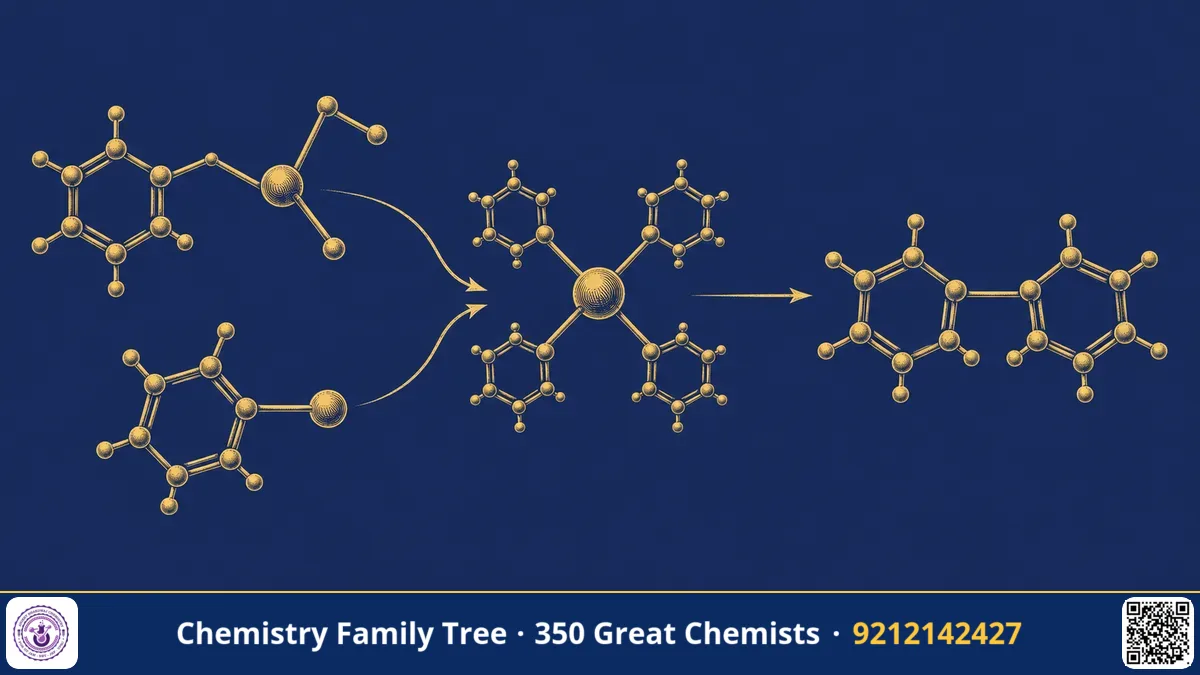
Worked example: bromobenzene + phenylboronic acid
- Pd(0) breaks the C–Br bond of bromobenzene. We get phenyl–Pd(II)–Br.
- The base replaces bromide on palladium. It also converts phenylboronic acid into a boron-ate complex.
- The second phenyl group moves from boron to palladium. Palladium now holds two phenyl groups.
- The two phenyl groups couple. The product is biphenyl, and Pd(0) is back.
Check yourself: the oxidation state of palladium should read 0, +2, +2, 0 across the four lines.
The debate about the base
The Suzuki reaction needs a base. For a long time, chemists did not fully understand why.
The first idea was about the boron side. The base was believed to form a trialkyl borate. This species could be considered more nucleophilic. A nucleophile is a species rich in electrons that attacks electron-poor centres. A more nucleophilic boron partner would react better with the palladium complex in the transmetalation step.
Later, Amatore and coworkers studied the question. They found that the base has three roles:
- It helps form the palladium complex, written as [ArPd(OR)L2].
- It forms the trialkyl borate.
- It speeds up the reductive elimination step by reacting with the palladium complex.
The lesson for students: never treat the base as a side detail. It is part of the mechanism and it acts on both partners, the palladium and the boron.
Stereochemistry: what the product keeps
Teachers like to ask about geometry. Two points are worth remembering.
- Oxidative addition proceeds with retention of stereochemistry with vinyl halides. With allylic and benzylic halides it gives inversion.
- The coupling keeps the configuration of double bonds, for both the organoboron reagent and the halide. When an alkenyl boron compound couples with an alkenyl halide, the product is a diene.
The first palladium complex formed is cis. It rapidly isomerises to the trans form, which is the predominant form.
Compare the four stages
| Stage | What happens to palladium | What happens to the groups |
|---|---|---|
| Oxidative addition | Pd(0) to Pd(II) | C–X bond breaks; R1 and X bind to Pd |
| Base step | Stays Pd(II) | Halide replaced; boronic acid becomes boron-ate complex |
| Transmetalation | Stays Pd(II) | R2 moves from boron to Pd |
| Reductive elimination | Pd(II) to Pd(0) | R1–R2 forms and leaves |
Why palladium and why boron
Palladium is often chosen because it tolerates many functional groups. Organopalladium compounds are generally stable towards water and air, which makes laboratory work easier.
There is a trade-off. Palladium catalysts can be a problem for the pharmaceutical industry, which faces strict regulation on heavy metals. So chemists there try to use coupling early in production, to keep metal traces out of the final product. Copper, iron, cobalt and nickel catalysts have also been studied as alternatives.
Boronic acids are popular building blocks because many are air-stable and commercially available. The most common way to make them is to react lithium or magnesium (Grignard) compounds with borate esters. Another route is the Miyaura borylation, a palladium-catalysed reaction of aryl halides with diboron compounds. When this is combined with the coupling, the sequence is called the Suzuki–Miyaura reaction.
How to study this for exams
- Draw a circle. Put Pd(0) at the top.
- Go clockwise and label the steps in order.
- Write the oxidation state of palladium next to each arrow.
- Mark where R1–X enters and where R1–R2 leaves.
- Add the base beside the boronic acid, on the side where it forms the boron-ate complex.
Repeat this drawing from memory twice. It is more useful than reading the mechanism five times.
Key takeaways
- The Suzuki coupling joins an organohalide and a boronic acid with a palladium catalyst and a base.
- The cycle is oxidative addition, transmetalation and reductive elimination, with palladium going 0 → +2 → 0.
- Oxidative addition is usually the slowest step.
- The role of the base was long unclear. It helps form the palladium complex, forms the borate, and speeds reductive elimination.
- Akira Suzuki shared the Nobel Prize in Chemistry with Heck and Negishi.
Frequently asked questions
What is the role of the base in the Suzuki coupling?
The base is part of the mechanism. According to the work of Amatore and coworkers, it helps form the palladium complex, forms the trialkyl borate, and speeds up reductive elimination.
Which step is rate-determining?
In most cases it is oxidative addition, where Pd(0) is oxidised to Pd(II) by breaking the carbon–halogen bond.
Why are bromides and iodides preferred to chlorides?
Chlorides are cheap, but the C–Cl bond is often too inert. Bromide or iodide leaving groups are usually needed for acceptable rates.
What does a boronic acid look like?
It has the general formula R–B(OH)2. It is related to boric acid, with one –OH replaced by an organic group R.
Who received the Nobel Prize for this work?
Akira Suzuki, Richard F. Heck and Ei-ichi Negishi shared the Nobel Prize in Chemistry for palladium-catalysed coupling reactions.
What to do next. Try it yourself on the page below.
Chemistry Family Tree — who taught whom among 350 great chemists →