Radium: atomic mass [226], alkaline earth metal, uses and myths
This post gives you radium's key data, taken from the element page of our periodic table.
You will also see where radium occurs, why it once lit up watch dials, and three ideas students often get wrong.
Radium data at a glance
Start with the numbers. Copy this table into your notebook. It is a quick revision sheet for group 2.
| Property | Radium |
|---|---|
| Symbol | Ra |
| Atomic number | 88 |
| Atomic mass | [226] |
| Category | Alkaline earth metal (group 2) |
| Natural or synthetic | Natural (found in uranium and thorium ores) |
| Appearance of pure metal | Silvery-white; turns black in air |
| Density | 5.5 g/cm3 |
| Crystal structure | Body-centred cubic |
| Most stable isotope | Radium-226, half-life 1,600 years |
Radium is the sixth element in group 2. It is the heaviest known alkaline earth metal and the only radioactive member of its group. Its properties are closest to barium, the lighter element in the same group.
In the interactive table, tap the Ra tile for a quick card with the atomic mass. Then choose Read all data to open the full profile. You can also use the Natural / synthetic filter to see which elements occur in nature.
What the bracket in [226] means
Most elements show an atomic mass such as 24.305 for magnesium. Radium shows [226] instead. The same style appears for polonium [209], radon [222] and actinium [227].
The bracket is a convention. It means the element has no stable isotope. An isotope is a form of an element with the same number of protons but a different number of neutrons. For such elements, the number in brackets is the mass number of a well-known long-lived isotope. For radium, that is radium-226.
Radium has 33 known isotopes, with mass numbers from 202 to 234. All of them are radioactive. That is why no single "average" mass is quoted, as it is for magnesium.
The mass number is the count of protons plus neutrons in the nucleus. The atomic number is the count of protons alone. Keep the two ideas apart, because many mistakes in nuclear questions come from mixing them.
Worked example: radium-226
Question. (a) How many neutrons are in radium-226? (b) The half-life of radium-226 is 1,600 years. What fraction of a sample is left after 4,800 years?
Step 1. Protons = atomic number = 88.
Step 2. Neutrons = mass number − atomic number = 226 − 88 = 138.
Step 3. The half-life is the time in which half of the radioactive nuclei decay. Number of half-lives = 4,800 ÷ 1,600 = 3.
Step 4. Fraction left = (1/2)3 = 1/8 of the original sample.
Check: 1 → 1/2 → 1/4 → 1/8. Three halvings, so the answer matches.
Natural occurrence: where radium is found
Radium is a natural element. It is found in uranium ores, and in thorium ores in trace amounts. In uranium ore the amount can be as small as about a seventh of a gram in a ton of uraninite. Uraninite is a uranium mineral.
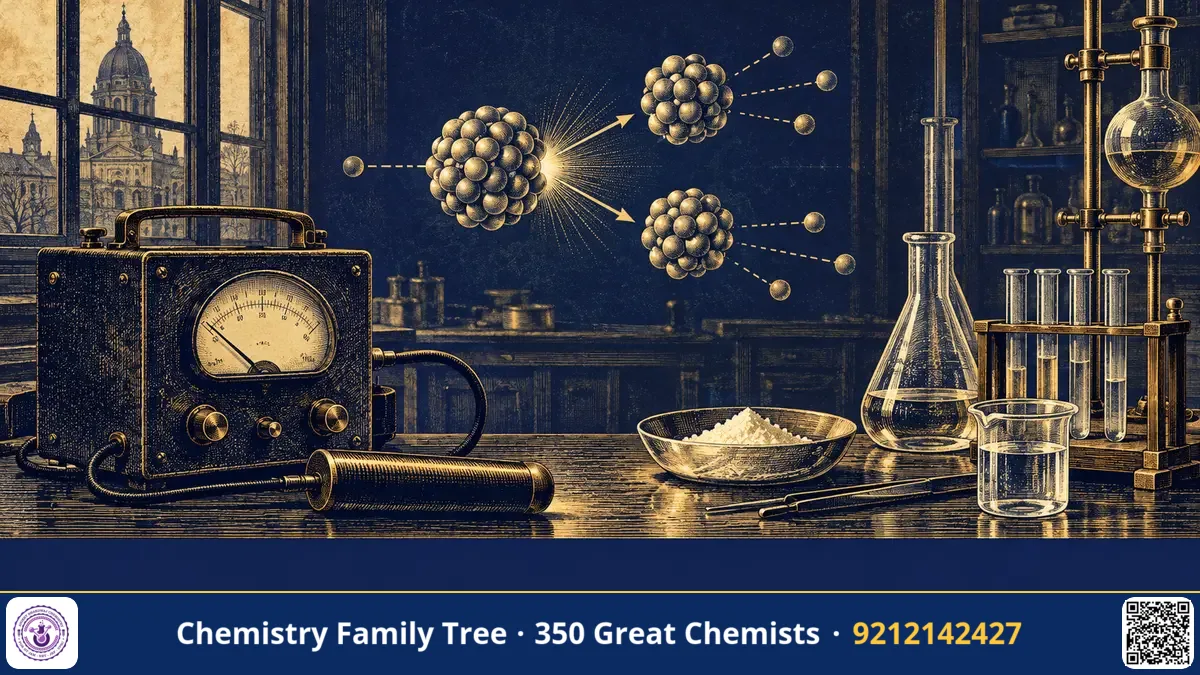
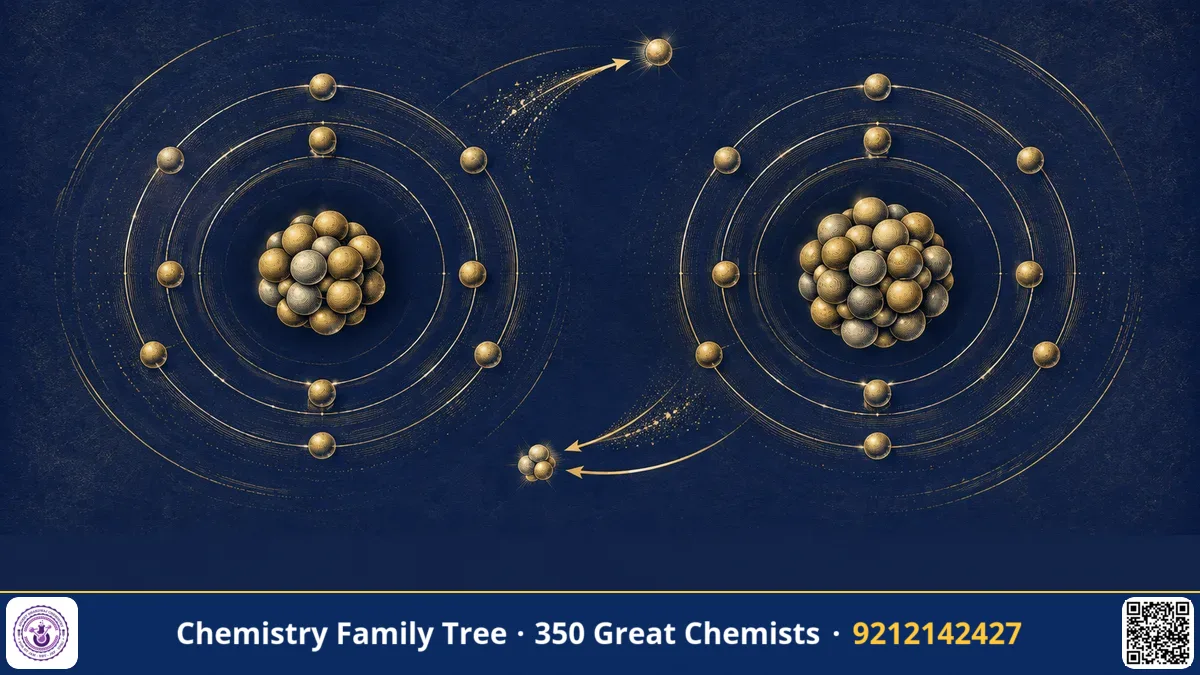
Why is it there at all? Radium is made by radioactive decay. Radium-226 forms in the decay chain of uranium-238. A decay chain is a series of steps in which one radioactive nucleus changes into another until a stable one is reached. Thorium and another uranium isotope feed the other natural radium isotopes in the same way. Four radium isotopes in all occur naturally.
This is the key idea. Radium-226 has a half-life of 1,600 years, which is short compared with the age of Earth. Radium keeps being made inside uranium and thorium ores, so it still exists. Without that new supply, it would have vanished.
The amount produced worldwide has always been small. By the 2010s, yearly production was under 100 grams, mainly by extraction from spent nuclear fuel.
On the periodic table page, natural means found on Earth or in its ores. Synthetic means first made in a laboratory. Radium belongs to the first group.
Glow-in-the-dark history
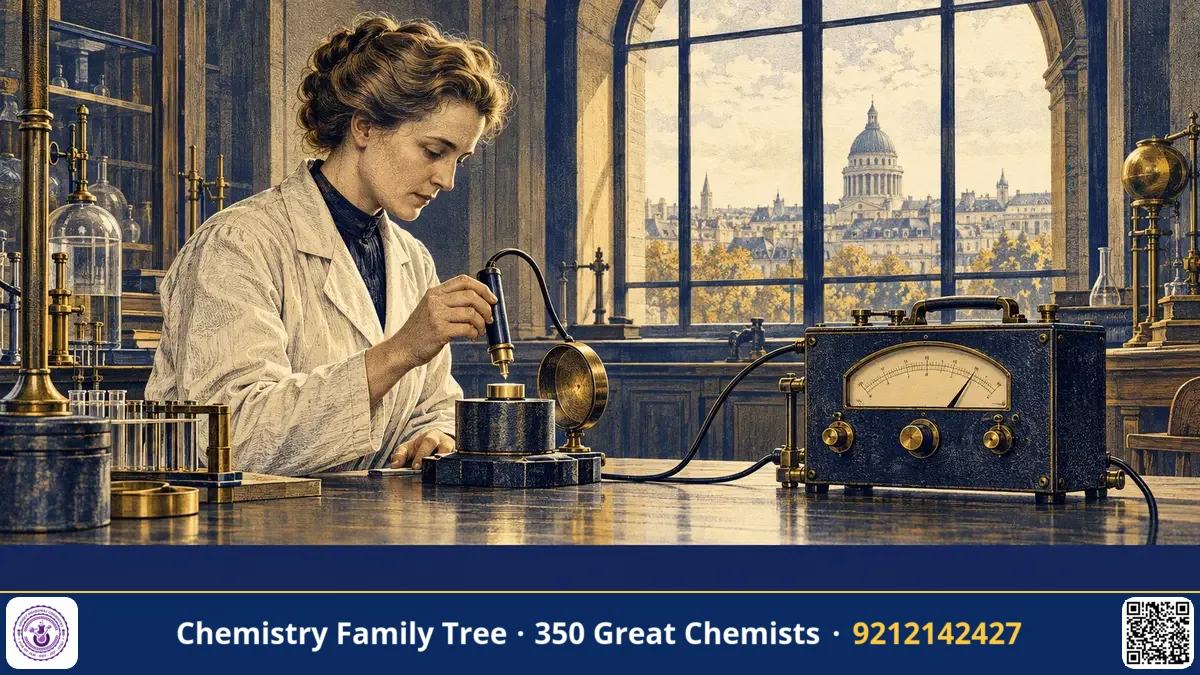
Marie and Pierre Curie discovered radium in 1898. They found it as radium chloride in ore, and they extracted the compound from uraninite. Marie Curie and André-Louis Debierne isolated the pure metal in 1910 by electrolysis of radium chloride. Electrolysis uses electric current to split a compound.
Soon after, radium became popular for a reason: radioluminescence. When radium decays, it gives out ionising radiation as a by-product. This radiation can excite certain fluorescent chemicals, and they glow. Makers mixed radium with such chemicals to create self-luminous paints. From the 1910s to the 1970s, radium served as the radioactive source in glowing devices. Dials that could be read in the dark are the common example.
Note the order of events. Radium supplies the energy. The fluorescent chemical gives the light.
The same period also saw radium used for its supposed curative power. This was quackery, meaning false medical claims. It had no sound basis.
Today the picture is different. As of 2018, apart from nuclear medicine, radium has no commercial applications. In almost all uses it has been replaced by less dangerous radioisotopes. One of its few remaining non-medical uses is making actinium in nuclear reactors.
Radium and barium compared
Radium sits below barium in group 2, so compare the two. This shows how group trends hold even for a rare radioactive element.
| Feature | Radium | Barium |
|---|---|---|
| Atomic mass | [226] | 137.33 |
| Crystal structure | Body-centred cubic | Body-centred cubic |
| Density | 5.5 g/cm3, higher than barium | Lower than radium |
| Radioactive? | Yes, all isotopes | Not the subject of this post |
Calcium, strontium and barium have a slight yellow tint. Radium does not. It is lustrous and silvery-white when fresh.
Three misconceptions about radium
- Misconception: radioactive means synthetic. This is wrong. Radioactivity and origin are two different questions. Radium is radioactive, yet it is natural, found in uranium ores. Use the Natural / synthetic filter to check any element instead of guessing from radioactivity.
- Misconception: radium glows by itself. Not quite. The glow comes from a fluorescent chemical that is excited by radium's radiation. Pure radium is a silvery-white metal. In air it reacts with nitrogen, not oxygen, and forms a black surface layer of radium nitride, Ra3N2. Most students expect oxygen here, so remember this exception.
- Misconception: radium was a harmless tonic. The opposite is true. Among radioactive elements that occur in quantity, radium is considered particularly toxic. It is carcinogenic, which means it can cause cancer. The reasons are its own radioactivity, that of its decay product radon, and its tendency to collect in bones. Radium mimics calcium because both are group 2 elements, so the body can take it up in the wrong place. The body does not need radium.
If you remember one chemistry link, remember the calcium one. It joins group trends to a real health effect.
How to study radium for your exam
- Write the symbol, atomic number and the bracketed mass [226] together, and say what the bracket means.
- Practise the neutron count: mass number minus atomic number.
- Practise half-life questions by counting halvings, as in the worked example.
- Revise the group 2 trend by comparing radium with barium, as in the table above.
Key takeaways
- Radium is Ra, atomic number 88, an alkaline earth metal in group 2 and the heaviest known one.
- The bracket in [226] means no stable isotope exists; 226 is the mass number of radium-226.
- Neutrons = mass number − atomic number, so radium-226 has 138 neutrons.
- Radium is natural, formed in uranium and thorium ores by decay, even though it is radioactive.
- The old glow came from fluorescent chemicals excited by radium; its toxicity is why safer substitutes replaced it.
Frequently asked questions
Why is the atomic mass of radium written as [226]?
Radium has no stable isotope. The bracket shows that the number is a mass number of a long-lived isotope, radium-226, and not a weighted average.
Is radium a metal?
Yes. Pure radium is a lustrous, silvery-white metal. It is an alkaline earth metal, like calcium, strontium and barium.
Which element is radium most similar to?
Barium. Radium's density of 5.5 g/cm3 is higher than barium's, and both have a body-centred cubic structure at standard conditions.
Is radium used in watch dials today?
No. Radium was used in self-luminous paints from the 1910s to the 1970s. It has since been replaced in nearly all uses by less dangerous radioisotopes.
Is the melting point of radium known exactly?
No. It is given as either 700 °C or 960 °C, and this is not well established. The boiling point is given as 1,737 °C, also not firmly established. Both values are slightly lower than barium's, which fits the trend down group 2.
What to do next. Try it yourself on the page below.
Interactive Periodic Table — All 118 Elements →