Kekulé and the Benzene Ring: Insight or Retelling?
This post explains how August Kekulé proposed the cyclic structure of benzene and examines the historical debate surrounding his insight. You will learn how proposals by Archibald Scott Couper, Johann Josef Loschmidt, and James Dewar fit into early aromatic chemistry.
The puzzle of six carbons and six hydrogens
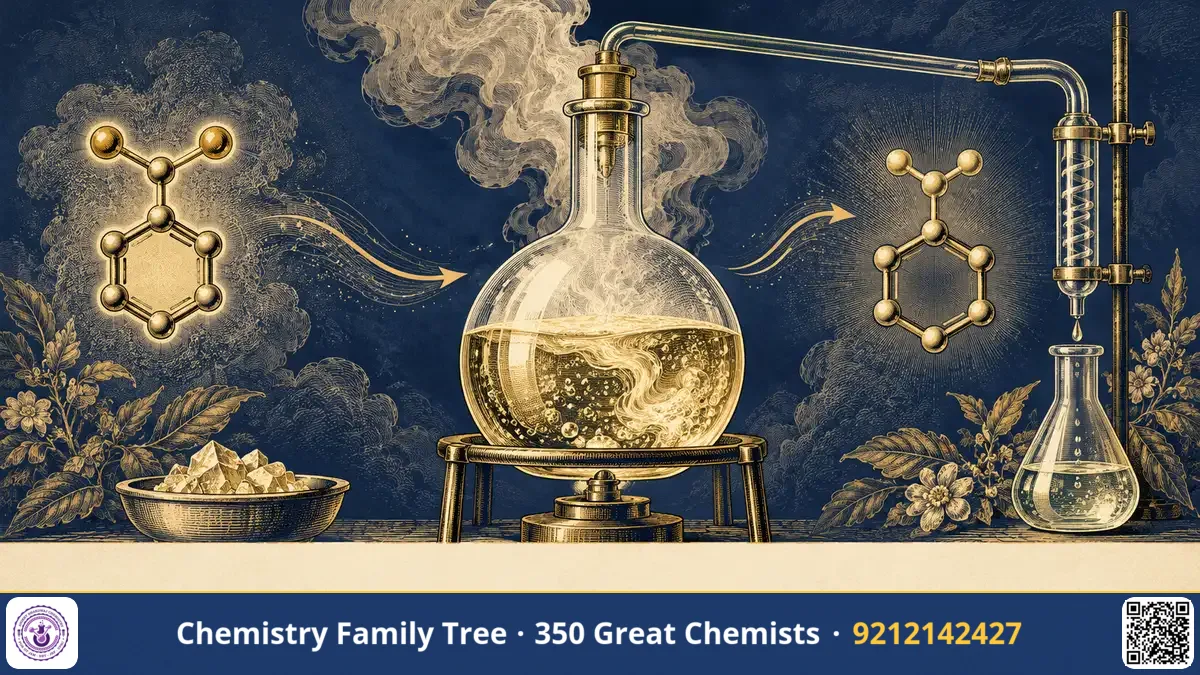
To understand why benzene challenged nineteenth-century science, begin with its elementary composition. Benzene has the molecular formula C6H6. It is a hydrocarbon, which means a compound composed entirely of carbon and hydrogen atoms. Michael Faraday first isolated and identified benzene in 1825 from the oily residue of illuminating gas production, calling it bicarburet of hydrogen. In 1833, Eilhard Mitscherlich produced the compound by distilling lime with benzoic acid obtained from gum benzoin, giving it the name benzin. Auguste Laurent studied the compound in 1836 and named it phène, which remains the root of terms such as phenol and phenyl.
In 1845, Charles Blachford Mansfield, working under August Wilhelm von Hofmann, isolated benzene from coal tar. Four years later, Mansfield began the first industrial-scale production of benzene using this coal-tar method. In 1855, Hofmann introduced the term aromatic to designate benzene and its chemically related family of substances. As an organic chemistry student, you should examine why this formula troubled early theorists. A six-carbon alkane contains fourteen hydrogen atoms, whereas benzene contains only six. Benzene is therefore highly unsaturated, meaning it lacks the maximum possible number of hydrogen atoms. Standard open-chain unsaturated hydrocarbons readily undergo addition reactions across multiple bonds. Benzene, however, displayed exceptional chemical stability and preferred substitution reactions. Early chemists could not explain how six carbon atoms and six hydrogen atoms could satisfy standard combining rules while maintaining such stability.
How valence and carbon chains set the stage
Before any chemist could solve benzene, the discipline needed a systematic theory of how atoms connect. August Kekulé originally entered the University of Giessen in 1847 to study architecture. After attending the chemistry lectures of Justus von Liebig, he chose to make chemistry his life's work. You can use Find a chemist on the Chemistry Family Tree to type a name, e.g. Liebig, and trace how these European mentors shaped their students. Kekulé completed four years of study in Giessen, fulfilled brief military service, and earned his doctoral degree in 1852. He then took assistantships in Paris between 1851 and 1852, in Chur between 1852 and 1853, and in London between 1853 and 1855, where Alexander Williamson influenced his theoretical outlook. In 1856, Kekulé became Privatdozent at the University of Heidelberg, before becoming a professor at the University of Ghent in 1858.
Between 1857 and 1858, Kekulé formulated the foundations of chemical structure theory. Late in 1857, he announced the tetravalence of carbon. Valence describes the combining capacity of an atom; tetravalence means that each carbon atom forms four chemical bonds. In May 1858, Kekulé published a paper demonstrating that carbon atoms possess the ability to link directly to one another to form chains. In June 1858, Archibald Scott Couper independently published the concept of carbon self-linking and drew the earliest formulas using lines to symbolize bonds between atoms. Other chemists, including Edward Frankland, Charles-Adolphe Wurtz, Alexander Crum Brown, Emil Erlenmeyer, and Alexander Butlerov, quickly advanced these ideas. Kekulé deduced these arrangements through chemical reaction evidence rather than direct physical measurements, providing organic chemistry with its first reliable structural roadmap.
The snake motif and the 1865 proposal
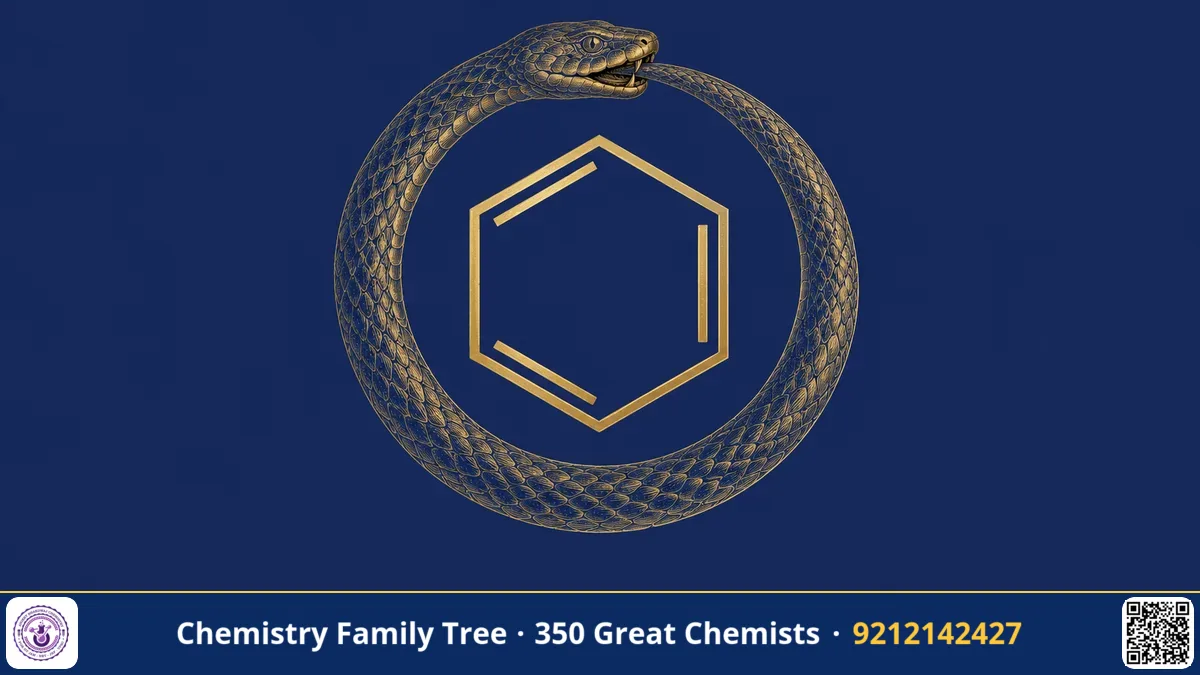
In 1865, while teaching at Ghent, Kekulé published a paper in French proposing that benzene forms a closed ring of six carbon atoms with alternating single and double bonds. In 1866, he published a longer German paper expanding this proposal. In this hexagonal ring, each carbon atom uses three affinity units, or valences, to bind to its two neighboring carbons in the loop, while the fourth valence binds a single hydrogen atom. This closed symmetrical geometry neatly explained why mono-substituted benzene produces only one isomer, as every position on the ring is equivalent.
Popular folklore often portrays this proposal as an effortless flash of inspiration from a dream of a snake biting its own tail. Historical facts provide a more tangible origin. In 1847, the charred body of countess Emile von Görlitz was discovered, prompting claims of spontaneous human combustion. Justus von Liebig testified at the trial of her servant, Stauff, demonstrating that spontaneous combustion was chemically impossible. Kekulé lived nearby and attended the trial as a witness. A central piece of courtroom evidence was a ring depicting two snakes biting each other's tails, one made of gold and the other of platinum. While Kekulé may have later used the snake metaphor to explain his thinking, his ring formula was the direct result of rigorous application of carbon tetravalence to experimental reaction data.
Assessing credit across rival proposals
When you evaluate the historical debate, consider whether Kekulé worked in isolation or retold concepts already circulating among his peers. Other chemists had proposed cyclic or unsaturated arrangements before 1865. In 1858, Archibald Scott Couper published line formulas for molecular bonds. In 1861, Johann Josef Loschmidt published circular diagrams and suggested possible structures with multiple rings or double bonds. However, aromatic chemistry was in its infancy in 1861, and investigators lacked the reaction data required to verify Loschmidt's complex formulas.
In 1869, James Dewar presented a list of possible structural isomers for C6H6, including bicyclo[2.2.0]hexa-2,5-diene, which is today called Dewar benzene. Modern students often assume Dewar proposed this bicyclic form to refute Kekulé. In reality, Dewar supported Kekulé's alternating ring as the correct formula for benzene and introduced his own bicyclic structure merely as an interesting isomeric possibility. Dewar benzene is non-planar because the bridgehead carbons adopt tetrahedral geometry. The strained molecule reverts to benzene with a half-life of two days. Chemists synthesized a tri-tert-butyl derivative of Dewar benzene in 1962, and synthesized unsubstituted Dewar benzene the next year. Kekulé earned primary credit not by being the sole thinker to sketch a loop, but by constructing a model that rigorously satisfied valence rules and matched observed chemical substitution.
| Chemist | Year | Core proposal | Historical significance |
|---|---|---|---|
| Archibald Scott Couper | 1858 | Carbon self-linking and line bonds | Introduced bonding lines independently of Kekulé |
| Johann Josef Loschmidt | 1861 | Circular formulas with multiple rings | Early cyclic sketches without sufficient reaction proof |
| August Kekulé | 1865 | Planar six-carbon ring with alternating bonds | First complete structure matching valence and reactivity |
| James Dewar | 1869 | Bicyclic isomer (Dewar benzene) | Explored C6H6 isomers while supporting Kekulé |
Modern resonance and the legacy of the ring
When you study aromatic chemistry in your NCERT textbook, you will find that Kekulé's localized alternating bonds represent an incomplete description. If benzene had fixed single and double bonds, it would form an irregular hexagon with alternating bond lengths. In 1928, valence bond theory resolved this physical paradox. Benzene is understood as a resonance hybrid where the two Kekulé structures act as the major contributors.
In this modern framework, continuous pi bonding delocalizes six electrons uniformly around the planar ring, conferring equal carbon-carbon bond lengths and special aromatic stabilization. The three possible Dewar structures serve as minor resonance contributors. Other historic isomers, such as prismane and benzvalene, were successfully synthesized in the 1970s, whereas Claus' benzene is physically impossible. In 1997, astronomers even detected benzene in deep space, demonstrating the enduring stability of this cyclic system. Kekulé's 1865 proposal served as the essential theoretical foundation that made modern structural chemistry possible.
Key takeaways
- August Kekulé introduced the alternating hexagonal ring for benzene in 1865, establishing that all six ring positions are chemically equivalent.
- The proposal depended on structural principles developed between 1857 and 1858, including carbon tetravalence and carbon-carbon catenation.
- The snake motif reflects a tangible courtroom artifact from the 1847 trial of Stauff, rather than an ungrounded daydream.
- James Dewar did not oppose Kekulé; he published Dewar benzene in 1869 as a theoretical isomer while endorsing Kekulé's ring.
- Valence bond theory in 1928 reconciled Kekulé's model with reality by treating the two Kekulé forms as primary resonance contributors.
Frequently asked questions
Did August Kekulé discover the benzene ring purely from a dream?
No. While Kekulé recounted a dream of a snake biting its tail, historical records show he encountered a two-snake ring exhibit during the 1847 trial of Stauff in Giessen. His actual ring hypothesis was built on systematic deduction from chemical reactions and carbon tetravalence.
What did Archibald Scott Couper contribute to chemical structure theory?
Archibald Scott Couper independently discovered that carbon atoms link together to form chains. His paper appeared in June 1858, and he became the first chemist to draw molecular formulas using lines to symbolize chemical bonds.
Did James Dewar attempt to replace Kekulé's benzene structure?
No. In 1869, James Dewar listed bicyclo[2.2.0]hexa-2,5-diene as one of several potential isomers sharing the C6H6 formula. Dewar explicitly supported Kekulé's alternating hexagonal ring as the true structure of benzene.
Why was Loschmidt's 1861 cyclic formula not widely adopted?
Johann Josef Loschmidt proposed circular representations in 1861, but aromatic chemistry was just beginning. Chemists at that time lacked sufficient experimental reaction evidence to confirm or apply his complex diagrams.
What to do next. Try it yourself on the page below.
Chemistry Family Tree — who taught whom among 350 great chemists →